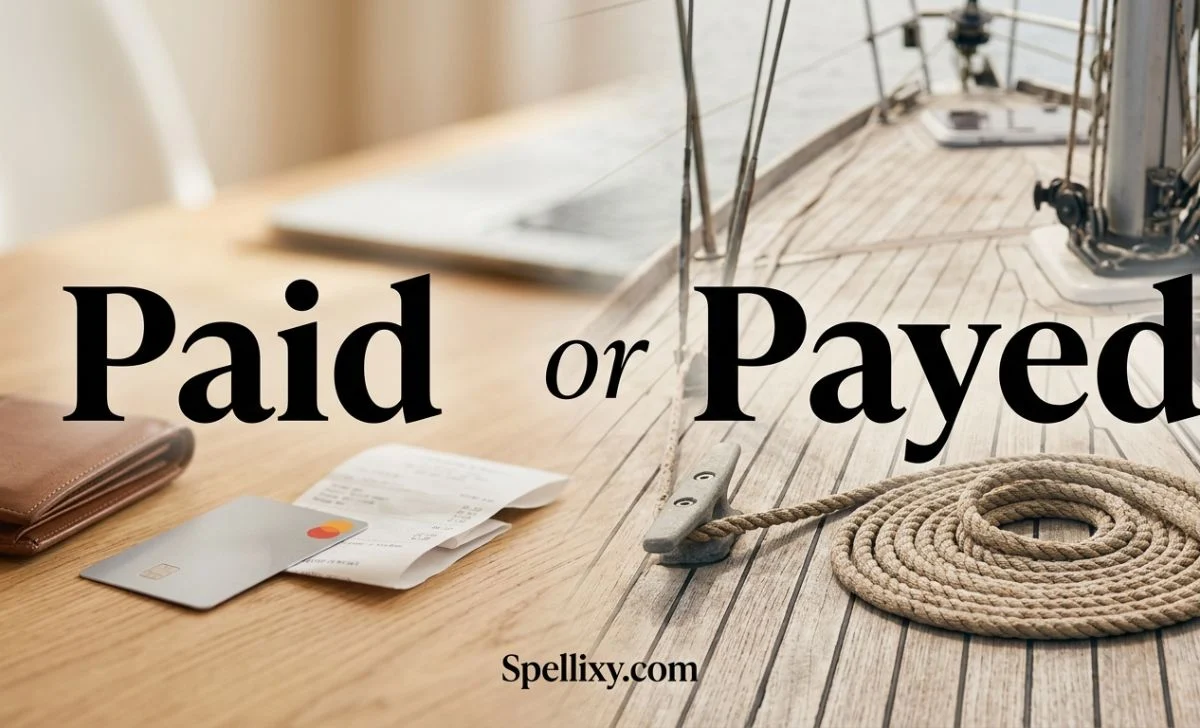
Have you ever wondered whether to write paid or payed? These two words look almost identical, so it is easy to confuse them. However, they have different uses.
Paid is the correct spelling when talking about money, bills, wages, or everyday payments. Payed is also a real English word, but it is mainly used in nautical contexts involving ropes, chains, and ship seams.
Quick Answer
Paid is the standard past tense and past participle of pay when referring to money or ordinary payments.
- Correct: I paid the bill yesterday.
- Incorrect: I payed the bill yesterday.
- Specialized use: The sailors payed out the anchor chain as the ship drifted back.
Use paid for everyday payments. Use payed only when its specialized nautical meaning fits the sentence.
What Is the Difference Between Paid and Payed?
The main difference between paid and payed is their meaning and use. Although both are associated with the verb pay, they are not interchangeable.
| Word | Meaning | Example |
|---|---|---|
| Paid | Gave money for something, settled a debt, or received payment | I paid the invoice yesterday. |
| Payed | Let out a rope or chain gradually, or sealed a ship’s seams | The crew payed out the anchor line. |
Use paid when discussing salaries, bills, purchases, debts, or other everyday payments. Use payed for its specialized nautical meanings.
What Does Paid Mean?
Paid is the past tense and past participle of pay. It usually means that someone gave money for a product or service, settled a debt, or received money for work.
Examples:
- I paid for my groceries with cash.
- She paid the electricity bill on Monday.
- The company paid its employees on time.
- We have already paid for the tickets.
- He paid attention to the teacher’s instructions.
- Their hard work finally paid off.
In everyday English, paid is the correct form for these meanings.
What Does Payed Mean?
Payed is a real but uncommon English word. In nautical use, it has two main meanings: letting out a rope or chain gradually, and sealing a ship’s seams with pitch or tar to make them watertight.
Examples:
- The sailors payed out the anchor chain as the ship drifted back.
- The crew payed out the line slowly so the boat could drift toward the dock.
- The shipwright payed the deck seams with hot pitch to make them watertight.
These meanings differ from ordinary financial payments, so payed should not replace paid in everyday writing.
Why Do People Write Payed Instead of Paid?
People sometimes write payed because they assume that pay follows the regular spelling pattern used by verbs such as play, which becomes played. However, when pay refers to money, its past tense is paid.
Another reason is that payed is a legitimate word in specialized contexts. Spell-checkers may accept it even when it does not fit the sentence.
For example:
- Incorrect: I payed my rent last week.
- Correct: I paid my rent last week.
The sentence refers to a financial payment, so paid is the right choice.
Common Expressions That Use Paid
The word paid appears in several everyday expressions. Knowing their meanings can help you use them correctly.
Paid Full
In full means that the entire amount owed has been paid.
- The customer paid the invoice in full.
- My loan is now paid in full.
Paid For
Means that someone covered the cost of something.
- I paid for dinner last night.
- They have already paid for their hotel room.
Paid back means that someone returned borrowed money or repaid a debt.
- He paid me back the money he borrowed.
- I paid back the loan ahead of schedule.
Paid attention means that someone listened carefully or focused on something.
- The students paid attention during the lesson.
- Please pay attention to the road.
These expressions use paid, not payed, because they refer to ordinary uses of the verb pay.
Is It Paid Out or Payed Out?
The two forms have different meanings.
Paid out refers to distributing money or making a payment. Payed out is used in nautical contexts when a rope or chain is let out gradually.
Examples of paid out:
- The insurance company paid out the claim.
- The organization paid out bonuses to its staff.
Examples of payed out:
- The sailors payed out the anchor chain as the boat drifted back.
- The crew payed out the rope slowly.
Check the meaning of the sentence before choosing the spelling. If money is being distributed, use paid out. If a rope or chain is being let out, payed out may be correct.
Should You Write I Paid or I Have Paid?
Both I paid and I have paid are correct. The choice depends on the context.
I paid is the simple past tense. It describes a completed action, often at a particular time.
- I paid the bill yesterday.
- I paid for the meal after work.
I have paid is the present perfect tense. It connects a completed payment to the present situation.
- I have paid the bill, so there is nothing left to do.
- I have already paid for the tickets.
Both forms use paid. When discussing ordinary payments, I payed is incorrect.
Is “I Already Paid” Correct?
Yes. “I already paid” is correct and common in everyday English, especially in American English.
Examples:
- I already paid for my coffee.
- I already paid the registration fee.
- Don’t charge me again. I already paid.
You can also say, “I have already paid.” Both forms are correct, although their use may vary by context and dialect.
The word already does not change the spelling. When referring to money, use paid.
Common Mistakes With Paid and Payed
The following examples show how to choose the correct spelling.
| Incorrect | Correct |
|---|---|
| I payed the bill yesterday. | I paid the bill yesterday. |
| She payed for the groceries. | She paid for the groceries. |
| He has payed his rent. | He has paid his rent. |
| They payed their workers. | They paid their workers. |
| I payed attention in class. | I paid attention in class. |
| We payed for the tickets. | We paid for the tickets. |
The general rule is simple: use paid for financial payments and everyday expressions. Use payed only when the sentence calls for its specialized nautical meaning.
How to Remember the Difference
A simple way to remember the difference is to connect paid with payments.
Think of these common phrases:
- Paid a bill
- Paid for lunch
- Paid a worker
- Paid attention
All use paid.
Reserve payed for specialized nautical meanings, such as letting out a rope or sealing a ship’s seams.
If you are writing an email, school assignment, business report, or everyday message about money, paid is almost always the correct choice.
FAQs
Is it paid or payed?
Paid is correct for ordinary payments, bills, wages, debts, and common expressions. Payed is used in specialized nautical contexts.
Is payed a real word?
Yes. Payed is a real but uncommon word used mainly for letting out a rope or chain or sealing a ship’s seams with pitch or tar.
Why do people write payed instead of paid?
People may assume that pay follows the regular pattern of adding -ed. However, its standard past tense and past participle for financial meanings are paid.
What are the past tense and past participle of pay?
For ordinary financial meanings, both are paid. For example, “I paid yesterday” and “I have paid already.”
Is “paid attention” or “payed attention” correct?
Paid attention is correct. The expression means to listen carefully or focus on something.
Is “paid out” or “payed out” correct?
Both can be correct in different contexts. Paid out refers to distributing money, while payed out can describe letting out a rope or chain.
Is “I paid” or “I have paid” correct?
Both are correct. I paid is the simple past tense, while I have paid is the present perfect tense. The choice depends on the sentence and context.
What is a synonym for paid?
Depending on the context, synonyms include settled, reimbursed, and compensated. These words have different uses and may not fit every sentence.
Conclusion
The difference between paid and payed becomes clear when you understand their meanings. Paid is the standard form for everyday payments, bills, wages, debts, and expressions such as paid attention.
Payed is a real but uncommon word used mainly in nautical contexts involving ropes, chains, and ship seams.
When writing emails, reports, school assignments, or everyday messages, choose paid whenever you are talking about money.
Remembering this simple rule will help you avoid a common English spelling mistake.