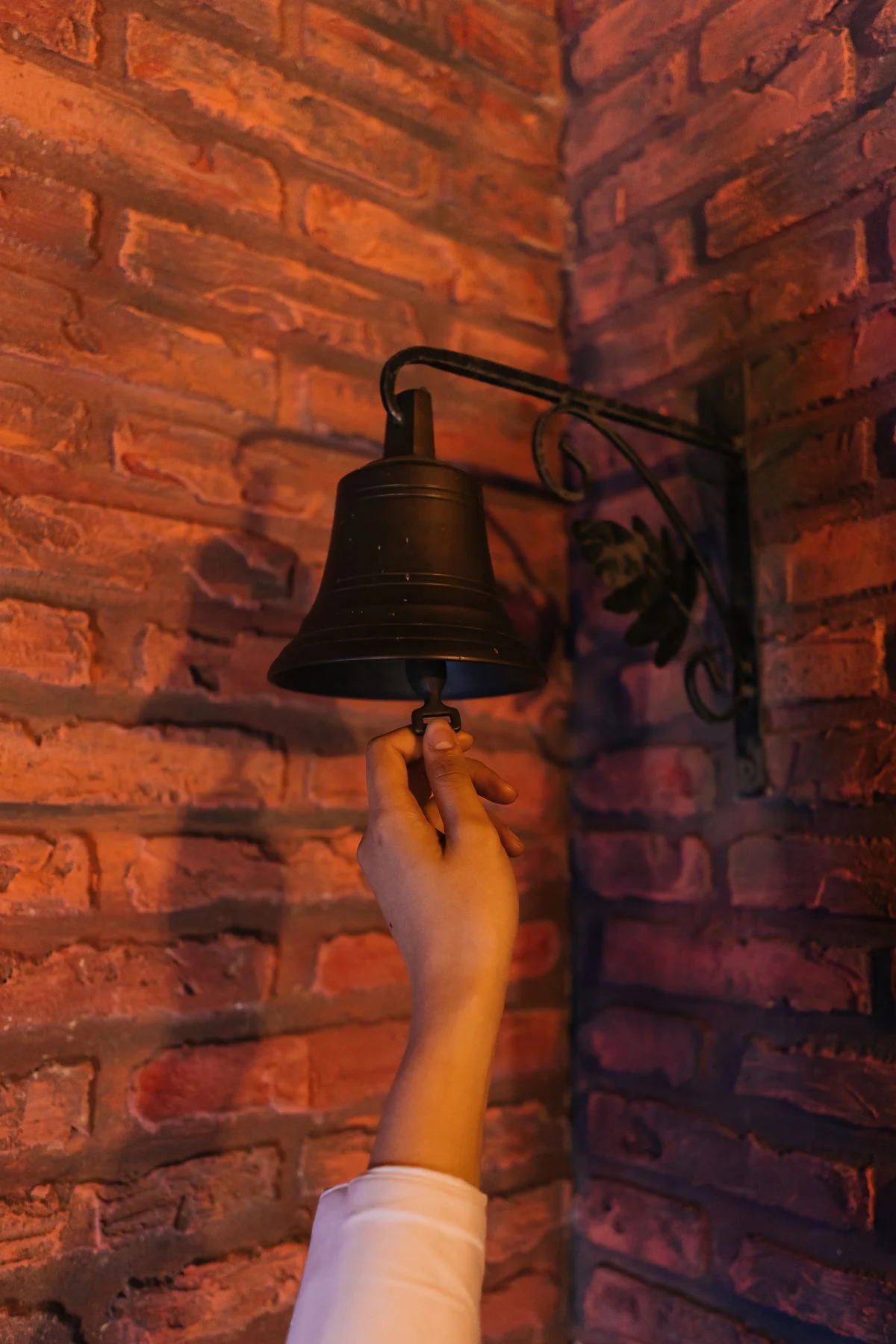
Quick answer: use rang for the simple past (The bell rang) and rung after has, have or had (The bell has rung).
The Verb Ring and Its Forms
Ring is an irregular verb in the same family as sing and drink. Its three forms are ring (base), rang (simple past) and rung (past participle). The vowel changes from “i” to “a” to “u”, which makes the pattern easy to remember: ring, rang, rung.
When to Use Rang
Choose rang when the action is finished and nothing like have or had comes before the verb.
- The phone rang during dinner.
- She rang the doorbell twice.
- The church bells rang at noon.
When to Use Rung
Choose rung when there is a helping verb. It appears in perfect tenses and in the passive voice.
- The alarm has rung three times already.
- By the time I arrived, they had rung the bell.
- The bell was rung to start the race.
Meaning Matters: Ring Has Two Verbs
There is a trap here. The verb ring meaning “to make a sound” or “to call by phone” follows the pattern above. But ring meaning “to surround” is regular: the police ringed the building, and the building was ringed with guards. So choose the form that matches the meaning, and do not write “the police rung the building.”
British and American Usage
In British English, “I rang you yesterday” is a normal way to say you phoned someone. Americans more often say “I called you.” Both are correct, and the verb forms stay the same.
Common Mistakes
| Incorrect | Correct |
|---|---|
| The bell has rang. | The bell has rung. |
| She rung me last night. | She rang me last night. |
| They had rang the alarm. | They had rung the alarm. |
Idioms With Ring
You will often meet ring in expressions. “That rings a bell” means something sounds familiar, and “ring in the new year” means to celebrate it. In the past, we say “that rang a bell” and “we rang in the new year.” If you have used the idiom with a helper, it becomes “that has rung a bell.”
Quick Practice
- The teacher (rang / rung) the bell at nine.
- Has the doorbell (rang / rung) yet?
- I (rang / rung) my mother this morning.
Answers: rang, rung, rang.
Final Thoughts
Keep the pattern in mind: ring, rang, rung. Use rang alone and rung with a helper, and check whether you mean the sound verb or the “surround” verb. With that, the choice becomes simple.