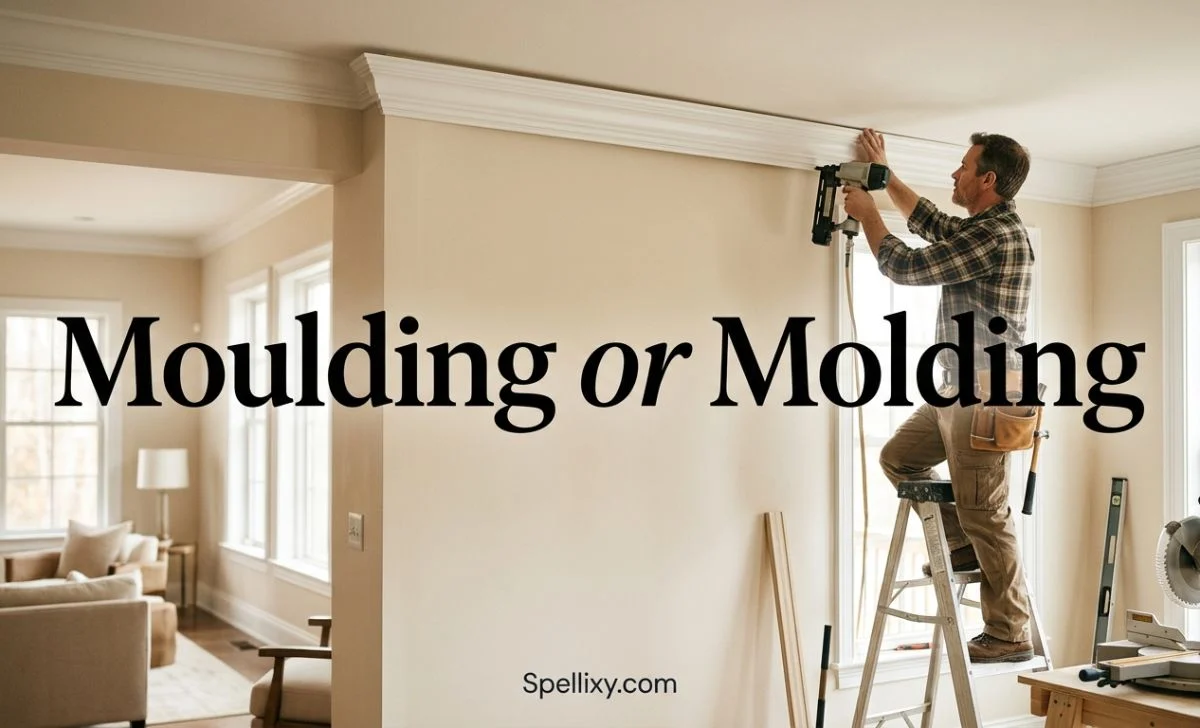
Have you ever wondered whether to write moulding or molding? Both spellings are correct, but the right choice depends on the type of English you use.
American English prefers molding, while British English uses moulding. This guide explains the difference with simple examples from home design, manufacturing, clay, food, and everyday language.
Quick Answer
Molding is the standard spelling in American English, while moulding is the standard spelling in British English.
Both words have the same meaning. The correct choice depends on your audience and the spelling style you follow.
| American English | British English |
|---|---|
| molding | moulding |
| mold | mould |
| molded | moulded |
| moldings | mouldings |
| crown molding | crown moulding |
| injection molding | injection moulding |
What Is the Difference Between Moulding and Molding?
The main difference is spelling, not meaning. American English usually drops the u, while British English keeps it.
- American English: We added decorative crown molding to the living room.
- British English: We added decorative crown moulding to the living room.
Both sentences describe the same work. The spelling changes to match the regional style.
What Does Molding or Moulding Mean?
Molding or moulding can refer to several things:
- Decorative trim: A shaped strip of wood, plaster, or another material used on walls, ceilings, doors, or windows.
- Manufacturing: The process of shaping a material inside a mold or mould.
- Clay and crafts: Shaping clay or another soft material by hand or with a tool.
- Food preparation: Shaping foods such as chocolate or gelatin in a mold.
- Personal development: Influencing how a person develops, thinks, or behaves.
The meaning depends on the context, but the American and British spellings follow the same regional pattern.
Crown Molding or Crown Moulding?
Both spellings are correct. Crown molding is standard in American English, while crown moulding is standard in British English.
- American English: We installed crown molding around the ceiling.
- British English: We installed crown moulding around the ceiling.
Crown molding is decorative trim fitted where the wall meets the ceiling. It can give a room a more finished look.
Wall Molding or Wall Moulding?
Use wall molding in American English and wall moulding in British English.
- American English: The designer added wall molding to the hallway.
- British English: The designer added wall moulding to the hallway.
Wall molding or moulding can be used to create decorative patterns, frame wall panels, or add detail to a plain wall.
Baseboard Molding or Moulding?
In American English, baseboard molding is a common term for decorative trim along the bottom of a wall. British English commonly uses skirting board for this feature.
- American English: The contractor replaced the damaged baseboard molding.
- British English: The contractor replaced the damaged skirting board (or baseboard moulding).
The terms can vary by region and building context, so skirting board is usually the more natural British term.
Moulding Design or Molding Design?
Both phrases are correct, depending on the spelling style.
- American English: The architect created a molding design for the living room.
- British English: The architect created a moulding design for the living room.
A molding or moulding design may describe the shape, profile, pattern, or placement of decorative trim.
Molding or Moulding in Manufacturing
In manufacturing, molding or moulding means shaping a material by placing it in a mold or mould. The process can be used with plastic, rubber, metal, and other materials.
- American English: The factory uses injection molding to make plastic parts.
- British English: The factory uses injection moulding to make plastic parts.
Common manufacturing methods include:
- Injection molding: Molten material is injected into a mold.
- Blow molding: Air expands heated material inside a mold to create a hollow object.
- Compression molding: Material is shaped under heat and pressure.
- Rotational molding: Material rotates inside a heated mold to form a hollow product.
These are examples of molding methods, not a complete or universal list.
Plastic Molding or Moulding
The spelling follows the same regional rule for plastic molding.
- American English: The company specializes in plastic molding.
- British English: The company specializes in plastic moulding.
Both phrases refer to processes used to shape plastic into products or components.
Moulding or Molding Clay
When working with clay, both spellings describe shaping the material by hand or with tools.
- American English: She is molding clay into a small bowl.
- British English: She is moulding clay into a small bowl.
The word can describe shaping pottery, sculptures, craft items, and other clay objects.
Molding or Moulding Food
Molding or moulding can also mean shaping food into a particular form, often by using a mold.
- American English: The chef is molding chocolate into small hearts.
- British English: The chef is moulding chocolate into small hearts.
The food is the same in both examples; only the regional spelling changes.
Molding a Person: What Does It Mean?
The phrase molding a person means influencing someone’s character, habits, beliefs, or development. It is usually figurative rather than a reference to physical shaping.
- American English: Her experiences are molding her into a confident leader.
- British English: Her experiences are moulding her into a confident leader.
The phrase molding me or moulding me means shaping the way someone thinks, acts, or develops.
For example:
- American English: My teachers are molding me into a better writer.
- British English: My teachers are moulding me into a better writer.
In both sentences, the word describes personal growth or influence.
Is Molding a Noun or a Verb?
It can be both.
As a noun, molding or moulding can mean decorative trim or the process of shaping a material.
- American English: The molding around the door is damaged.
- British English: The moulding around the door is damaged.
As a verb form, molding or moulding is the present participle of mold or mould. It can describe shaping an object or influencing a person’s development.
- American English: They are molding the plastic into a new shape.
- British English: They are moulding the plastic into a new shape.
The base verbs are mold and mould. Their past-tense forms are molded and moulded, respectively.
How Do You Pronounce Molding and Moulding?
Molding and moulding are pronounced the same way: roughly /ˈmoʊldɪŋ/ in American English and /ˈməʊldɪŋ/ in British English. The extra u is not pronounced separately.
The difference is in the spelling, not an extra sound.
Molding, Moulding, Mold, and Mould: Common Mistakes
A common mistake is mixing American and British spellings in the same piece of writing. Choose one style and use it consistently.
| American English | British English |
|---|---|
| mold | mould |
| molding | moulding |
| molded | moulded |
| moldings | mouldings |
Remember that mold can also mean a type of fungus, while mould is the common British spelling for the same word. Context tells you which meaning is intended.
What About Canadian English?
Canadian English combines British and American spelling conventions, and preferences can vary by word, publication, and style guide. Do not assume that every word follows one system.
For a Canadian audience, check a reliable Canadian dictionary or the publication’s style guide and use the chosen spelling consistently.
Canada’s Language Portal recommends using a reliable Canadian dictionary, such as the Canadian Oxford Dictionary, when deciding between spelling variants. Read the Government of Canada’s spelling guidance.
FAQs
1. Which is correct, moulding or molding?
Both are correct. Molding is the standard American spelling, and moulding is the standard British spelling.
2. Is molding and moulding the same?
Yes. They have the same meaning; the difference is regional spelling.
3. What does molding mean?
It can mean decorative trim, the process of shaping a material, or influencing someone’s development.
4. What is molding a person?
It means influencing a person’s character, habits, beliefs, or behavior as they develop.
5. What does “molding me” mean?
It means shaping or influencing the way you think, behave, or grow as a person.
6. Is it crown molding or crown moulding?
Use crown molding in American English and crown moulding in British English.
7. Is it wall moulding or molding?
Both are correct. Wall molding is American English; wall moulding is British English.
8. What is molding in a house called?
It usually refers to decorative trim around ceilings, walls, doors, or windows. The exact name depends on where the trim is installed.
9. What are the three types of molding?
There is no single list of exactly three types. Injection molding, blow molding, and compression molding are three common manufacturing methods. Rotational molding is another.
10. What is another word for molding?
Depending on the context, alternatives include shaping, forming, or trim. These words are not interchangeable in every sentence.
11. Is it molded or moulded?
Molded is the standard American spelling, while moulded is the standard British spelling.
12. What does moulding mean in medical terminology?
In childbirth, moulding can refer to the temporary shaping or overlapping of a baby’s skull bones as the head passes through the birth canal. This is a specific medical use of the word.
13. Can you use molding or moulding for clay?
Yes. Both words can describe shaping clay. Choose the spelling that matches your audience.
14. Can molding or moulding describe food?
Yes. Both can describe shaping food, such as chocolate or gelatin, in a mold or mould.
Conclusion
Both molding and moulding are correct spellings, but the choice depends on the type of English you use. Molding is standard in American English, while moulding is preferred in British English.
Both words can describe decorative trim, shaping clay or food, manufacturing products, and other processes that involve forming or shaping materials.
When writing about crown molding, injection molding, or any other related topic, choose the spelling that matches your target audience.
Most importantly, stay consistent throughout your article to keep your writing clear, professional, and easy to follow.
Discover More Blogs :
- Sneek or Sneak: From a Common Typo to the Correct Word
- Feed or Fed: One Verb, Two Tenses Explained
- Say or Said: From What You Say to What You Said
- Lighted or Lit: Why English Keeps Both Forms Alive
- Bind or Bound: Present or Past Tense? Know the Difference
- PNG or JPG: Finding the Best Balance Between Quality and Size
- Premier or Premiere: From First-Class Status to Opening Night