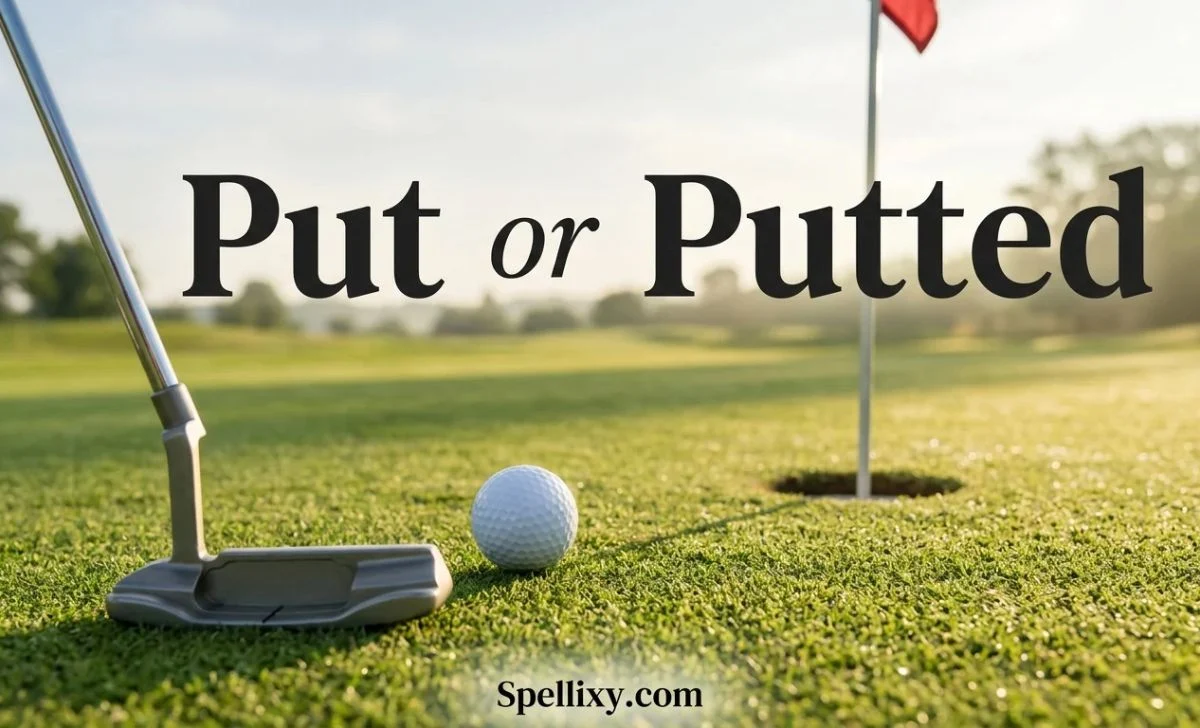
Have you ever wondered whether to write put or putted when describing something that happened in the past?
The answer depends on the action. The verb put keeps the same form in the past, while putted is used for a specific action in golf.
Quick Answer:
Put is the correct past tense and past participle of the general verb put, which means to place or move something into a position. Its three main forms are put, put, and put.
Putted is correct when it comes from the golf verb putt, meaning to hit a golf ball gently toward the hole.
Examples:
- General use: I put my keys on the table yesterday.
- Golf: He putted the ball toward the hole.
What Is the Past Tense of Put?
The past tense of put is put. Unlike regular verbs that add -ed, this verb does not change its spelling in the simple past.
Consider these examples:
- Present: I put my lunch in the fridge every morning.
- Past: I put my lunch in the fridge yesterday.
- Future: I will put my lunch in the fridge tomorrow.
The time words make the tense clear, even though the verb stays the same.
What Is the Past Participle of Put?
The past participle is also put. It is used with helping verbs such as has, have, and had.
- I have put the files in the folder.
- She has put her phone on silent.
- They had put the chairs outside before the rain started.
When you mean placing or moving something, use put rather than putted in these sentences.
When Is Putted Correct?
Putted is the past tense and past participle of putt, a verb used in golf. To putt means to hit a golf ball gently so that it rolls toward the hole.
For example:
- He putted the ball into the hole.
- Maya putted carefully on the final green.
- The golfer has putted well throughout the match.
- They had putted several times before the rain began.
In each sentence, putted describes a golf action. It is not the past tense of the general verb put.
Put vs. Putted: Key Differences
| Word or form | Meaning | Example |
|---|---|---|
| Put (base, past, past participle) | To place or move something | I put the keys on the table. |
| Putt | To hit a golf ball gently toward the hole | I need to putt more carefully. |
| Putted | Past tense or past participle of putt | She putted the ball toward the hole. |
| Puts | Present-tense form used with he, she, or it | He puts his wallet in the same drawer. |
| Putting | The -ing form of put and putt | She is putting the dishes away. |
The main difference is the action. Use put for ordinary placement and putted for a golf stroke.
How to Use Put in Different Tenses
Although the spelling stays the same in several forms, the sentence structure changes with the tense.
Simple Present
Use put with I, you, we, and they. Use puts with he, she, and it.
- I put my bag by the door.
- They put their books on the shelf.
- She puts her keys in a small bowl.
Simple Past
Use put to describe an action that happened in the past.
- I put the milk back in the fridge.
- He put his coat on the chair.
- We put the wrong date on the form.
Present Perfect
Use have put or has put for a past action connected to the present.
- I have put your name on the list.
- She has put the children to bed.
- They have put the new rules in writing.
Past Perfect
Use had put when one past action happened before another.
- I had put the letter in the drawer before I left.
- She had put the food away when the guests arrived.
Present Continuous
Use am putting, is putting, or are putting for an action happening now or around the present time.
- I am putting the groceries away.
- He is putting his shoes on.
- They are putting new signs around the building.
Put or Putted in a Sentence: Examples
These examples show how the correct form depends on what you want to say.
Examples With Put
- I put my phone on the charger last night.
- She put the report on her manager’s desk.
- We have put enough money aside for the trip.
- He put his jacket over the back of the chair.
- They had put the groceries away before dinner.
- Please put your signature at the bottom of the page.
- The teacher put the students into small groups.
- I put the meeting on my calendar yesterday.
Examples With Putted
- The golfer putted the ball toward the hole.
- She putted well on the last three holes.
- He putted the ball too hard and missed the cup.
- The player putted from the edge of the green.
- They putted toward the flag after reaching the green.
- She has putted confidently throughout the tournament.
The first group uses put for placing, moving, or arranging something. The second group uses putted for the golf action.
Common Mistakes to Avoid
Using Putted for Ordinary Actions
Incorrect: I putted my keys on the table.
Correct: I put my keys on the table.
When you mean to place something somewhere, use put. The form putted is for the golf verb putt.
Using Putt Instead of Put
Incorrect: She putt the book in her bag.
Correct: She put the book in her bag.
Putt is a golf verb. The simple past of the general verb put remains put.
Changing the Past Participle
Incorrect: I have putted the documents in the folder.
Correct: I have put the documents in the folder.
Use have put, has put, or had put when the verb means placing or moving something.
Confusing Put and Puts
Incorrect: Nowadays, he put his phone on the desk every morning.
Correct: Nowadays, he puts his phone on the desk every morning.
Use puts with he, she, or it for a present habit. The form put can still be correct with those subjects when describing a past action or habit.
Easy Trick to Remember the Difference
Think about the action you want to describe:
- Put = place something. “I put the cup on the table.”
- Putt = hit a golf ball gently. “I putted the ball toward the hole.”
For ordinary actions, remember the three main forms: put, put, put. There is no need to add -ed when talking about the past.
Practice Exercises: Put or Putted
Choose the correct word to complete each sentence.
- Yesterday, I ___ my wallet in the drawer.
- She has ___ the clean plates away.
- The golfer ___ the ball into the hole.
- Nowadays, he ___ his phone on the desk every morning.
- They had ___ the chairs outside before the guests arrived.
- The player has ___ carefully on the final green.
Answers
- Put — a past action of placing something.
- Put — the past participle of the general verb.
- Putted — a golf action in the past.
- Puts — a present habit with he.
- Put — the past participle used with had.
- Putted — the past participle of the golf verb putt.
FAQs
What is the past tense of put?
The past tense is put. For example, “I put my bag by the door yesterday.”
Is putted grammatically correct?
Yes. Putted is correct as the past tense or past participle of the golf verb putt. When you mean placing something, use put.
Which is correct: “I have put” or “I have putted”?
Use “I have put” when you mean that you placed something somewhere. Use “I have putted” when you mean that you have played a golf stroke.
Is putting the -ing form of put?
Yes. Putting is the -ing form of put. It is also the -ing form of the golf verb putt, as in “She is putting the ball toward the hole.”
Is putt a noun or a verb?
It can be both. As a verb, putt means to hit a golf ball gently toward the hole. As a noun, a putt is the golf stroke itself. For example, “His final putt won the match.”
How do you pronounce putt?
Putt rhymes with cut and hut. It has the short vowel sound heard in those words.
What are some common phrases with put?
English has several common expressions with put. “Put up with” means to tolerate something, while “put someone down” means to insult or belittle them. “Put off” can mean to delay something.
Conclusion
The choice between put and putted depends on the meaning. Use put when you mean to place, move, or arrange something; its base form, past tense, and past participle are identical.
Use putted when describing a golf stroke. Remembering this difference will help you choose the right verb form in everyday writing, conversations, and grammar exercises.