You read a message from your manager and want to reply that everything is clear. Should you write “I understand,” “I understood,” or simply “Understood”?
All three can be correct, but they do not mean exactly the same thing in every situation.
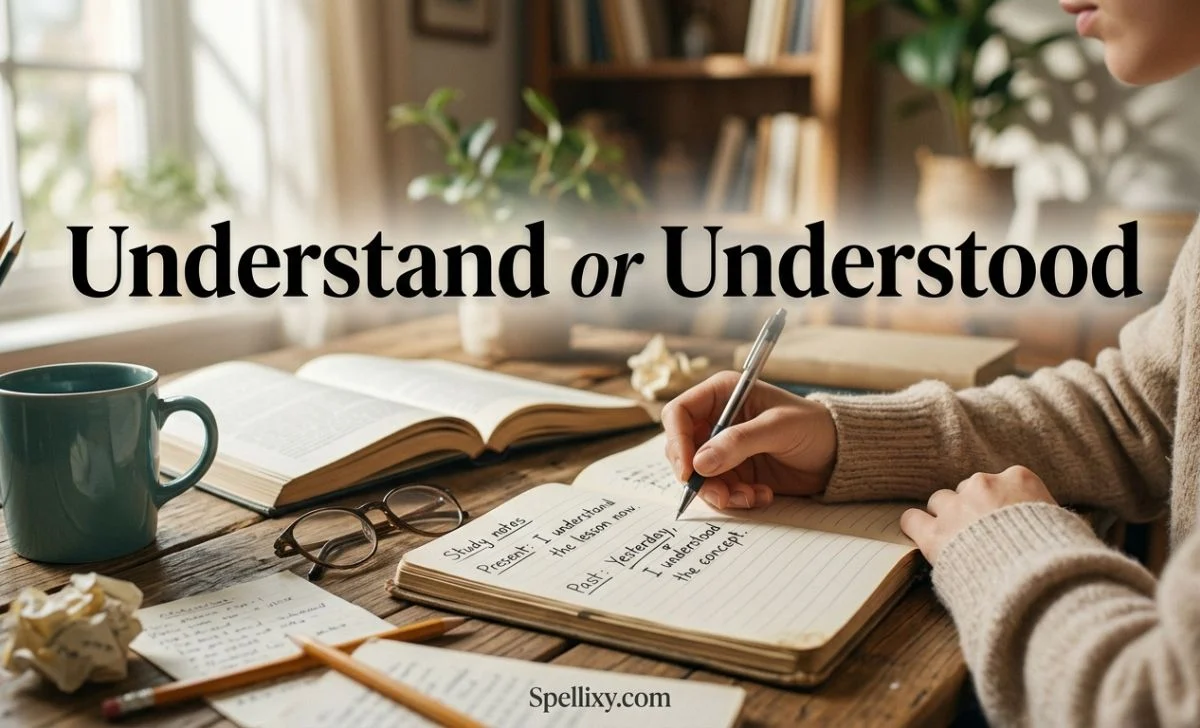
Understand is the base form of the verb and is used for present understanding. Understood is its simple past tense and past participle. It can also serve as a short reply when you acknowledge instructions or information.
The trick is to look at the time you are talking about and the words around the verb. Once you know these two things, choosing the correct form becomes much easier.
The Correct Choice
Use understand when you understand something now or describe a general fact. Use understood when talking about past understanding or forming a perfect tense.
| Situation | Correct expression | Example |
|---|---|---|
| You understand something now | I understand | I understand your concern. |
| You understood something in the past | I understood | I understood your point yesterday. |
| You want to describe a past experience connected to the present | I have understood | I have understood the main idea. |
| You ask about someone’s current understanding | Do you understand? | Do you understand the question? |
| You ask about a past experience | Did you understand? | Did you understand the lesson? |
| You acknowledge an instruction | Understood. | Understood. I’ll update the file. |
The most important rule: after do, does, or did, use understand. After have, has, or had, use understood when forming a perfect tense.
Why Does Understand Change to Understood?
Understand is an irregular verb. This means it does not form its past tense by adding -ed in the usual way.
Its main forms are:
| Form | Example |
|---|---|
| Base form: understand | I understand the instructions. |
| Present simple with he, she, or it: understands | She understands the instructions. |
| Present participle: understanding | Understanding grammar takes practice. |
| Simple past: understood | She understood the instructions yesterday. |
| Past participle: understood | She has understood the instructions. |
Notice that understood serves two grammatical purposes. It is the simple past in “She understood the lesson” and the past participle in “She has understood the lesson.”
The helping verb tells you which tense you are using.
When to Say “I Understand” Instead of “I Understood”
Imagine a friend is explaining why they missed an appointment. You follow their explanation and want to show that you understand. You would naturally say, “I understand.”
Now imagine you are talking about a meeting that happened yesterday. You want to explain that you followed the discussion at that time. “I understood” is the better choice.
Use “I Understand” for the Present
Choose this form when something is clear to you now. It can also show that you recognize someone’s feelings or point of view.
Examples:
- I understand what you mean.
- I understand why you are upset.
- I understand the instructions now.
- I understand your concerns about the deadline.
- I understand how difficult this decision is for you.
In the last two examples, understand does more than show that you know the facts. It can also express empathy or recognition.
Use “I Understood” for the Past
Choose this form when you are describing something you understood at an earlier time.
Examples:
- I understood the question after reading it twice.
- I understood your message when you explained it.
- We understood the rules before the game began.
- At first, I was confused, but I understood the instructions later.
You can often identify the correct form by looking for a past-time expression such as yesterday, last week, earlier, or during the meeting.
However, the time expression is not the only factor. The main question is whether you are describing your understanding now or at a past time.
“I Understand Now” vs. “I Understood Now”
When something finally becomes clear, “I understand now” is the natural expression.
Examples:
- I understand now why you made that decision.
- Oh, I understand now. Thanks for explaining it.
- I understand now how the new system works.
“I understood now” is generally unnatural in standard English when you mean that you have just grasped something and understand it at present.
If you are describing a past moment, use a past-time expression instead:
- I understood it then.
- I understood after you explained the problem.
- I finally understood what she meant during the meeting.
In casual conversation, “I get it now” is another natural way to express the same present understanding.
Have Understand or Have Understood?
The correct form is “have understood,” not “have understand.”
The present perfect tense follows this pattern:
Subject + have/has + past participle
Because understood is the past participle of understand, it is the form needed after have or has.
Correct examples:
- I have understood your main point.
- We have understood the new procedure.
- She has understood the instructions.
- They have understood what the client needs.
Incorrect examples:
- I have understand your main point.
- We have understand the new procedure.
- She has understand the instructions.
The same rule applies to the past perfect tense:
- I had understood the issue before the meeting began.
- They had understood the rules before the match started.
Is “I Understood” Different From “I Have Understood”?
Yes. Both can be correct, but the emphasis differs.
“I understood the lesson yesterday” places the event in the past. “I have understood the main idea” presents that understanding as relevant to the current situation.
In everyday English, people often use the simple past when describing a completed event. The present perfect is useful when the result or experience matters now.
Do You Understand or Did You Understand?
These questions differ in tense.
Do you understand? asks whether someone understands something now.
- Do you understand the instructions?
- Do you understand what I am asking?
- Do you understand how to use this tool?
Did you understand? asks whether someone understood something in a past situation.
- Did you understand the lesson yesterday?
- Did you understand what the speaker said?
- Did you understand the instructions during the meeting?
Never write “Did you understood?” The word did already marks the past, so the main verb must stay in its base form.
The same rule applies to other verbs:
- Correct: Did you go?
- Incorrect: Did you went?
- Correct: Did she see it?
- Incorrect: Did she saw it?
Is “Understood” a Good Reply?
Yes. “Understood” is a natural, concise reply when you acknowledge an instruction or confirm that a message is clear.
Consider this exchange:
Manager: Please review the document and send your changes before noon.
Employee: Understood. I’ll send the revised document before noon.
The reply works because it acknowledges the instruction and confirms the next step.
You can also use understood when someone gives you a reminder, explains a rule, or confirms a change.
Colleague: The meeting has been moved to Thursday.
You: Understood. Thank you for letting me know.
However, a short acknowledgment is not always the best response. If someone shares a personal problem, “I understand” may sound more caring. If you are unsure about an instruction, ask for clarification instead of replying “Understood.”
“Okay, Understood” or “Okay, Understand”?
Use “Okay, understood” when acknowledging a message.
- Okay, understood. I’ll make the changes.
- Okay, understood. I’ll be there at 9 a.m.
If you want to use understand, include the subject:
- Okay, I understand.
- Okay, I understand what you mean.
“Okay, understand” is not a natural standalone reply in standard English. The base form understand normally needs a grammatical structure around it.
Choosing the Right Phrase in an Email
In professional emails, the best wording depends on whether you are acknowledging instructions, responding to a concern, or confirming an action.
When You Want to Show Understanding
Use “I understand” when responding to a concern or showing that you recognize someone’s position.
Examples:
- I understand your concern and will review the issue.
- I understand why the deadline is important.
- I understand the changes you have requested.
This form is especially useful when the message calls for a thoughtful response rather than a quick acknowledgment.
When You Want to Acknowledge Instructions
Use “Understood” when the request is clear and you want to confirm that you have received it.
Examples:
- Understood. I’ll make the requested changes.
- Understood, thank you for the clarification.
- Understood. I’ll send the report by Friday.
For a more formal email, you can use a complete sentence that states your next action.
| Phrase | Best use |
|---|---|
| I understand. | Confirming present understanding |
| Understood, thank you. | Acknowledging instructions politely |
| Thank you for clarifying. | Responding to an explanation |
| I’ll take care of it. | Confirming responsibility |
| I’ll proceed as requested. | Confirming a planned action |
| I’ve noted the changes. | Confirming that you have taken note |
| Thank you for the update. | Acknowledging new information |
These phrases are not exact substitutes for one another. For example, “I’ve noted the changes” means you have taken note of them; it does not necessarily mean you understand every detail.
Understand or Understood: Synonyms
The best synonym depends on the meaning of the sentence. Some words describe understanding an idea, while others describe becoming aware of something.
| Word | Meaning | Example |
|---|---|---|
| Comprehend | Understand information or an idea | I comprehend the explanation. |
| Grasp | Understand something, often after thought | I grasp the main point. |
| Follow | Understand an explanation or argument | I follow your reasoning. |
| Realize | Become aware of something | I realized why the plan had failed. |
| Appreciate | Recognize the value or importance of something | I appreciate your concern. |
For past understanding, you can use comprehended, grasped, or followed when they fit the sentence.
For a short reply, alternatives include “Got it,” “I see,” and “Noted.” Their meanings differ slightly: “Got it” is conversational, while “Noted” often signals that you have recorded or acknowledged information.
Common Errors to Avoid
Many mistakes with understand and understood come from using the wrong verb form after a helping verb.
| Incorrect | Correct | Reason |
|---|---|---|
| I have understand the issue. | I have understood the issue. | Use the past participle after have. |
| Did you understood me? | Did you understand me? | Use the base form after did. |
| Do you understood the question? | Do you understand the question? | Use the base form after do. |
| She understand the problem. | She understands the problem. | Use understands with she in the present simple. |
| I understood now. | I understand now. | Use the present form for current understanding. |
| Okay, understand. | Okay, understood. | Understood is the natural short acknowledgment. |
A simple way to check your sentence is to look at the word before the main verb. After do, does, or did, use the base form. After have, has, or had in a perfect tense, use the past participle.
Test Your Grammar: Understand or Understood?
Choose the correct answer in each sentence.
1. I _____ what you mean now.
A. understand
B. understood
C. have understand
2. Did you _____ the instructions yesterday?
A. understood
B. understand
C. understands
3. We have _____ the main points of the meeting.
A. understand
B. understands
C. understood
4. Your manager asks you to send a report by noon. Which is the most natural short reply?
A. Understand.
B. Did understand.
C. Understood.
5. Which sentence is grammatically correct?
A. Did you understood the question?
B. Do you understood the question?
C. Do you understand the question?
Answers: 1. A — understand. 2. B — understand. 3. C — understood. 4. C — Understood. 5. C — Do you understand the question?
FAQs
Which Is Correct: “I Understand” or “I Understood”?
Both are correct. Use “I understand” for present understanding and “I understood” for a past situation.
Which Is Correct: “Have Understood” or “Have Understand”?
“Have understood” is correct because the present perfect tense requires the past participle.
When Can I Say “Understood”?
Use it to acknowledge instructions, confirm information, or show that you have grasped a message.
Is “Fully Understand” or “Fully Understood” Correct?
Both are correct in the right context. “I fully understand” describes present understanding, while “I fully understood” describes past understanding. After have or has, use “fully understood.”
Is “We Understand” or “We Understood” Correct?
Both are correct. “We understand” refers to the present, while “we understood” refers to the past.
Is It “Did You Understand” or “Did You Understood”?
“Did you understand?” is correct because the main verb stays in its base form after did.
Conclusion
Understand and understood express the same basic idea, but they work differently in a sentence.
Use understand for present comprehension, understood for past comprehension, and have understood when the present perfect tense is needed.
When replying to a message, “Understood” is a natural way to acknowledge a clear instruction. In a sentence about what you know now, use “I understand.”
Check the tense and sentence structure before choosing the word, and you can avoid the most common mistakes.
Discover More Blogs :
Gluing or Glueing: Why One Spelling Is Preferred
Everyone or Every One: How Context Determines the Correct Form
Leaped or Leapt: How English Uses Both Forms
Bear or Bare: From Basic Meanings to Common Expressions
Barbeque or Barbecue: Spelling, Meaning, and Usage
Web Site or Website: The Story Behind the Spelling