Meta Description: Suppose to or supposed to , which is correct? Learn the grammar rule, why the mistake happens, and how to use “supposed to” correctly.
You’re typing a text, and you pause. Was it “I’m suppose to call her” or “I’m supposed to call her”? Both look almost identical, and honestly, both sound the same when spoken out loud. That tiny missing letter is exactly why this mistake spreads so widely, even among confident writers.
This guide breaks down the real difference, why your ears trick you into dropping the “d,” and how to fix the mistake permanently in your own writing.
The Short Answer
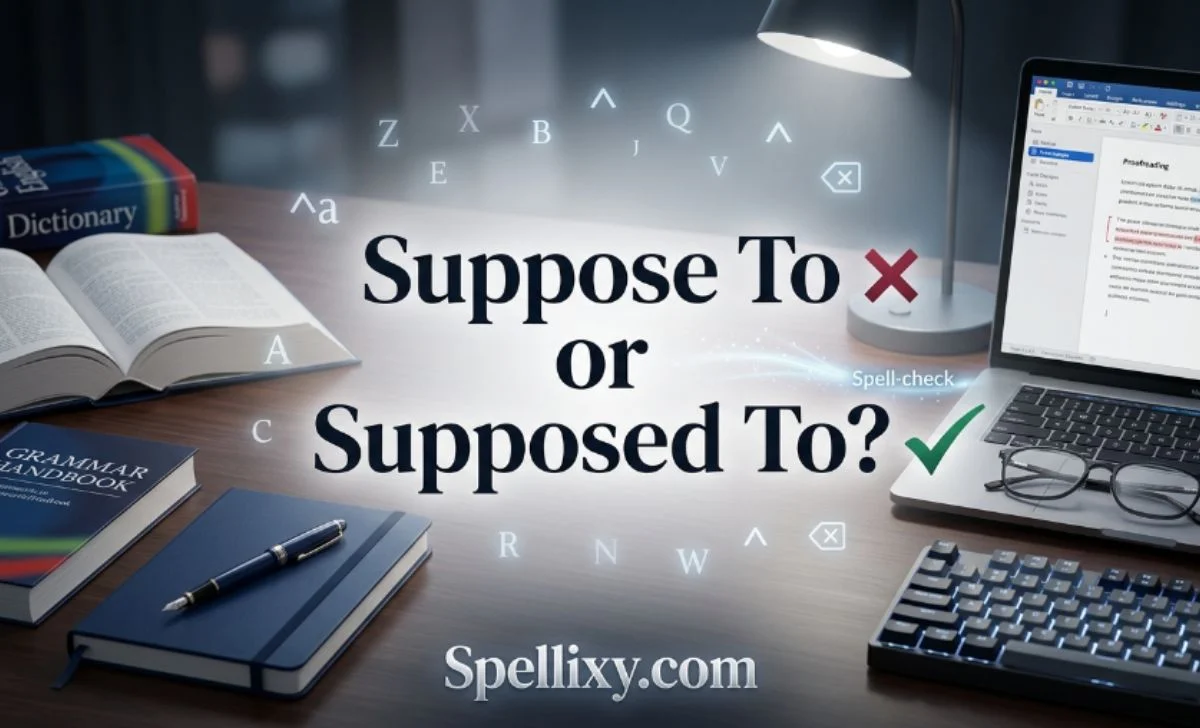
“Supposed to” is always correct in writing. “Suppose to” is a mistake, no matter how casual or formal the context is.
This isn’t a British-versus-American spelling issue, and it isn’t a matter of personal style. It’s a straightforward grammar rule: the phrase requires the “-ed” ending, full stop.
- ✅ I’m supposed to meet him at noon.
- ❌ I’m suppose to meet him at noon.
Why Your Ears Deceive You Here
Say the sentence “I’m supposed to leave” out loud, at normal speaking speed. Notice something? The “-ed” in “supposed” blends directly into the “t” sound of “to.” Your mouth barely pauses between them, so the two words fuse into something that sounds like “suppose-to.”
This happens because English speakers naturally simplify consonant clusters in fast speech. The “d” sound in “supposed” gets absorbed by the following “t,” and the result is a spoken phrase that no longer clearly signals the written “-ed” ending.
Written language doesn’t get to skip that letter, though. What sounds smooth in conversation still needs the full spelling on the page.
Breaking Down the Grammar
To understand why “supposed to” needs the “-ed,” it helps to separate the two related words completely.
“Suppose” (No -ed) Is a Verb Meaning “To Assume”
Used on its own, “suppose” expresses a guess, an assumption, or a hypothesis.
- I suppose he’s running late again.
- Suppose we missed the last train — what then?
- Do you suppose she already knows?
“Supposed” (With -ed) Functions as Part of an Obligation Phrase
When paired with “to” and a form of the verb “be,” “supposed” no longer means “assumed.” Instead, the whole phrase “supposed to” describes an expectation, a plan, a rule, or an obligation.
- She is supposed to arrive at 6 PM.
- We were supposed to finish the project by Friday.
- You’re supposed to wear a helmet on this trail.
Grammatically, “supposed” here is a past participle acting like an adjective, similar to how “expected” or “required” would function in the same sentence slot. That’s the real reason the “-ed” can’t be dropped: without it, the sentence loses the grammatical piece that creates the obligation meaning in the first place.
A Quick Substitution Test
Whenever you’re unsure, try swapping in the word “expected” or “meant.” If the sentence still makes sense, you need “supposed to,” not “suppose to.”
- “He’s expected to call tonight” → “He’s supposed to call tonight.” ✅
- “You’re meant to be here at nine” → “You’re supposed to be here at nine.” ✅
This test works because “expected” and “meant” are also past participles functioning as adjectives — exactly the grammatical role “supposed” plays in this phrase. If “expect” or “mean” (without -ed) sounded right instead, you’d know you were dealing with a completely different sentence structure.
Table: Suppose vs Supposed To at a Glance
| Suppose | Supposed To | |
|---|---|---|
| Part of speech | Main verb | Past participle + infinitive (functions as modal-like phrase) |
| Core meaning | To assume, guess, or believe | Expected to, required to, or planned to |
| Needs “to be” before it? | No | Yes (is/am/are/was/were) |
| Can stand alone? | Yes (“I suppose so”) | No, always followed by “to” + a verb |
| Example | I suppose it’s true. | I’m supposed to finish this today. |
Common Mistakes People Make
Dropping the “-ed” in Writing
By far the most frequent error. Because the spoken form glosses over the “d” sound, many writers simply type what they hear.
❌ You suppose to bring your ID. ✅ You’re supposed to bring your ID.
Forgetting the Verb “Be” Before “Supposed To”
“Supposed to” almost never appears without a form of “to be” directly in front of it.
❌ He supposed to call yesterday. ✅ He was supposed to call yesterday.
Confusing “Supposed To” With Plain “Suppose”
❌ I’m suppose you’re right. ✅ I suppose you’re right. (No “to be” needed here, since this is the plain verb meaning “assume.”)
Mixing Up “Supposedly” and “Supposably”
“Supposedly” is the standard, correct adverb meaning “as generally believed” (often with a hint of doubt). “Supposably” is technically a real but rarely used word meaning “able to be supposed,” and it’s frequently used by mistake as a substitute for “supposedly.” In almost every case, “supposedly” is what you actually want.
- ✅ The restaurant is supposedly the best in town.
- ⚠️ The restaurant is supposably the best in town. (Non-standard in this context; avoid it.)
Corrected Examples Side-by-Side
| Incorrect | Correct |
|---|---|
| I’m suppose to be there by 8. | I’m supposed to be there by 8. |
| We suppose to meet at the cafe. | We’re supposed to meet at the cafe. |
| The store suppose to open at 9. | The store is supposed to open at 9. |
| They suppose to know the rules. | They’re supposed to know the rules. |
| She suppose to bring the tickets. | She’s supposed to bring the tickets. |
How “Supposed To” Compares to Similar Modal Phrases
English has a cluster of expressions that describe obligation or expectation, and they’re often confused with one another because they overlap in meaning but not in strength.
Supposed To vs Have To
“Have to” expresses a firm requirement, something that must happen, with no real flexibility.
- I have to submit this by midnight, or I fail the assignment.
“Supposed to” expresses an expectation that may or may not actually happen.
- I’m supposed to submit this by midnight, but I might ask for an extension.
Supposed To vs Ought To
“Ought to” is softer still, more of a recommendation than an obligation.
- You ought to double-check your work before submitting.
Compare the difference in strength across all three:
- Supposed to = expected, but not guaranteed
- Have to = required, no exceptions
- Ought to = advisable, but optional
Supposed To vs Used To
These two phrases look structurally similar but mean completely different things. “Used to” describes a past habit or state that no longer applies.
- I used to play piano every day. (past habit, no longer true)
- I’m supposed to play piano every day. (current expectation)
Because both phrases end in “to” and involve a form that can sound reduced in speech, learners sometimes blend the two concepts, even though they serve entirely different grammatical purposes.
Supposed To vs Need To
“Need to” expresses necessity based on a requirement, often practical or urgent rather than rule-based.
- I need to finish this before the deadline, or the whole project stalls.
Compared side by side, the four expressions form a rough scale from softest to strongest:
- Ought to → mild suggestion
- Supposed to → expected, but not guaranteed to happen
- Need to → practical necessity
- Have to → firm, non-negotiable requirement
Recognizing where “supposed to” sits on this scale helps explain why it often carries a slightly disappointed or apologetic tone when the expectation isn’t met , “I was supposed to call you” almost always implies an unfulfilled expectation, whereas “I had to call you” simply states that the action happened out of necessity.
Real-World Examples in Context
Workplace Communication
- Employees are supposed to log their hours daily.
- The report was supposed to be finalized before the client call.
- You’re supposed to CC your manager on all vendor emails.
School and Academic Writing
- Students are supposed to submit their essays through the online portal.
- The experiment was supposed to run for three weeks.
- You’re supposed to cite every external source you use.
Everyday Conversation
- We’re supposed to meet Sarah at seven.
- He was supposed to text me when he landed.
- The weather’s supposed to clear up by the weekend.
Text Messages and Informal Writing
- omg i’m supposed to be at the airport in an hour 😭
- wait weren’t we supposed to bring snacks?
Even in casual texting, “supposed to” (not “suppose to”) remains the technically correct spelling — informal tone doesn’t change the underlying grammar rule, even though enforcement is naturally more relaxed in texts between friends.
Does This Differ Between American and British English?
No. This is one of the rare grammar points where American English, British English, Australian English, and every other major English variety agree completely.
“Supposed to” is correct everywhere; “suppose to” is incorrect everywhere. Unlike genuine regional spelling differences (color/colour, organize/organise), this is purely a grammar and pronunciation issue, not a dialect variation.
Why This Mistake Is So Persistent
A few overlapping reasons explain why “suppose to” refuses to disappear, even among careful writers:
- The sound genuinely disappears in fluent speech. Unlike some spelling errors that come from unfamiliarity, this one comes from accurately representing how the phrase actually sounds when spoken quickly.
- Autocorrect doesn’t always catch it, since “suppose” is a perfectly valid word on its own , spellcheckers see a real word, not a typo, and often let it slide unless grammar-checking features are specifically enabled.
- Children learn spoken language before written grammar rules, so the reduced pronunciation gets internalized first, and the correct spelling has to be taught explicitly later, usually in school.
- The mistake is everywhere online, including in casual writing, comments, and even some published content, which reinforces the incorrect form through repeated exposure.
The Origin of “Suppose” and “Supposed To”
The verb “suppose” traces back to the 13th-century Old French word “suposer,” meaning “to assume.” Further back, it derives from the Latin “supponere,” a combination of “sub-” (under) and “ponere” (to put or place) , literally “to put under” or “to place as a foundation for an argument.”
This root explains the core meaning of assumption: supposing something means mentally placing it underneath your reasoning as a starting point, even without full certainty.
The verbal sense meaning “to believe something is probably true” developed by the early 16th century. Over time, English speakers began using the past participle “supposed” together with “to” and a form of “be” to describe something that was expected, planned, or required , effectively treating an assumption or expectation as if it had been formally established as a rule.
This is how the modern obligation-based meaning of “supposed to” emerged, distinct from the simple assumption meaning of “suppose” on its own.
Understanding this shared root helps explain why the two forms feel so closely related, even though their modern uses have diverged into two very different grammatical functions.
More Practice Examples
Testing yourself with a range of sentences is one of the fastest ways to make this rule automatic. Try reading each pair below and notice how only the correct version fits naturally into formal writing.
Present Tense
- ❌ The bus suppose to arrive at 8:15.
- ✅ The bus is supposed to arrive at 8:15.
Past Tense
- ❌ We suppose to visit last weekend, but plans changed.
- ✅ We were supposed to visit last weekend, but plans changed.
Questions
- ❌ Isn’t he suppose to be here already?
- ✅ Isn’t he supposed to be here already?
Negative Form
- ❌ You not suppose to open that door.
- ✅ You’re not supposed to open that door.
With Modal Softening
- ❌ I think we suppose to wait for confirmation.
- ✅ I think we’re supposed to wait for confirmation.
“Supposed To” in Everyday Idioms and Expressions
Beyond simple obligation, “supposed to” appears in a few common expressions worth knowing, since they follow the same spelling rule but carry slightly different shades of meaning.
- “What’s that supposed to mean?” — used to challenge or question the intended meaning behind something someone said, often with a hint of offense or suspicion.
- “It’s not supposed to be easy.” — often used as encouragement, implying that difficulty is expected and normal, not a sign of failure.
- “Who’s supposed to do this?” — used to question responsibility or assign a task.
- “This is supposed to be fun!” — expressing frustration when an activity that was expected to be enjoyable isn’t turning out that way.
In every one of these expressions, the “-ed” spelling remains fixed and non-negotiable, regardless of how casual or emotional the sentence sounds.
A Simple Self-Check Method
Before sending an email, submitting an assignment, or publishing content, run through this quick mental check whenever the phrase appears:
- Is there a form of “to be” right before the word? (is, am, are, was, were) If yes, you almost certainly need “supposed to,” not plain “suppose.”
- Does the sentence describe an expectation, rule, or plan rather than a personal guess or belief? If yes, use “supposed to.”
- Try the substitution test — swap in “expected to” or “meant to.” If the sentence still makes sense, “supposed to” is confirmed as correct.
If none of these apply, and the sentence is simply expressing a guess or assumption (“I suppose it will rain”), then the plain verb “suppose” without “-ed” is what you actually need.
Why This Rule Is Especially Tricky for English Learners
Non-native English speakers often struggle with “supposed to” more than with many other grammar points, for a few specific reasons.
It doesn’t behave like a typical modal verb. Words like “can,” “must,” and “should” never change form and never need “to be” in front of them. “Supposed to,” however, requires a conjugated form of “be” (is, am, are, was, were) directly before it, which breaks the pattern learners expect from other obligation words.
The meaning shifts depending on tense. “Is supposed to” often implies a rule or expectation that’s still relevant, while “was supposed to” frequently implies something that didn’t actually happen , a nuance that isn’t obvious just from translating the phrase word-for-word into another language.
Textbooks sometimes underexplain the pronunciation gap. Learners are taught to write “supposed to” correctly, but they may not be told clearly why native speakers seem to “skip” the d sound, which can create doubt about whether they misheard the rule entirely.
It overlaps with several similar-sounding structures. Between “used to,” “have to,” “ought to,” and “supposed to,” learners are juggling multiple similar-looking obligation and habit phrases, each with its own subtle rule, which naturally increases the chance of confusing one for another.
Additional Real-World Context Examples
Customer Service and Support
- Our policy states that refunds are supposed to be processed within five business days.
- You’re not supposed to share your account password with anyone.
- The technician was supposed to call before arriving.
Legal and Formal Documents
- Tenants are supposed to provide thirty days’ notice before vacating the property.
- All visitors are supposed to sign in at the front desk upon arrival.
- The contractor was supposed to complete the work by the agreed deadline.
Parenting and Family Communication
- You’re supposed to be in bed by nine on school nights.
- We’re supposed to visit grandma this weekend, remember?
- He’s supposed to finish his homework before watching TV.
News and Journalism
- The bill was supposed to pass before the end of the session.
- Officials say the bridge repairs were supposed to be finished last spring.
- The ceasefire was supposed to take effect at midnight.
One More Distinction Worth Noting: “Supposed” as a Standalone Adjective
Outside the “supposed to” obligation structure, the word “supposed” can also function as a plain adjective meaning “believed to be true, but not confirmed” , often carrying a tone of doubt or skepticism.
- The supposed expert turned out to have no real qualifications.
- Police are investigating the supposed sighting reported by witnesses.
- Her supposed friendship with the actress was mostly media speculation.
In this usage, “supposed” appears directly before a noun, rather than being followed by “to” and a verb. The spelling still keeps the “-ed,” but the grammatical role and meaning are distinctly different from the obligation-based “supposed to” structure covered throughout this guide.
FAQs
1. Is “suppose to” ever grammatically acceptable? No. In every context , formal, informal, spoken transcription, or written , “supposed to” is the only correct form when expressing obligation or expectation.
2. Why does “supposed to” sound like “suppose to” when spoken? Because the “-ed” ending in “supposed” is pronounced like a “t” sound, which blends smoothly into the “t” at the start of “to,” making the “d” nearly disappear in fast speech.
3. Can I use “suppose” by itself correctly? Yes. “Suppose” without “-ed” is correct when used as a standalone verb meaning “to assume” or “to guess,” as in “I suppose you’re right.”
4. Is “supposably” a real word? Technically yes, but it’s rarely used correctly and often mistakenly substituted for “supposedly.” In nearly all everyday writing, “supposedly” is the word you actually want.
5. Does British English use “suppose to” instead of “supposed to”? No. Both British and American English require “supposed to.” There is no regional variant where “suppose to” is considered standard.
6. What’s the difference between “supposed to” and “have to”? “Supposed to” expresses an expectation that might not be fulfilled, while “have to” expresses a firm, non-negotiable requirement.
7. Is “was supposed to” different from “is supposed to”? Yes, they use different tenses. “Is supposed to” describes a current expectation, while “was supposed to” describes a past expectation, often one that wasn’t fulfilled (“I was supposed to call you, but I forgot”).
8. How can I quickly check if I need “supposed to” in a sentence? Try replacing the phrase with “expected to” or “meant to.” If the sentence still makes sense, “supposed to” is correct.
9. Does Grammarly or spellcheck catch “suppose to” automatically? Advanced grammar-checking tools like Grammarly typically catch this error, but basic spellcheckers often miss it, since “suppose” is a valid word on its own.
10. Is “s’posed to” ever acceptable to write? “S’posed to” is an informal, phonetic spelling sometimes used in casual texting or dialogue writing to represent speech patterns, but it should never appear in formal or professional writing. The correct standard spelling remains “supposed to.”
11. Can “supposed to” be used in questions? Yes. For example, “Aren’t we supposed to leave by now?” or “Isn’t the store supposed to be open already?”
12. What’s the negative form of “supposed to”? The negative form typically places “not” after the verb “be,” as in “You’re not supposed to be here” or “I wasn’t supposed to tell you that.”
13. Is “supposed” always pronounced the same way? No. As a past participle in “supposed to,” it’s pronounced with a “t” sound at the end (suh-POHST). As a standalone adjective meaning “believed” or “alleged” (as in “the supposed culprit”), it can be pronounced the same way, but the grammatical function differs.
14. Does using “suppose to” hurt professional or academic credibility? Yes. In resumes, emails, reports, and academic writing, using “suppose to” instead of “supposed to” is generally viewed as a clear grammar mistake and can make writing look less polished or carefully proofread.
15. Is there a simple memory trick for remembering the “-ed”? One helpful trick is to remember that “supposed to” behaves like other “-ed” adjective phrases such as “expected to” or “required to” — if those need the “-ed,” so does “supposed to.”
16. Is “supposed to” the same as “meant to”? They’re very close in meaning and often interchangeable, though “meant to” can sometimes carry a slightly more personal or fated tone, as in “We were meant to meet,” while “supposed to” leans more toward rules or plans.
17. Can “supposed to” express permission instead of obligation? Yes, in some contexts it implies what is or isn’t allowed, as in “You’re not supposed to park here,” which functions closer to a rule about permission than a task-based obligation.
18. Why do some people write “spose to” or “sposed to”? These are phonetic spellings that attempt to represent casual pronunciation directly. They’re common in informal texting or dialogue in fiction but are not acceptable in standard formal writing.
19. Does “supposed to” ever appear without “to be” in casual speech? In very casual speech, speakers sometimes drop the “to be” verb entirely, as in “You supposed to bring that?” This is grammatically nonstandard and should be avoided in writing, even informal writing.
20. Is there a difference between “he’s supposed to” and “he supposed to” in meaning? Yes, and it’s significant — “he’s supposed to” (with the contracted “is”) is grammatically complete, while “he supposed to” is missing the required verb “be” entirely and is not standard English.
Conclusion
“Supposed to” is the only correct written form when describing expectation, obligation, or plans , “suppose to” is always a mistake, regardless of tone or context.
The confusion exists almost entirely because of how the phrase sounds in fast, natural speech, where the “-ed” quietly disappears into the following “t” sound.
Once you separate the two meanings , “suppose” as a standalone verb for assuming something, and “supposed to” as a fixed phrase for expectation , the rule becomes easy to apply consistently.
A quick substitution test with “expected to” or “meant to” will confirm the correct form every time you’re unsure, keeping your writing accurate and polished.