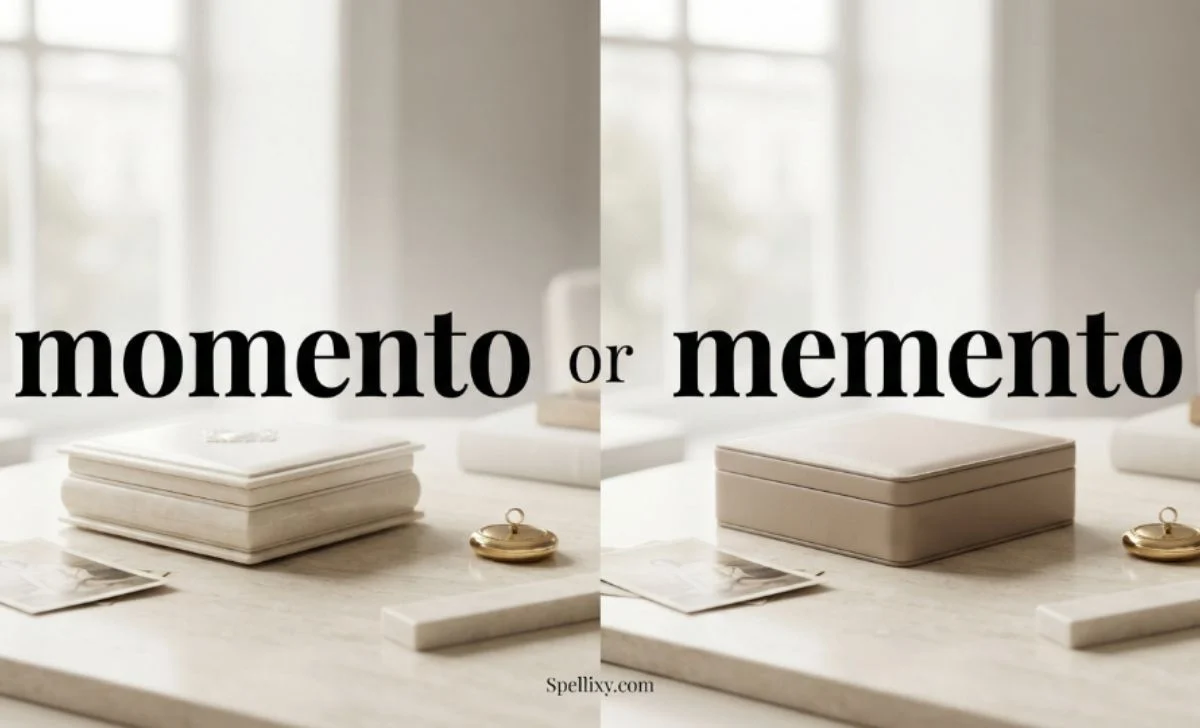
Memento is the correct spelling when you mean a keepsake or something that helps you remember a person, place, event, or experience. Momento is usually a misspelling of memento.
The confusion is easy to understand. The two forms look almost the same, and their pronunciation can make the middle vowel hard to notice. But in standard English, the word you want is memento.
The Quick Answer
Use memento when you mean a meaningful object kept as a reminder.
She kept the old photograph as a memento of her childhood.
Momento is generally not the correct spelling for this meaning.
| Word | Status | Meaning |
|---|---|---|
| Memento | Correct | A keepsake or reminder |
| Momento | Usually incorrect | Common misspelling of memento |
So, if you are writing an email, essay, article, caption, or other standard English text, choose memento.
What Does Memento Mean?
A memento is an object that reminds you of someone, somewhere, an event, or a special experience.
It can be something simple, such as a photograph, letter, ticket, postcard, or small souvenir. The object does not need to be expensive. What matters is the memory attached to it.
For example:
- A wedding invitation can be a memento of a special day.
- An old photograph can be a memento of childhood.
- A postcard can be a memento of a trip.
- A handwritten letter can be a memento of someone you love.
Memento in Simple English
Memento means a keepsake or reminder.
If you keep an object because it helps you remember something important, you can call it a memento.
Why Is Memento Spelled With an E?
The spelling becomes easier when you connect memento with memory.
Both begin with mem-:
memory → memento
This is a useful way to remember the first part of the word. The correct spelling is:
m-e-m-e-n-t-o
Not:
m-o-m-e-n-t-o
The second form is the common spelling mistake.
Why Do People Write Momento?
The mistake usually comes from pronunciation and familiarity.
When people hear memento, the first unstressed vowel can be easy to overlook. Someone who has heard the word but has rarely seen it written may naturally guess momento.
There is another reason, too: momento looks like a word that could exist in English. Because it follows familiar spelling patterns, the incorrect version can look right at first glance.
That is why it is better to remember the word visually rather than rely only on its sound.
Memento = memory + keepsake
How Do You Pronounce Memento?
The standard pronunciation is commonly represented as:
/məˈmɛntoʊ/
The main stress falls on the middle syllable.
A simple pronunciation guide is muh-MEN-toh.
Because the first syllable is weak, some speakers may not pronounce every sound with equal strength. That can make the spelling harder to guess from speech alone.
This is one reason memento and momento are often confused.
What Is a Memento Used For?
A memento is used to preserve the memory of something meaningful.
For example, someone might keep:
- A photo from a family celebration
- A ticket from a memorable concert
- A souvenir from a first trip abroad
- A letter from a close friend
- A medal from an important achievement
- A small gift from a loved one
The word focuses on the memory or reminder, not on a particular type of object.
A souvenir can be a memento, but not every memento has to be a souvenir.
Memento vs. Souvenir
These words are closely related, but they are not always interchangeable.
A souvenir is usually something kept or bought to remember a place, trip, or experience.
A memento has a broader meaning. It can remind you of a person, event, relationship, place, or period in your life.
For example:
I bought a magnet as a souvenir from Paris.
I kept my grandmother’s ring as a memento of her.
The first is connected to travel. The second carries a more personal meaning.
Memento vs. Keepsake
Keepsake is another close synonym.
A keepsake is something kept because it has sentimental or personal value. A memento can serve exactly the same purpose.
Compare:
She kept the letter as a keepsake.
She kept the letter as a memento of their friendship.
Both sentences work. Keepsake often sounds more personal, while memento can also be used for events, places, and experiences.
What Is the Plural of Memento?
The standard plural is mementos.
| Singular | Plural |
|---|---|
| memento | mementos |
Examples:
- She keeps her travel mementos in a box.
- The family displayed several old mementos.
- The museum contains mementos from the artist’s career.
The plural does not require a change to mementoes in ordinary modern English usage. Mementos is the simple form to use.
Memento or Memento Mori?
The correct expression is memento mori.
Memento mori is a Latin phrase traditionally understood as a reminder of human mortality. In English, it is often translated along the lines of “remember that you must die.”
Notice the spelling:
Memento mori ✓
Not:
Momento mori ✗
The phrase is commonly discussed in literature, philosophy, art, and cultural history. Here, memento carries its older sense of a reminder.
Is “Momento” a Real Word?
If you mean a keepsake or reminder, momento is not the standard English spelling.
You may still encounter momento in other situations. It can appear in names, branding, usernames, creative projects, or text written in another language.
A company or product can choose a nonstandard spelling as part of its name.
That does not change the normal English spelling.
For everyday English, the distinction is simple:
Memento = the correct word for a keepsake or reminder.
Momento = usually a misspelling in that context.
Memento Example Sentences
Here are some natural examples:
- She kept the photograph as a memento of her school days.
- He brought home a small carving as a memento of the trip.
- The old watch is a special memento from my grandfather.
- They saved the invitation as a memento of their wedding.
- I still have the concert ticket as a memento.
- The box contains letters and other family mementos.
- She gave him a book as a memento of their time together.
These examples show that a memento can be connected to people, places, events, or personal experiences.
Common Mistakes With Memento
The most common mistake is simple:
Momento
Memento
Another mistake is assuming that because momento appears online, it must be an accepted alternative. Frequent use does not automatically make a spelling standard.
You may also see people write:
momento mori
memento mori
And for the plural:
momentos
mementos
If you are unsure, look for the mem at the beginning.
A Simple Trick to Remember Memento
Think of this pair:
MEMory → MEMento
Both start with MEM.
Then remember that a memento is connected to a memory. This gives you both the spelling and the meaning at the same time.
Another useful breakdown is:
me-men-to
Keeping the e after the first m helps prevent the common momento mistake.
What Is Another Word for Memento?
Depending on the sentence, you can use:
- Keepsake
- Souvenir
- Reminder
- Token
- Memorial
These words are related, but they are not exact substitutes in every situation.
For example, souvenir often suggests something associated with travel, while memorial usually has a stronger connection to remembering a person or event.
Keepsake is often the closest everyday alternative to memento.
Is “Uno Momento” the Same Word?
No. “Uno momento” should not be used to decide whether momento is the correct English spelling of memento.
If you want to ask someone to wait briefly in English, say:
One moment, please.
The phrase un momento can occur in other languages, including Spanish and Italian, but that is a separate language issue. It does not make momento the standard English spelling for a keepsake.
When Should You Use Memento?
Use memento when you are talking about something kept as a reminder.
It works naturally in:
- Personal writing
- School assignments
- Articles
- Books
- Emails
- Captions
- Stories
- Formal writing
- Everyday conversation
For example:
The photograph remains a treasured memento of her childhood.
If you mean a keepsake, there is no need to use the incorrect momento form.
Final Comparison
| Point | Memento | Momento |
|---|---|---|
| Standard English spelling | Yes | No |
| Means a keepsake | Yes | No |
| Means a reminder | Yes | No |
| Plural | Mementos | — |
| Used in “memento mori” | Yes | No |
| Common online spelling mistake | No | Yes |
The key difference is the e in memento.
FAQs
What does memento mean?
A memento is a keepsake or object kept to remember a person, place, event, or experience.
Is memento a gift?
A gift can become a memento if it is kept as a reminder of someone or a special occasion. However, not every gift is a memento.
What does momento mean in English?
When momento is intended as the word for a keepsake or reminder, it is generally a misspelling. The correct English word is memento.
Is momento a real word?
Momento is not the standard English spelling for a keepsake. It may appear in names, branding, or other languages, but memento is the correct standard form for this meaning.
Which is correct, momento or memento?
Memento is correct when you mean a keepsake, souvenir, or reminder.
What is memento used for?
A memento is used to remember a person, place, event, or meaningful experience.
How do you pronounce memento?
Memento is commonly pronounced /məˈmɛntoʊ/, with the main stress on the middle syllable.
What is another word for memento?
Common related words include keepsake, souvenir, reminder, and token. The best choice depends on the context.
What is the plural of memento?
The standard plural is mementos.
Is it memento or momento mori?
The correct phrase is memento mori.
What is a personal memento?
A personal memento is an object kept because it has a special connection to a person, memory, or life event.
Can you use memento in a sentence?
Yes. For example: “She kept the old photograph as a memento of her childhood.”
Conclusion
Memento is the correct spelling. Momento is usually a misspelling when you mean a keepsake or reminder.
A memento can be a photograph, letter, souvenir, gift, ticket, or another object connected to a meaningful memory. Its plural is mementos, and the familiar Latin phrase is memento mori.
The easiest way to remember the spelling is to connect memento with memory:
MEMory → MEMento
So when you mean something that helps you remember, choose memento.
Discover More Blogs :
- Journies or Journeys: The Right Ending for “Journey”
- Follow Up or Follow-Up: The Correct Form Depends on Usage
- Bachelor or Bachelor’s: Where Each Form Naturally Fits