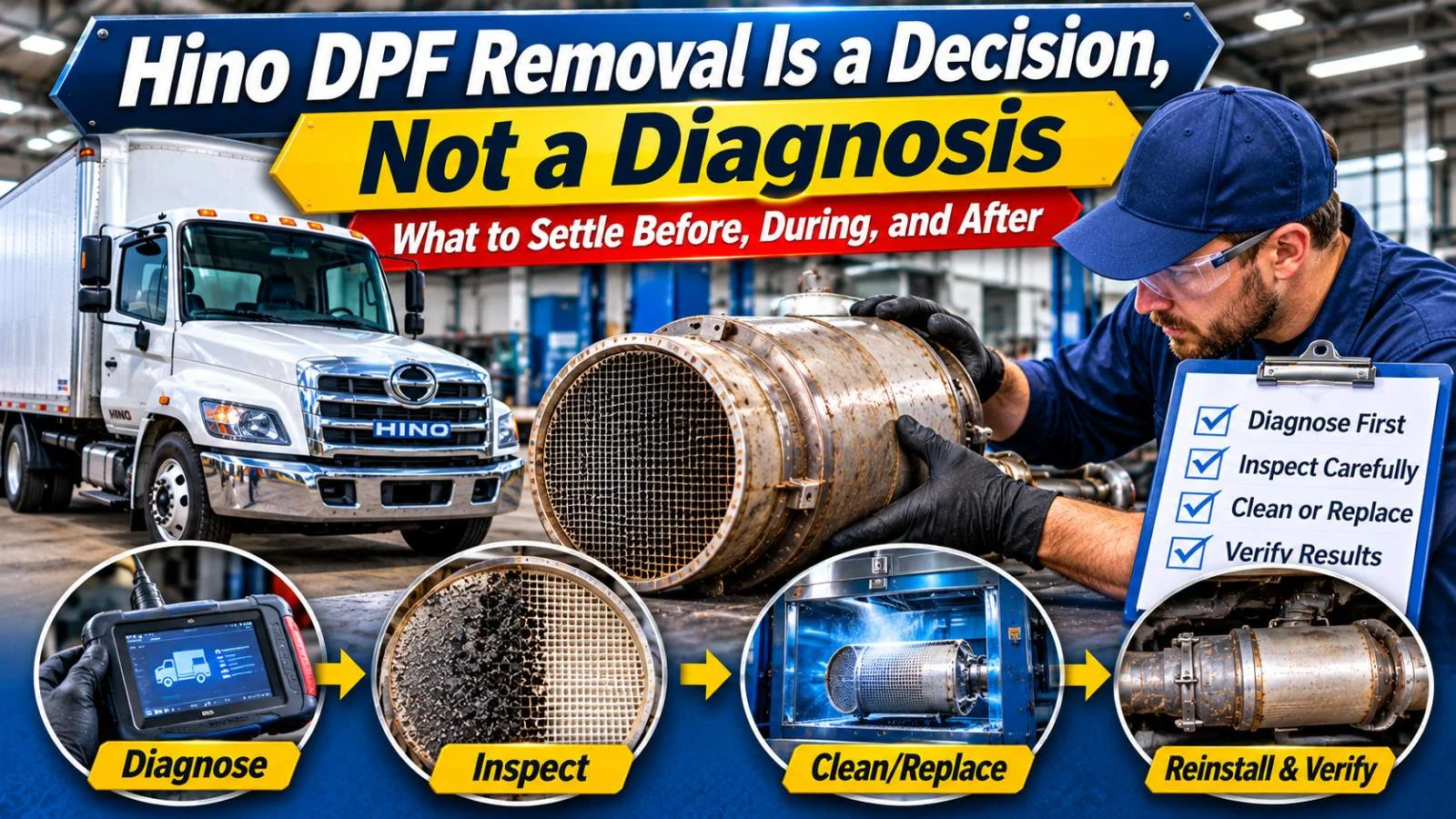
A Hino box truck starts logging a DPR warning on delivery routes, regeneration cycles seem to come around more often, and somebody in the shop suggests pulling the filter. Sometimes that is the right call. Often it is a step taken before the real cause has been identified. Knowing when Hino DPF filter removal in Virginia is justified, what a technician should examine once the filter is on the bench, and what must be confirmed after it goes back on the truck can spare a fleet both an unnecessary replacement and a repeat failure.
A Note on Terminology
Hino calls its particulate-filter system DPR, short for Diesel Particulate Reduction. Hino’s owner documentation describes it as a system that collects soot from the exhaust and burns it off once the collected amount passes a set level. Trade coverage of Hino’s earlier emissions-era trucks described the DPR as combining the filter and an oxidation catalyst in one unit.
That matters because a Hino DPF filter is part of a larger assembly, and layouts, sensors, and procedures are not identical across engines and model years. Anything specific to a particular truck belongs in that truck’s workshop manual, not in a general article.
Diagnosis Comes Before Removal
A warning light or frequent regeneration is a symptom, and Hino’s own service bulletins show how many different things can sit behind one.
A 2014 campaign bulletin for certain 2008–2010 models describes soot accumulating in the filter because of aging fuel injectors, with engine-control behavior that could misfire as a result. It paired an ECU software update with a visual check of the filter. A 2017 bulletin for 2011–2016 J08-equipped conventional trucks released new ECU software that changed how the truck responds to incomplete-regeneration codes and improved automatic regeneration during sustained high-speed driving.
Both documents are model-specific, so neither is a guide to your truck. The shared lesson is that a recurring regen problem can come from fueling, calibration, sensors, exhaust leaks, or duty cycles that never let a cycle finish.
A sound diagnostic pass reviews stored fault codes, regeneration history, and sensor data. It also checks for exhaust leaks and for any sign of oil or coolant reaching the exhaust. Removal makes sense when the evidence points at the filter itself: restriction that persists after successful regenerations, soot on the outlet side suggesting internal damage, contamination, or a damaged can or flange.
Removal Is Where Small Mistakes Start
Taking a Hino DPF off the truck involves more than unbolting a canister. Hino’s bulletin procedures, written for dealer technicians, show how many connected parts are involved: a temperature sensor connector, clamps, flange hardware, and adjoining muffler piping. All of them have to be disconnected and later restored correctly. Those procedures send technicians to the workshop manual for assembly and torque specifications, which is where those details belong. This article intentionally gives no removal steps, because they vary by model and should come from Hino’s documentation.
Sensors and Connectors
Temperature and pressure sensors sit close to the filter, and their wiring is easy to strain or forget. A disconnected or damaged sensor connection can set new codes that muddy the diagnosis. Hino’s final inspection checklist explicitly includes confirming that a disconnected DPF exhaust temperature sensor connector has been reconnected.
Clamps, Fasteners, and Gaskets
Hardware is where reinstalled filters often develop trouble. Fasteners should be torqued to the manufacturer’s value, not by feel, and sealing parts should be judged on condition rather than reused out of habit. A fatigued or mismatched clamp can leave an exhaust leak that skews the pressure readings the ECU relies on. That can produce fault codes pointing back at a filter that is actually fine.
Inspection Decides Between Cleaning and Replacement
Once the filter is off the truck, it needs a proper look before anyone cleans it. Hino’s campaign procedure for the affected 2008–2010 trucks starts at the tailpipe. If the tailpipe shows heavy soot, the technician checks the filter’s outlet face for heavy soot or melting, and a filter showing either is replaced rather than cleaned.
Industry guidance follows the same logic. Fleet Maintenance’s coverage of DPF inspection notes that soot on the exhaust side of a filter points to an internal crack. Technicians also look for fused or melted substrate, gouges, missing plugs, and damage to the can or flanges.
If the substrate is intact, the question becomes what is loading it. Soot can be burned off by regeneration. Ash, the residue of engine oil additives, cannot, and it takes physical cleaning to remove. Oil- or coolant-soaked filters are a different problem again, and cleaning one without fixing the source only resets the clock. Hino DPF filter cleaning is a reasonable path for an intact filter restricted by soot and ash. It is the wrong answer for a cracked or melted one.
Results will also differ from filter to filter, so no cleaning outcome should be assumed in advance. 30 Minute DPF Clean, for example, describes its Hino work as covering the filter alongside DOC, EGR, and SCR components, with an air flush and functional test after cleaning. That reflects the broader principle: the filter is judged as part of a system and verified afterward.
What to Confirm After Reinstallation
A filter that has been cleaned and bolted back on is not yet a finished job. The checks that matter:
- Hardware and connections: Fasteners torqued to Hino’s specified values, clamps seated properly, sensor connectors reconnected, and no leaks at the joints.
- Codes and stored data: Clear the codes left by the repair, and reset any counters or protection data the manufacturer’s procedure calls for. Dustin Carnes of Diesel Laptops has cautioned that resets performed when they aren’t needed can throw off a control module’s calculations.
- Regeneration: Hino’s own procedures use a diagnostic-tool DPR check with manual forced regeneration to verify operation. The right tool and steps depend on the model, so confirm that a regeneration actually completes.
- Follow-up: Watch regeneration frequency and warning lights over the following weeks.
Chase the Soot to Its Source
If excess soot is what loaded the filter, cleaning has treated a symptom. Short-trip or low-load duty that never lets exhaust temperatures climb, worn injectors, a failing EGR component or sensor, and oil entering the exhaust can all refill a freshly serviced filter. Carnes told Fleet Maintenance that most DPF replacements trace back to upstream problems or missed maintenance.
Fleets that log regeneration frequency and warning history before and after a service are better placed to see whether the fix held. If the same warnings return, the cause is probably still there.