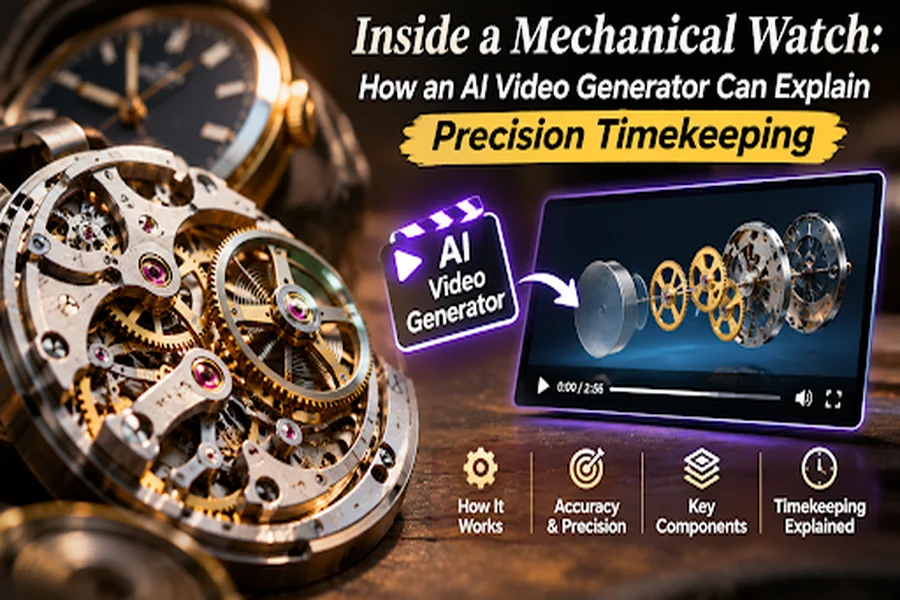
A mechanical watch can fit comfortably around a person’s wrist, yet its movement depends on a remarkable arrangement of tiny components. Gears transfer energy, springs regulate its release, and carefully coordinated parts keep the hands moving. For someone unfamiliar with watchmaking, understanding how these pieces work together can be difficult, especially when explanations rely only on technical diagrams or written descriptions.
An ai video generator can make this intricate subject easier to explore by turning individual mechanisms into visual explanations. Watchmaking educators, repair specialists, and horology enthusiasts can use moving sequences to introduce the parts, demonstrate their relationships, and explain why precision matters. The aim is not simply to make a watch look impressive, but to help viewers understand the engineering hidden beneath its dial.
Begin With the Movement Behind the Dial
Most people interact with a watch by checking the time, adjusting the crown, or fastening the strap. They rarely see the mechanism responsible for keeping time. An educational video can begin with this familiar experience before revealing the movement inside the case.
A visual transition from the watch face to its internal components gives viewers a reason to look more closely. The explanation can introduce the main parts without overwhelming the audience with technical terminology. A mainspring stores energy, gears transfer it, and the regulating mechanism controls how that energy is released. This gradual introduction creates a useful foundation. Once viewers understand the main purpose of each component, they are better prepared to follow the more detailed mechanics.
Follow the Energy From Spring to Hands
A mechanical watch does not depend on a battery in the same way a typical quartz watch does. In a traditional hand-wound model, turning the crown winds a mainspring, storing energy that is gradually released as the watch operates. Automatic watches also use movement from the wearer’s wrist to wind the spring through an internal winding system. A sequence can follow this energy through the movement. The mainspring releases force, the gear train transfers it, and the hands receive the motion through the appropriate wheel arrangement.
The advantage of animation is that it can make an otherwise hidden process visible. Viewers can follow the movement from one component to another instead of trying to imagine what happens inside a closed case. During visual planning, Dreamina can help explore a consistent presentation style, while the mechanical details should be checked against reliable watchmaking references.
Give the Escapement Its Own Explanation
One of the most important parts of a mechanical watch is the escapement. It controls how energy passes from the gear train to the balance wheel, releasing it in carefully timed intervals rather than allowing the stored energy to run out freely. This is a subject that benefits from a focused visual explanation. A video can show the interaction between the escape wheel and pallet fork, followed by the movement of the balance wheel. Instead of presenting all these parts at once, it can isolate each component and then bring them together to show their coordinated action.
This is also an opportunity to explain why the escapement matters. Its controlled operation helps establish the regular rhythm that allows the watch to measure time. Without this regulation, the stored energy would not produce the consistent movement expected from a mechanical timepiece.
Make Precision More Than a Technical Word
The word precision often appears in descriptions of fine watches, but viewers may not understand what it means in practical terms. A watch can have beautifully finished components and still require careful adjustment to maintain reliable timekeeping. Visual content can introduce the factors that influence performance, including friction, lubrication, temperature, component wear, and positional differences. A simplified comparison might show how a small change in the regulating system can affect the movement’s timing.
These explanations should avoid suggesting that every watch behaves identically. Construction, materials, condition, and design all influence performance. The purpose is to introduce the idea that accuracy depends on several interacting factors rather than one isolated component.
Show Why Watch Design Involves Trade-Offs
Watchmaking combines engineering with decisions about size, durability, appearance, and ease of maintenance. A slim movement may suit an elegant dress watch, while a different design may prioritize robustness or a longer power reserve. A visual comparison can help explain these choices. One scene might highlight the compact arrangement of components in a thin movement, while another shows how a larger design accommodates different features. A close-up of finishing can also introduce the craftsmanship involved in polishing, shaping, and decorating visible components.
The explanation should distinguish between appearance and function. Decorative finishing may contribute to a movement’s visual appeal, but it does not automatically determine its timekeeping performance. Showing both aspects helps audiences appreciate watchmaking as a balance of technical and artistic decisions.
Use Visuals Responsibly When Explaining Repairs
Watch repair involves delicate tools, specialist knowledge, and procedures that vary by movement. An educational video can introduce common maintenance concepts, such as the purpose of cleaning, lubrication, inspection, and adjustment. It can also show why dust or unsuitable handling may affect small mechanical parts. However, simplified visuals should not be treated as repair instructions. Opening a watch or attempting an internal repair without appropriate training can cause damage. Videos should make clear when a task belongs with a qualified watchmaker, particularly when it involves delicate components or specialized equipment.
Accuracy is especially important when generated scenes are used. Component shapes, their positions, and the direction of movement should be reviewed by someone familiar with the mechanism. An attractive but mechanically incorrect animation can leave viewers with a misleading understanding.
Help Curiosity Lead to Deeper Learning
A single video does not need to explain every feature of mechanical watchmaking. It can serve as an introduction that encourages viewers to explore more specific subjects, such as automatic winding, power reserve, complications, or movement finishing.
A series of short lessons can build knowledge in a natural order. Beginners might start with the basic energy path, then move to the escapement and regulating system. More experienced audiences could explore differences between movement designs or learn about the work involved in servicing a timepiece. This approach makes complex information easier to revisit. Viewers can return to the explanation they need instead of searching through one long presentation.
Final Thoughts
An AI video generator can help reveal the engineering that makes a mechanical watch work. By showing how energy moves through the mechanism, explaining the escapement, and exploring the factors behind precision, visual storytelling can make watchmaking more accessible to a wider audience. Its value depends on clear explanations and mechanically accurate visuals. When technical knowledge guides the creative process, even the smallest components can become easier to understand and appreciate.
Frequently Asked Questions
What makes a mechanical watch different from a quartz watch?
A mechanical watch uses stored energy from a wound mainspring and a mechanical regulating system. A quartz watch generally uses a battery and an electronic oscillator to keep time.
Why is the escapement important?
The escapement controls the release of energy from the gear train and works with the balance wheel to regulate the movement of a mechanical watch.
Can animated videos accurately show tiny watch components?
They can illustrate the mechanisms, but the component shapes, positions, and movements should be reviewed by a watchmaking specialist before publication.
Are educational watch videos suitable for people with no technical background?
Yes. Starting with familiar ideas and introducing components gradually can make the subject understandable without requiring prior watchmaking knowledge.
Can a video teach someone to repair a mechanical watch?
It can introduce repair concepts and explain the tools and expertise involved, but it should not replace professional training or qualified servicing.