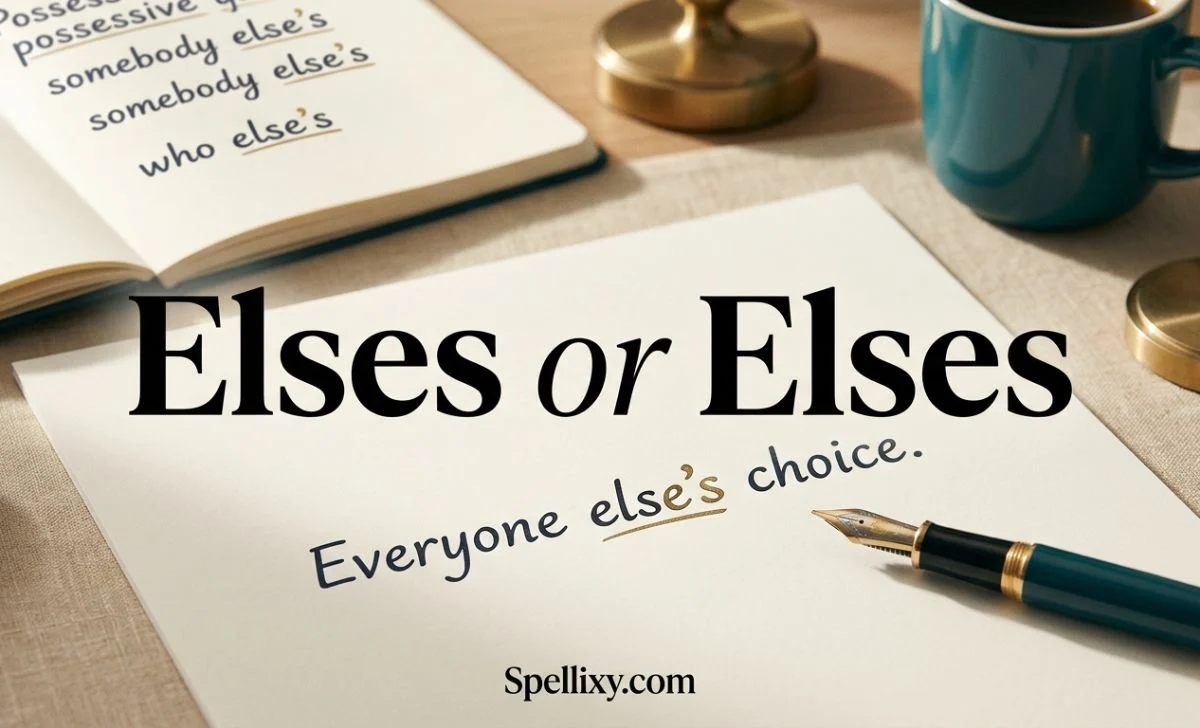
The words else’s and elses can be confusing because they look almost identical, but the apostrophe makes a difference.
If you want to show that something belongs to another person, you need the correct possessive form.
For example, you might write someone else’s phone, somebody else’s idea, or no one else’s responsibility.
These expressions are common in everyday English, emails, school assignments, and professional writing. Understanding the spelling rule will help you avoid mistakes and make your sentences clearer.
In this guide, you’ll learn when to use else’s, why elses is usually incorrect in possessive expressions, and how to apply the rule through clear examples.
Quick Answer:
Use else’s to show possession, as in “someone else’s phone.” The spelling elses is incorrect when you mean that something belongs to another person because it leaves out the apostrophe.
| Form | Meaning | Example |
|---|---|---|
| Else | Other or additional | What else do you need? |
| Else’s | Shows possession in a phrase | Someone else’s bag is here. |
| Elses | Not the standard possessive form | Write “someone else’s book,” not “someone elses book.” |
In most cases, elses is simply a missing apostrophe when the writer intends to show possession.
Why Is It “Someone Else’s” and Not “Someone Elses”?
The phrase someone else means another person. To show that something belongs to that person, add the possessive marker to the last word of the phrase. That gives you someone else’s.
For example:
- Someone else’s coat was left by the door.
- Somebody else’s name was on the package.
- Anyone else’s opinion may be different.
- No one else’s password should be on this list.
The same pattern works with everyone else, anyone else, somebody else, and nobody else. The first word changes according to the meaning, but the possessive form remains consistent.
Compare these sentences:
Correct: I accidentally took someone else’s umbrella.
Incorrect: I accidentally took someone elses umbrella.
The first sentence shows that the umbrella belongs to another person. The second is missing the apostrophe.
Can You Leave Out the Noun After “Else’s”?
Yes. You can leave out a noun when its meaning is already clear from the sentence. This avoids unnecessary repetition.
For example:
- My answer was different from everyone else’s.
This means your answer was different from everyone else’s answer. Since the word answer is understood, you do not need to write it twice.
Here are two more examples:
- My desk is clean, but somebody else’s is covered with papers.
- Her presentation was longer than anyone else’s.
In both examples, the reader can work out which noun has been omitted. The possessive form stays the same.
Does “Else” Have a Plural Form?
In ordinary English, else does not have a standard plural form such as elses. It usually appears after words such as who, what, someone, anyone, and everyone.
Consider these examples:
- Who else is coming to the meeting?
- Is there anything else to discuss?
- Everyone else has already left.
In these sentences, else means another person, thing, or option. It does not need a plural ending.
If you want to refer to several other people, use a suitable expression such as others or other people. For example, instead of writing “The elses were waiting,” write “The others were waiting.”
Common Mistakes With Else’s and Elses
The most common error is forgetting the apostrophe. Another mistake is putting the apostrophe after the s instead of before it.
| Incorrect | Correct | Explanation |
|---|---|---|
| Someone elses phone is ringing. | Someone else’s phone is ringing. | The apostrophe shows possession. |
| I followed somebody elses advice. | I followed somebody else’s advice. | The advice belongs to another person. |
| No one elses business matters here. | No one else’s business matters here. | The possessive form needs an apostrophe. |
| Everyone elses plans changed. | Everyone else’s plans changed. | The apostrophe is missing. |
| This is anyone elses’ problem. | This is anyone else’s problem. | The apostrophe goes before the s, not after it. |
A useful proofreading tip is to check the meaning of the entire phrase. If you are talking about something that belongs to another person, look for the possessive marker at the end of the expression.
For example, someone else’s decision refers to a decision made by another person, while someone else made the decision describes who performed the action. The apostrophe changes the grammatical role of the phrase.
FAQs
1. Is “else’s” a word?
Else’s is the possessive form used in expressions such as someone else’s phone and everyone else’s opinion. It shows that something belongs to another person or group.
2. What does “elses” mean?
Elses is not the standard spelling for possession in phrases such as someone else’s book. When used this way, it usually indicates that the writer has omitted the apostrophe.
3. What does “anyone else’s” mean?
It refers to something belonging to any other person. For example, “You should not use anyone else’s account without permission” means that you should not use an account belonging to another person without permission.
4. Is “everyone else’s” correct?
Yes. For example, “Everyone else’s work was ready before noon” means the work belonging to all the other people was ready before noon.
5. How do you pronounce “else’s”?
Else’s is pronounced roughly “EL-siz,” with the stress on the first syllable.
6. Can I write “elses’” with the apostrophe after the s?
No. The correct form is else’s. The apostrophe comes before the s.
7. What is the difference between “someone else” and “someone else’s”?
Someone else means another person. Someone else’s shows possession.
For example, “Someone else took my seat” means another person took it. “That is someone else’s seat” means the seat belongs to another person.
Conclusion
Choosing between else’s and elses becomes easier when you understand how possession works in English.
Use else’s in phrases such as someone else’s phone, somebody else’s idea, and no one else’s responsibility.
The apostrophe and s show ownership, even when the noun is left out because its meaning is already clear.
Avoid elses and elses’ when you intend to show possession in these expressions. When referring to other people or things, use a natural alternative such as others or other people.
With this rule in mind, you can write these phrases accurately and avoid a common spelling mistake.
Discover More Blogs :
- Whether or Wether: Learn the Difference Through Sentences
- Molding or Moulding: US and UK Spelling Explained
- Win or Lose Characters: Names and Pictures Meet the Main Cast
- Shiny or Shiney: Which Version Belongs in Your Writing?
- Comradery or Camaraderie: The Spelling Behind Team Spirit
- Useable or Usable: Why English Uses Both