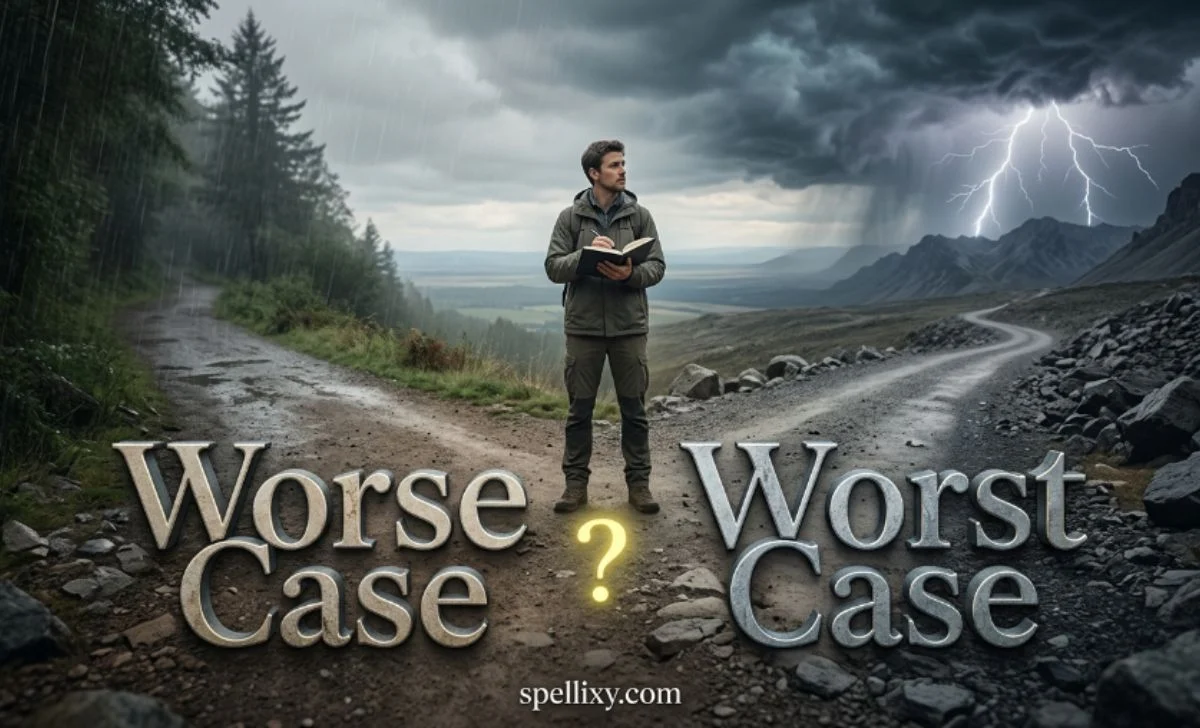
Have you ever written “worse case” and wondered if it sounds correct? You are not alone. Many English learners and even native speakers confuse worse and worst because both words describe negative situations.
However, they are not used in the same way. The correct phrase is “worst case,” not “worse case.” This small grammar difference can change the meaning of your sentence.
In this guide, you will learn the difference between worse and worst, understand why worst-case scenario is the correct expression, see real examples, and learn how to avoid this common English mistake. By the end, choosing the right word will become simple.
Worse Case or Worst Case – Quick Answer
The correct phrase is “worst case.” The phrase “worse case” is generally considered incorrect because worse is a comparative adjective, while worst is a superlative adjective.
We use worse when comparing two things or situations. We use worst when talking about the highest level of something bad, usually among three or more possibilities or an extreme situation.
A worst-case scenario means the most negative possible outcome that could happen.
Examples:
- We need to prepare for the worst-case scenario. ✅
- The project failed in the worst case. ✅
- The weather could get worse tomorrow. ✅
- This is the worst problem we have faced. ✅
Incorrect:
- We need a plan for the worse case scenario. ❌
Correct:
- We need a plan for the worst-case scenario. ✅
The confusion happens because people think “worse” means “more bad,” so they use it before “case.” However, when talking about the most negative possible situation, the correct word is worst.
Correct Examples
Here are some correct examples using worst case and worst-case scenario:
- In the worst case, we may lose the entire investment.
- The company prepared for the worst-case scenario.
- What is the worst case if this plan does not work?
- The doctor explained the worst possible outcome to the patient.
- We should always consider the worst-case situation before making a decision.
In professional fields, worst-case scenario is commonly used for planning and risk management.
Examples:
Business:
- Managers create backup plans for the worst-case scenario.
Technology:
- Developers test how software behaves in the worst-case situation.
Finance:
- Investors analyze the worst-case outcome before investing money.
Emergency Planning:
- Authorities prepare for the worst-case event during natural disasters.
The phrase is widely accepted in formal and informal English.
Incorrect Examples
These examples show common mistakes:
- We should prepare for the worse case scenario. ❌
Correct:
- We should prepare for the worst-case scenario. ✅
- This is the worse case we have ever seen. ❌
Correct:
- This is the worst case we have ever seen. ✅
- The company planned for the worse possible outcome. ❌
Correct:
- The company planned for the worst possible outcome. ✅
- This problem is worse than the previous one, so it is the worse case. ❌
Correct:
- This problem is worse than the previous one, but it is not the worst case. ✅
Remember:
Worse = more bad than something else
Worst = the most bad or the highest level of difficulty
What Do Worse and Worst Mean?
To understand why worst case is correct, you first need to understand the meanings of worse and worst.
Both words come from the adjective bad, but they have different grammar functions.
The basic comparison is:
Bad → Worse → Worst
This is called the degree of comparison in English grammar.
- Bad = negative quality
- Worse = more negative than another thing
- Worst = the most negative among all options
Understanding this pattern removes most confusion.
Meaning of Worse
Worse is the comparative form of bad.
We use it when comparing two people, things, conditions, or situations.
The meaning is:
Worse = more unpleasant, more serious, or lower in quality than something else
Examples:
- My headache is worse today than yesterday.
- The traffic is worse during the evening.
- This situation is worse than we expected.
- The second version of the product is worse than the first.
In each example, two things are being compared:
- Today vs yesterday
- Evening traffic vs normal traffic
- Current situation vs expectation
- Second version vs first version
That is why worse is used.
You can often identify worse by looking for comparison words such as:
- than
- compared with
- compared to
- before and after
- another
Examples:
- This problem is worse than the previous one.
- The new results are worse compared to last year.
However, worse does not mean “the most bad.” It only means something has become more negative compared with another thing.
Meaning of Worst
Worst is the superlative form of bad.
We use it when describing the highest or extreme level of something negative.
The meaning is:
Worst = the most unpleasant, most serious, or least favorable option
Examples:
- This is the worst day of my life.
- That was the worst mistake I ever made.
- The worst case is losing all the data.
- She experienced the worst possible outcome.
Unlike worse, worst does not compare only two things. It refers to the highest level in a group or an extreme possibility.
Examples:
Comparison:
- Monday was bad.
- Tuesday was worse.
- Wednesday was the worst.
Here:
- Bad = normal negative situation
- Worse = more negative than Monday
- Worst = the most negative of all three days
This is why we say:
✅ Worst case scenario
❌ Worse case scenario
Because a worst-case scenario represents the most negative possible result.
Worse vs Worst Comparison Table
| Word | Grammar Form | Meaning | Example |
|---|---|---|---|
| Bad | Base adjective | Negative condition | This is a bad situation. |
| Worse | Comparative adjective | More negative than another | This situation is worse than before. |
| Worst | Superlative adjective | Most negative possible | This is the worst situation. |
The easiest way to remember:
Two things → Worse
The highest level → Worst
Examples:
- My old phone was bad, but my new phone is worse.
- This is the worst phone I have ever used.
Why Is “Worst Case” Correct?
The phrase “worst case” is correct because it describes the most negative possible situation. The word worst works here because it shows the highest degree of something bad.
In English grammar, adjectives often have three forms:
- Bad → Worse → Worst
The word bad describes something negative.
The word worse compares one negative thing with another.
The word worst describes the final or highest level of negativity.
A worst case means the situation where everything goes as badly as possible.
Examples:
- The worst case is that we lose the entire project.
- In the worst case, the company may close.
- The worst case scenario involves complete data loss.
- Doctors explained the worst possible outcome.
The phrase does not compare two cases. Instead, it describes the most serious possibility. That is why worst is needed.
Why “Worse Case” Is Incorrect
The phrase “worse case” is a common mistake because people remember that worse means something bad becoming more serious. However, worse requires a comparison.
For example:
- This problem is worse than yesterday’s problem.
- The second option is worse than the first option.
In both examples, two things are compared.
But in worst case, there is no direct comparison. It refers to the final or most extreme possibility.
Incorrect:
- We should prepare for the worse case. ❌
Correct:
- We should prepare for the worst case. ✅
Incorrect:
- What is the worse case scenario? ❌
Correct:
- What is the worst-case scenario? ✅
A simple memory trick:
Worse = compared with something else
Worst = the final level or maximum problem
What Is a Worst-Case Scenario?
A worst-case scenario means the most unfavorable situation that could happen. It is used when people plan for possible risks and imagine the most serious outcome.
The phrase is common in:
- Business planning
- Finance
- Project management
- Software development
- Emergency preparation
- Healthcare
- Decision-making
A worst-case scenario does not mean that the situation will definitely happen. It only describes the most negative possibility so people can prepare for it.
For example:
A business owner may ask:
“What is the worst-case scenario if sales decrease?”
The answer could be:
“The company may need to reduce expenses or close some operations.”
This does not mean the company will fail. It simply helps the owner create a backup plan.
Worst-Case Scenario Meaning
The meaning of worst-case scenario is:
The most serious or unfavorable possible outcome in a situation.
Breaking the phrase down:
- Worst = most bad or most negative
- Case = situation or example
- Scenario = possible future event
Together:
Worst-case scenario = the most negative possible situation that could happen
Examples:
- The worst-case scenario is losing all important files.
- Engineers tested the system for the worst-case scenario.
- Emergency teams prepare for worst-case scenarios.
- Investors consider the worst-case scenario before making decisions.
How to Spell Worst-Case Scenario
Many people ask whether it should be written as one word or two.
The correct spelling is:
✅ worst-case scenario
The word worst-case is usually hyphenated because it works together as a compound adjective describing the noun scenario.
Examples:
- We prepared a worst-case scenario plan. ✅
- The company created a worst-case strategy. ✅
Without the hyphen, the meaning can become less clear:
- We prepared a worst case scenario.
Although many people write it this way informally, the hyphenated form is preferred in professional and edited writing.
When the phrase is not directly describing another noun, the hyphen may not always be needed.
Example:
- The worst case is that we lose money.
Here, worst case is acting as a noun phrase, so no hyphen is necessary.
Worst Case vs Worse Case Comparison
The difference between these two phrases is mainly about grammar.
| Feature | Worst Case | Worse Case |
|---|---|---|
| Correct usage | ✅ Correct | ❌ Usually incorrect |
| Grammar form | Superlative | Comparative |
| Meaning | Most negative situation | A comparison, not a fixed phrase |
| Common phrase | Worst-case scenario | Not standard English |
| Example | Prepare for the worst case | Avoid using this phrase |
Worst Case Examples
- We must prepare for the worst case.
- The worst case would be a complete system failure.
- The team created a plan for the worst-case scenario.
- They calculated the worst possible outcome.
Why People Use “Worse Case”
Many people say “worse case” because they connect the phrase with something becoming worse. The logic seems reasonable, but English grammar requires the correct comparison form.
For example:
Correct:
- The weather is worse today than yesterday.
Incorrect:
- This is the worse case scenario.
The second sentence needs worst because it describes the most extreme case.
Best-Case vs Worst-Case Scenario
The opposite of a worst-case scenario is a best-case scenario.
These phrases are often used together in planning and decision-making.
| Type | Meaning | Example |
|---|---|---|
| Best-case scenario | Most positive possible outcome | Sales increase quickly |
| Average-case scenario | Most likely outcome | Sales remain stable |
| Worst-case scenario | Most negative possible outcome | Business loses money |
Companies often analyze all three possibilities before making important decisions.
For example:
A company launching a new product may consider:
Best case:
- High customer demand
- Strong profits
- Rapid growth
Average case:
- Moderate sales
- Normal market response
- Expected profits
Worst case:
- Low demand
- Financial losses
- Product failure
This type of planning is called scenario analysis or risk assessment.
Worst-Case Decision-Making
Worst-case thinking is a method used to prepare for risks before they happen. It helps people make safer decisions by considering possible problems.
This approach is common in:
- Business strategy
- Financial planning
- Engineering
- Healthcare decisions
- Emergency management
For example:
A software company may ask:
“What is the worst-case scenario if the system crashes?”
Possible answer:
“Customers may lose access to their accounts.”
The company can then create solutions such as:
- Data backups
- Security systems
- Recovery plans
- Customer support procedures
Worst-case decision-making does not mean expecting failure. Instead, it helps people become prepared.
Word History of Worse and Worst
The words worse and worst have a long history in the English language. Both come from the Old English word wyrsa, meaning “more bad” or “inferior.”
Over time, English developed different forms to show comparison:
- Bad → Worse → Worst
This pattern is called an irregular adjective comparison because the words do not follow the usual rule of adding -er and -est.
Regular example:
- Small → Smaller → Smallest
Irregular example:
- Bad → Worse → Worst
Because these forms developed naturally over centuries, many speakers confuse them today.
The confusion is especially common in phrases like:
- Worst case
- Worst-case scenario
- Worse than before
Understanding their grammar history helps explain why the correct phrase is worst case, not worse case.
How to Use Worse and Worst in Sentences
Understanding the difference between worse and worst becomes easier when you see how they work in real sentences. Both words describe negative situations, but the level of negativity is different.
Use worse when something becomes more negative compared with another thing. Use worst when something reaches the highest level of negativity or represents the most serious possibility.
Worse in Sentences
Worse is used when comparing two conditions, situations, or things.
Examples:
- My cold is worse today than yesterday.
- The traffic is worse during rush hour.
- This problem is worse than we expected.
- The second version of the software is worse than the original.
- The weather became worse after the storm arrived.
Notice that each example compares one thing with another:
- Today vs yesterday
- Rush hour vs normal traffic
- Current problem vs expectation
- New version vs original version
A useful clue is the word “than.” Many sentences with worse include a comparison.
Examples:
- This option is worse than the previous one.
- The results are worse than last year.
However, worse can also be used without “than” when the comparison is understood.
Example:
- The situation is getting worse.
Here, the meaning is that the situation is becoming more negative compared with its earlier condition.
Worst in Sentences
Worst is used for the highest level of something bad. It describes the most serious, extreme, or unfavorable situation.
Examples:
- This is the worst mistake I have ever made.
- That was the worst experience of my life.
- Losing all customer data would be the worst outcome.
- This is the worst weather we have seen this year.
- The company prepared for the worst possibility.
In these examples, there is no simple comparison between two things. Instead, the word shows the maximum negative level.
A common pattern is:
- The worst + noun
Examples:
- The worst situation
- The worst outcome
- The worst result
- The worst mistake
- The worst scenario
Worst Case in Sentences
The phrase worst case is used when discussing the most negative possible result.
Examples:
- In the worst case, we may need to cancel the project.
- The worst case is that the company loses money.
- What is the worst case if the plan fails?
- We should always prepare for the worst case.
When worst-case works as an adjective before another noun, use a hyphen.
Examples:
- A worst-case scenario
- A worst-case estimate
- A worst-case analysis
- A worst-case plan
The hyphen helps readers understand that worst-case describes the noun that follows.
Worst-Case Scenario in Everyday Writing
The phrase worst-case scenario is widely used because people often need to think about possible risks. It appears in casual conversations as well as professional documents.
People use it when they want to ask:
“What is the most negative thing that could happen?”
Emails
In professional emails, people often discuss risks, delays, or possible problems.
Examples:
- In the worst-case scenario, delivery may be delayed by two weeks.
- We should prepare for the worst-case situation before starting the project.
- The worst-case outcome would affect our deadline.
Using this phrase helps communicate risks clearly without causing unnecessary fear.
Business Writing
Businesses frequently use worst-case analysis to understand possible challenges.
Companies consider:
- Financial losses
- Market changes
- Customer complaints
- Supply problems
- Project delays
Examples:
- The management team reviewed the worst-case scenario before launching the product.
- The company created backup plans for worst-case situations.
- Investors study the worst-case outcome before making decisions.
Risk planning helps businesses make better decisions because they understand possible problems before they occur.
News Writing
News articles often use worst-case scenario when discussing disasters, emergencies, or uncertain events.
Examples:
- Officials prepared for the worst-case scenario during the storm.
- Experts explained the worst possible outcome of the crisis.
- The report examined the worst-case effects of the event.
Journalists use this phrase carefully because it describes a possibility, not a guaranteed result.
School Writing
Students may use worst-case scenario in essays, projects, and research assignments.
Examples:
- The essay discusses the worst-case effects of climate change.
- The project explains possible risks and worst-case outcomes.
- Researchers considered the worst-case results of the experiment.
In academic writing, the phrase should be used accurately and not exaggerated.
Technical Writing
Software developers, engineers, and scientists often use worst-case analysis.
Examples:
- Engineers tested the machine under worst-case conditions.
- Developers measured worst-case performance.
- The system was designed to handle worst-case situations.
In computer science, worst-case analysis is especially important because it measures how a system performs under the most demanding conditions.
Common Mistakes with Worse and Worst
Many English learners confuse these words because they have similar meanings. However, a few simple rules can prevent most mistakes.
Frequent Errors
Mistake 1: Using worse for the highest level
Incorrect:
- This is the worse mistake I have made. ❌
Correct:
- This is the worst mistake I have made. ✅
Why?
Because it describes the most serious mistake, not a comparison.
Mistake 2: Writing worse case scenario
Incorrect:
- We need to prepare for the worse case scenario. ❌
Correct:
- We need to prepare for the worst-case scenario. ✅
Why?
Because the phrase means the most negative possible scenario.
Mistake 3: Confusing comparison with maximum level
Incorrect:
- Today is the worst than yesterday. ❌
Correct:
- Today is worse than yesterday. ✅
Why?
Because two days are being compared.
Mistake 4: Using worst when comparing two things
Incorrect:
- This option is worst than the other one. ❌
Correct:
- This option is worse than the other one. ✅
Why?
Because the sentence compares two options.
Corrected Examples
| Incorrect | Correct |
|---|---|
| This is the worse situation. | This is the worst situation. |
| The weather is worst than yesterday. | The weather is worse than yesterday. |
| Prepare for the worse case. | Prepare for the worst case. |
| This was the worse day of my life. | This was the worst day of my life. |
| The second result is worst than the first. | The second result is worse than the first. |
Practice Exercises: Worse or Worst?
Practice helps you remember when to use each word.
Choose the correct option:
1. This is the _____ mistake I have ever made.
A) Worse
B) Worst
Answer: Worst
2. My headache is _____ today than yesterday.
A) Worse
B) Worst
Answer: Worse
3. The company prepared for the _____-case scenario.
A) Worse
B) Worst
Answer: Worst
4. This situation is _____ than before.
A) Worse
B) Worst
Answer: Worse
5. Losing all files would be the _____ possible outcome.
A) Worse
B) Worst
Answer: Worst
Simple Rule to Remember
Ask yourself:
Am I comparing two things?
→ Use worse
Example:
- This movie is worse than the first one.
Am I talking about the highest or most extreme level?
→ Use worst
Example:
- This is the worst movie I have ever seen.
Related Grammar Rules
The confusion between worse and worst is part of a larger grammar topic called comparative and superlative adjectives. Many English words change form when we compare things or describe the highest level.
Understanding these patterns can help you avoid similar mistakes.
Comparative vs Superlative Adjectives
Comparative adjectives are used when comparing two things.
Examples:
- My old phone is better than my previous one.
- This problem is worse than yesterday.
- The second option is cheaper than the first.
Superlative adjectives are used when describing the highest or lowest level among several things.
Examples:
- This is the best phone I have used.
- This is the worst mistake I have made.
- It was the cheapest option available.
Common comparison patterns:
| Base Form | Comparative | Superlative |
|---|---|---|
| Good | Better | Best |
| Bad | Worse | Worst |
| Little | Less | Least |
| Far | Farther/Further | Farthest/Furthest |
The word bad follows an irregular pattern:
Bad → Worse → Worst
Because it does not use the normal -er and -est endings, many learners find it confusing.
Similar Grammar Mistakes
Many English users confuse words that have similar meanings but different grammar rules.
Better vs Best
Incorrect:
- This is the better restaurant I have visited. ❌
Correct:
- This is the best restaurant I have visited. ✅
Use better for comparison:
- This restaurant is better than the other one.
Use best for the highest level:
- This is the best restaurant in the city.
Less vs Least
Incorrect:
- This is the less expensive option available. ❌
Correct:
- This is the least expensive option available. ✅
Use:
- Less = smaller amount compared with something else
- Least = smallest amount among all options
Farther vs Farthest
Incorrect:
- This is the farthest than that location. ❌
Correct:
- This location is farther than the other one. ✅
Use farther for comparison and farthest for the maximum distance.
Later vs Latest
Incorrect:
- This is the later news update. ❌
Correct:
- This is the latest news update. ✅
Use:
- Later = after another time
- Latest = most recent
FAQs
1. Which is correct, worse or worst?
Both words are correct, but they have different uses. Worse is used for comparing two things, while worst describes the highest level of something bad.
2. Which is correct, worse case or worst case?
The correct phrase is worst case. “Worse case” is not the standard phrase because worse needs a comparison.
3. What does worst case mean?
Worst case means the most negative possible situation or outcome that could happen.
4. What is a worst-case scenario?
A worst-case scenario is the most unfavorable situation that people consider when planning for risks or problems.
5. How do you spell worst-case scenario?
The preferred spelling is worst-case scenario with a hyphen because “worst-case” works as a compound adjective.
6. Is worst case one word or two?
Worst case is usually written as two words when it acts as a noun phrase. When it describes another noun, it is usually hyphenated as worst-case.
7. Is “worse case” grammatically correct?
No. “Worse case” is generally considered incorrect because the phrase refers to the most extreme situation, which requires worst.
8. What does worst mean?
Worst means the most bad, most serious, or least favorable among several options.
9. What does worse mean?
Worse means more bad, more serious, or lower in quality compared with something else.
10. What is the difference between worse and worst?
Worse compares two things, while worst describes the highest level of negativity.
Example:
- This problem is worse than yesterday.
- This is the worst problem we have faced.
11. When should I use worse?
Use worse when one thing is more negative than another.
Example:
- My condition is worse than before.
12. When should I use worst?
Use worst when describing the most serious or extreme situation.
Example:
- This is the worst outcome possible.
13. Why is “worst case” correct?
Because it describes the most negative possible case, not a comparison between two cases.
14. Why do people say “worse case” instead of “worst case”?
People often confuse the words because both relate to negative situations. However, grammar requires worst for the highest level.
15. What is the best-case and worst-case scenario?
A best-case scenario describes the most positive possible result, while a worst-case scenario describes the most negative possible result.
16. What is meant by a worst-case scenario?
It means the most serious possible event or outcome that could happen in a situation.
17. How do you use “worst case” in a sentence?
Examples:
- In the worst case, we may need to restart the project.
- The worst case would be losing all important data.
18. How do you use “worse” in a sentence?
Examples:
- The weather is worse today than yesterday.
- The situation became worse after the delay.
19. How do you use “worst” in a sentence?
Examples:
- That was the worst decision I ever made.
- This is the worst possible result.
20. Is it “10 times worse” or “10 times worst”?
The correct phrase is 10 times worse because it compares one level with another.
Example:
- The problem is 10 times worse than before.
21. Is “worst-case” hyphenated?
Yes, when it comes before a noun, use a hyphen.
Example:
- A worst-case scenario
22. What is the opposite of a worst-case scenario?
The opposite is a best-case scenario, which means the most positive possible outcome.
23. What is worst-case decision-making?
Worst-case decision-making means considering the most negative possible outcome before making a choice.
24. What are some examples of worst-case scenarios?
Examples include:
- Losing important data
- A business failing
- A project being cancelled
- A system completely crashing
25. Can I use “worse case” in formal writing?
No. Avoid “worse case” in formal writing. Use worst case or worst-case scenario instead.
Conclusion
The correct phrase is “worst case,” not “worse case.” The difference is simple: worse is used when comparing two things, while worst describes the most extreme or negative situation.
A worst-case scenario means the most unfavorable possible outcome and is commonly used in business, planning, technology, and everyday conversations.
Many people confuse these words because they both come from the adjective bad, but remembering the pattern bad → worse → worst makes the rule easier.
Always use worse for comparisons and worst for the highest level. By following this simple grammar rule, your writing will become clearer, more accurate, and more professional.