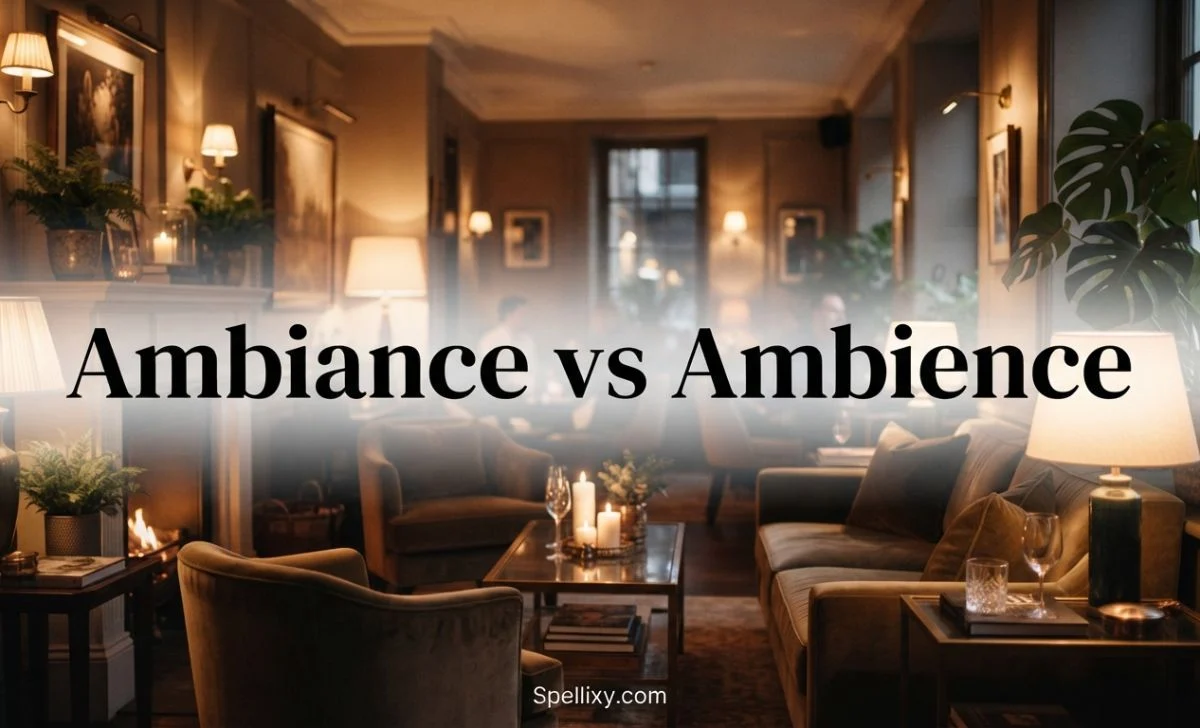
Ambiance and ambience are two accepted spellings of the same word. Both describe the atmosphere, mood, or character of a place or situation.
If you are unsure which spelling to use, you can use either one. The choice is mainly about spelling and style, not meaning.
Quick Answer
Ambiance and ambience mean the same thing. Both are nouns used to describe the atmosphere or character of a place or situation.
For example:
The restaurant has a warm and relaxing ambience.
You can also write:
The restaurant has a warm and relaxing ambiance.
Both sentences are correct.
Major dictionaries support this usage. Cambridge Dictionary: ambience lists ambiance as an alternative spelling, while Oxford Learner’s Dictionaries: ambience does the same.
Ambiance vs Ambience Meaning
Ambiance and ambience mean the overall atmosphere or character of a place or situation.
A place’s ambience can come from many details, including:
- lighting
- music
- decoration
- colors
- furniture
- sounds
- layout
- general mood
For example, a café with soft lights, quiet music, and comfortable chairs may have a cozy ambience.
A busy café with bright lights and loud music may have a lively ambiance.
The word describes the overall effect of these details rather than just one feature.
What does ambiance mean?
Ambiance means the atmosphere or character of a place.
The hotel has a peaceful ambiance.
This means the hotel creates a peaceful atmosphere.
What does ambience mean?
Ambience has the same meaning as ambiance.
The small café has a warm and welcoming ambience.
You could replace ambience with ambiance without changing the meaning.
Ambiance vs Ambience: Which Is Correct?
Both ambiance and ambience are correct.
They are alternative spellings of the same noun. Cambridge and Oxford both list ambiance alongside ambience.
So, this is correct:
The hotel has a beautiful ambience.
And this is also correct:
The hotel has a beautiful ambiance.
There is no need to “correct” one to the other.
If you are writing an article, report, or website, the best approach is to choose one spelling and use it consistently.
Is Ambiance American or British?
Ambiance is not exclusively American, and ambience is not exclusively British.
It is sometimes described as an American spelling, but that simple rule can be misleading. Both spellings are used in English, and major dictionaries recognize ambiance as an alternative to ambience.
Cambridge, for example, lists both forms in its English and American dictionary entries.
So you should not assume:
American English = ambiance
British English = ambience
That is too strict.
If you are following a particular publication’s style guide, use the spelling that guide prefers. Otherwise, either spelling is acceptable.
Ambiance vs Ambience Examples
Here are natural examples using both spellings:
The restaurant has a warm and welcoming ambiance.
We loved the peaceful ambience of the garden.
Soft music created a relaxing ambiance.
The café is popular for its cozy ambience.
The hotel has an elegant ambiance.
The lighting gives the room a romantic ambience.
In these examples, ambiance and ambience could be switched without changing the basic meaning.
Ambiance vs Ambience Pronunciation
The two spellings can be pronounced in different ways depending on the speaker, accent, and reading style.
For ambience, Cambridge gives different UK and US pronunciations, while its American entry also records a more French-influenced pronunciation for the word.
For ambiance, some speakers use a more French-influenced pronunciation, but spelling does not decide how you must say the word.
In other words, AHM-bee-AHNS can be heard as a French-influenced pronunciation, but it should not be presented as the one fixed pronunciation of ambiance.
The pronunciation can vary naturally between speakers.
Ambiance vs Ambience Synonym
Depending on the context, useful synonyms include:
- atmosphere
- mood
- vibe
- feel
- character
- tone
- setting
For example:
The café has a relaxed ambience.
You could also say:
The café has a relaxed atmosphere.
In casual English, vibe may work well:
This café has a great vibe.
These words overlap, but they are not always perfect replacements.
What Is the Difference Between Atmosphere and Ambience?
Atmosphere and ambience can both describe the mood or character of a place.
The restaurant has a friendly atmosphere.
The restaurant has a friendly ambience.
Both sentences describe the feeling or character of the restaurant.
However, atmosphere has other meanings too. For example, it can refer to the layer of gases surrounding a planet.
Ambience is more specifically used for the character or atmosphere of a place or situation.
What Is the Difference Between Ambient and Ambience?
Ambient and ambience are related words, but they have different grammatical roles.
Ambient is usually an adjective. It describes something related to the surrounding area or conditions.
Ambience is a noun that means the atmosphere or character of a place.
Compare these sentences:
The restaurant has a relaxing ambience.
The restaurant uses soft ambient lighting.
In the first sentence, ambience names the atmosphere.
In the second, ambient describes the lighting.
A simple way to remember the difference is:
ambience = atmosphere
ambient = surrounding
What Is an Example of Ambiance?
Imagine a small restaurant with warm lights, wooden tables, soft music, and quiet background noise.
You could say:
The restaurant has a warm and cozy ambiance.
The word ambiance describes the combined atmosphere created by those details.
The same sentence works with ambience:
The restaurant has a warm and cozy ambience.
What Is a Fancy Word for Ambience?
There is no single fancy replacement for ambience.
The best alternative depends on what you want to say:
- atmosphere — the overall mood or character
- character — the distinctive quality of a place
- tone — the general feeling or character
- vibe — an informal word for the feeling a place gives you
- mood — the emotional quality of a setting
For formal writing, atmosphere is often the easiest alternative.
For casual writing:
This restaurant has a great vibe.
Is Ambience a Feeling?
Not exactly.
Ambience is the atmosphere or character of a place. That atmosphere can create a particular feeling in people.
For example:
The soft lighting gave the room a relaxing ambience.
The ambience is the atmosphere created by the room. The relaxed feeling is the response a person may have to it.
So, ambience can affect how you feel, but the word itself does not simply mean “feeling.”
Beautiful Ambience Meaning
Beautiful ambience means an attractive, pleasant, or enjoyable atmosphere.
For example:
The restaurant has a beautiful ambience.
This may refer to attractive lighting, pleasant decoration, music, design, or the overall setting.
The phrase can describe restaurants, hotels, homes, gardens, weddings, events, and other places.
How Do You Describe an Ambiance?
You can describe an ambiance with adjectives that tell readers what the place feels like.
Common choices include:
- peaceful
- cozy
- warm
- romantic
- lively
- elegant
- luxurious
- welcoming
- modern
- intimate
- cheerful
- dark
- mysterious
- relaxing
For example:
The café has a cozy and peaceful ambience.
Or:
The hotel has an elegant and welcoming ambiance.
A stronger description can also explain what creates the mood:
Soft lighting and quiet music give the café a relaxed ambience.
How Do You Say “Good Ambience”?
Good ambience is grammatically correct, but you can often be more specific.
For example:
- pleasant ambience
- relaxing ambience
- warm ambience
- cozy ambience
- welcoming atmosphere
- peaceful atmosphere
Instead of:
The restaurant has good ambience.
You could write:
The restaurant has a warm and welcoming ambience.
That tells the reader more about the place.
Why Do People Say Ambiance?
People use ambiance because it is an accepted spelling of the word.
The spelling is closely related to the French form ambiance, while ambience is also well established in English. Oxford notes the connection between the word and French ambiance.
So, if you see ambiance in an article, restaurant review, or advertisement, it is not automatically a spelling mistake.
Ambiance or Ambience in a Restaurant
Both spellings work naturally when talking about restaurants.
The restaurant has a romantic ambience.
The restaurant has a romantic ambiance.
The word can describe the lighting, music, decoration, seating, noise level, and general atmosphere.
For example:
Soft lighting gives the restaurant a romantic ambience.
Or:
We chose the restaurant because of its relaxed ambiance.
Can Ambience Be Negative?
Yes.
Ambience does not always mean something pleasant or beautiful.
A place can have a:
- dark ambience
- tense ambience
- gloomy ambience
- uncomfortable ambience
- eerie ambience
- noisy ambience
For example:
The old building had a strange and unsettling ambience.
The word simply describes the atmosphere. That atmosphere can be positive, negative, or neutral.
Can a Person Have an Ambience?
Usually, ambience is used for a place, setting, or situation.
When describing a person, words such as presence, energy, personality, or manner may sound more natural.
For example:
She has a warm presence.
This is more natural than saying:
She has a warm ambience.
In creative writing, however, writers may use ambience more loosely to describe the feeling surrounding a person or scene.
Ambiance vs Ambience: Common Mistakes
The biggest mistake is thinking that one spelling is correct and the other is wrong.
Both ambiance and ambience are accepted.
Another common mistake is confusing ambience with ambient.
Remember:
The room has a relaxing ambience.
The room has soft ambient lighting.
Also, ambience does not always mean “beautiful” or “pleasant.” It can describe any atmosphere.
Ambiance vs Ambience: Quick Comparison
| Word | Meaning | Part of speech | Example |
|---|---|---|---|
| Ambiance | Atmosphere or character of a place | Noun | The café has a cozy ambiance. |
| Ambience | Atmosphere or character of a place | Noun | The café has a cozy ambience. |
| Ambient | Related to the surrounding area or conditions | Adjective | The ambient lighting was soft. |
| Atmosphere | Mood or character of a place; also has other meanings | Noun | The restaurant has a relaxed atmosphere. |
A Simple Way to Remember Ambiance vs Ambience
Think of these two spellings as equivalents:
ambiance = ambience
The meaning stays the same.
The more useful distinction is between ambience and ambient:
ambience → a noun meaning atmosphere
ambient → an adjective meaning surrounding or related to the surroundings
That distinction will help you avoid one of the more common usage errors.
FAQs
What does ambiance mean?
Ambiance means the atmosphere, mood, or character of a place or situation.
What is an example of ambiance?
A restaurant with soft lighting, quiet music, and comfortable seating may have a warm and relaxing ambiance.
What is the difference between atmosphere and ambience?
Both can describe the mood or character of a place. Atmosphere also has other meanings, while ambience is mainly used for the character or atmosphere of a place or situation.
What is the difference between ambient and ambience?
Ambient is usually an adjective related to surrounding conditions. Ambience is a noun meaning the atmosphere or character of a place.
What is a fancy word for ambience?
Depending on the context, atmosphere, character, tone, or vibe can replace ambience. Atmosphere is usually the closest general alternative.
Why do people say ambiance?
Ambiance is an accepted spelling of ambience. Both words have the same basic meaning.
Which is right, ambience or ambiance?
Both are correct. They are alternative spellings of the same noun.
What is ambience used for?
Ambience is used to describe the atmosphere or character of a place or situation.
How do you describe an ambiance?
Use words such as peaceful, cozy, romantic, lively, elegant, dark, or welcoming. You can also mention the details that create the mood.
How do you say good ambience?
You can say good ambience, but phrases such as pleasant ambience, relaxed ambience, or warm and welcoming atmosphere are often more descriptive.
Is ambience a feeling?
Not exactly. Ambience is the atmosphere or character of a place that can create a particular feeling in people.
What does “beautiful ambience” mean?
Beautiful ambience means an attractive or pleasant atmosphere, often created by things such as lighting, decoration, music, or surroundings.
Conclusion
Ambiance and ambience are both correct spellings of the same word. They describe the atmosphere, mood, or character of a place or situation.
You can write:
The café has a peaceful ambience.
Or:
The café has a peaceful ambiance.
The meaning stays the same.
There is also no need to treat ambiance as strictly American and ambience as strictly British. Both forms are used in English.
For everyday writing, choose the spelling that fits your style or the style guide you are following.
Most importantly, do not confuse ambience, the noun for atmosphere, with ambient, the adjective related to surrounding conditions.
Discover More Blogs :
- In Process or In Progress: Know the Difference
- Theirs or Their’s: When Possession Needs No Apostrophe