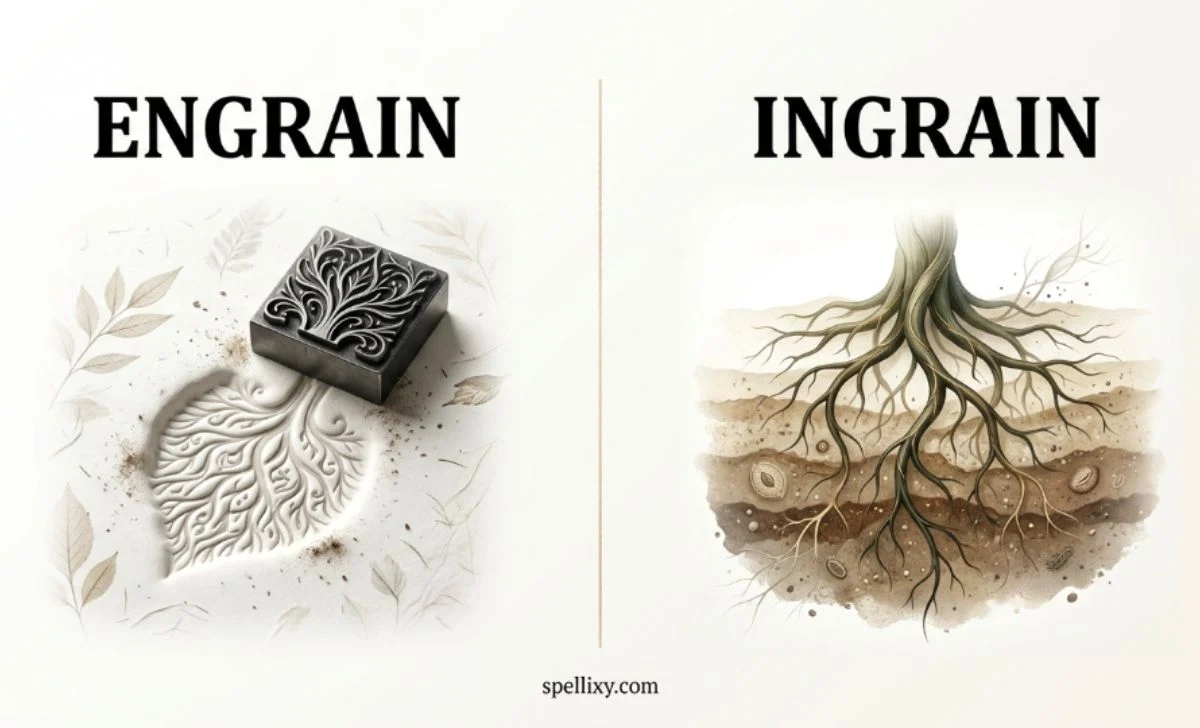
If you are unsure whether to write engrain or ingrain, you are not alone. Both forms appear in dictionaries, but ingrain is the better default choice in modern English. It means to fix something deeply in a person’s mind, character, or nature.
Engrain is also a recognized variant of ingrain. Merriam-Webster lists engrain as a less common spelling, while Collins lists it as a variant of ingrain. So it would be too strong to call engrain simply “wrong.”
The same pattern appears with their past forms: ingrained is the usual form, while engrained is also recognized as a less common variant.
For most everyday, academic, and professional writing, however, ingrain / ingrained is the safest choice.
The Quick Answer
Ingrain is the preferred spelling in general English, while engrain is a recognized but less common variant.
Both can mean to fix something deeply and firmly, especially in the mind or character.
- Ingrain — preferred form
- Engrain — accepted variant
- Ingrained — preferred past form/adjective
- Engrained — accepted, less common variant
For example:
Good habits can become ingrained through repetition.
You may also see:
Good habits can become engrained through repetition.
The first version is the one I would recommend for most readers.
What Does Ingrain Mean?
Ingrain means to fix something so deeply that it becomes a lasting part of someone’s mind, behavior, character, or way of thinking.
Merriam-Webster defines ingrain as working something indelibly into a person’s mental or moral nature. Collins also gives the sense of impressing something deeply on the mind or nature.
For example:
- Parents may ingrain good manners in their children.
- Years of practice ingrained the habit in her.
- The experience became deeply ingrained in his memory.
- The coach wanted to ingrain discipline in the team.
The key idea is deep and lasting. If something is ingrained, it is not just remembered for a few minutes. It has become firmly established.
What Does Engrain Mean?
Engrain has essentially the same meaning as ingrain when it is used in this context.
Collins describes engrain as a variant spelling of ingrain, while Merriam-Webster calls it a less common spelling of ingrain.
So if someone writes:
The lesson was engrained in his mind.
the intended meaning is clear: the lesson was deeply fixed in his mind.
However, if you are choosing the spelling yourself, ingrained is generally the better option.
This is an important distinction. Engrain is not simply a spelling mistake, but it is less common than ingrain.
Ingrain vs Engrain: What Is the Difference?
The main difference is usage and spelling preference, not meaning.
| Word | Meaning | Usage |
|---|---|---|
| ingrain | Fix deeply in the mind, character, or nature | Preferred form |
| engrain | Same basic meaning as ingrain | Less common variant |
| ingrained | Deeply fixed or established | Preferred past form/adjective |
| engrained | Same basic meaning as ingrained | Less common variant |
Merriam-Webster specifically lists engrained as a less common variant of ingrained.
Therefore, you do not need to learn two different meanings. The important thing is knowing which form is the better choice for your writing.
Ingrained vs Engrained in the UK
British English can make this question a little confusing because engrained is recognized in British English as well.
Collins lists ingrain in British English and gives engrain as a variant. It also lists engrained as a variant of ingrained.
That means it would be inaccurate to say:
“Engrained is never correct in British English.”
It is recognized.
Still, ingrained is the form to favor when you want the most familiar and straightforward spelling. For a school essay, website, report, email, or other general writing, choosing ingrain and ingrained keeps your wording simple and conventional.
So:
UK: ingrained ✓
UK: engrained — recognized variant
The same basic recommendation applies if your audience includes readers from different English-speaking countries.
Ingrained vs Engraved: What Is the Difference?
This is a more important distinction because ingrained and engraved do not mean the same thing.
Ingrained means deeply fixed, established, or embedded.
Engraved usually means marked or carved into a hard surface. It can also be used figuratively for something remembered very strongly.
Compare:
Respect for others was ingrained in him.
This means respect had become a deep part of his character.
Now compare:
Her name was engraved on the trophy.
This means the name was physically carved or marked on the trophy.
There is also a figurative use:
The image was engraved in his memory.
Here, engraved does not mean someone literally carved the image into his brain. It means the memory was extremely strong and lasting.
So the two words can overlap when talking about memory, but they emphasize different ideas:
- Ingrained → deeply established or rooted
- Engraved → strongly marked or fixed, often with an image of something being carved
Is It Engraved or Ingrained in My Brain?
Both expressions can be grammatically possible, but they communicate slightly different ideas.
Ingrained in my brain suggests that a thought, habit, fact, or pattern has become deeply fixed in your mind.
That rule is ingrained in my brain after years of practice.
Engraved in my brain is more figurative. It suggests that something is so memorable that it feels permanently marked in your memory.
That terrible scene is engraved in my brain.
For everyday writing, ingrained in my mind is often a natural choice when you mean that an idea or habit has become deeply established.
If you mean that a vivid memory is permanently marked in your memory, engraved in my mind can be a stronger metaphor.
“Ingrained in My Mind” Meaning
The phrase “ingrained in my mind” means that something has become deeply fixed in your thoughts or memory.
For example:
The advice my grandfather gave me is ingrained in my mind.
This means the advice has stayed with you and has become a strong part of the way you think.
You can also say:
- The lesson is ingrained in my mind.
- That image is deeply ingrained in my mind.
- The rule became ingrained in my mind.
- The experience left an ingrained impression on me.
A related and very common structure is “ingrained in me.”
My parents ingrained the importance of honesty in me.
Here, the idea is not simply that you remember honesty. It means the value has become deeply rooted in your character or thinking.
Is “Engrained in My Head” or “Ingrained in My Head” Correct?
“Ingrained in my head” is the spelling to prefer.
For example:
That song is ingrained in my head.
However, there is a small usage point worth knowing. Native speakers may also say “stuck in my head” when talking about a song, phrase, or thought that keeps repeating in their mind.
For example:
That song is stuck in my head.
This is more natural in casual conversation than ingrained in my head when you simply mean that you cannot stop thinking about something.
Use ingrained when you want to emphasize something deeply established:
The habit was ingrained in my mind.
Use stuck when you mean something keeps coming back:
That melody is stuck in my head.
What Is Another Word for Ingrain?
The best synonym depends on the context.
Common alternatives include:
- instill
- implant
- embed
- impress
- fix
- root
- establish
- imbue
- inculcate
Merriam-Webster lists words such as infuse, imbue, implant, instill, and inculcate among related synonyms.
For example:
Parents ingrain good habits in children.
could become:
Parents instill good habits in children.
But the words are not always interchangeable. Instill often focuses on gradually introducing an idea, value, or feeling.
Embed emphasizes putting something deeply into something else. Ingrain strongly suggests that the result becomes firmly established.
What Is Another Word for Engrained?
Since engrained is a variant of ingrained, many of the same synonyms apply.
Depending on the sentence, you could use:
- deeply rooted
- fixed
- established
- deep-seated
- embedded
- entrenched
- habitual
- firmly established
For example:
She has an ingrained fear of failure.
You could say:
She has a deep-seated fear of failure.
Or:
She has an entrenched fear of failure.
Collins lists fixed, rooted, deep-seated, and fundamental among synonyms for ingrained.
Examples of Ingrained
Here are some natural examples showing how ingrained works in different contexts.
Habits
Checking his phone first thing in the morning became an ingrained habit.
Beliefs
Her belief in hard work was deeply ingrained.
Behavior
The team has an ingrained habit of arriving early.
Culture
These traditions are deeply ingrained in the local culture.
Memory
The experience remains ingrained in my mind.
Personal values
Honesty was ingrained in him from childhood.
Collins commonly uses ingrained with habits, beliefs, attitudes, culture, and similar ideas because the word describes things that have become difficult to change or remove.
Common Mistakes to Avoid
The biggest mistake is assuming that engrain and ingrain are completely different words.
They are not. In the relevant sense, engrain is a recognized variant of ingrain.
A second mistake is treating engrained as automatically wrong.
It is recognized as a variant, although ingrained is the better default.
A third mistake is confusing ingrained with engraved.
Remember:
Ingrained = deeply fixed or established.
Engraved = carved, marked, or figuratively fixed like something carved.
Finally, do not use ingrained when you only mean “remembered.” Something can be remembered without being deeply rooted in your thinking or behavior.
A Simple Memory Trick
If you regularly forget whether the word begins with in- or en-, remember this:
Ingrain → ingrained
The i stays in both forms.
Think of ingrained as something that has gone in deeply.
IN + GRAIN → INGRAIN → INGRAINED
This is only a memory aid, not a complete rule for English word formation. However, it can help you choose the preferred spelling when you are writing quickly.
FAQs
1. What is the difference between ingrain and engrain?
There is little difference in meaning. Ingrain is the preferred form, while engrain is a recognized but less common variant.
2. What does “engrain” mean?
Engrain means to fix or impress something deeply in the mind, character, or nature. It is a variant of ingrain.
3. What does the word “ingrain” mean?
Ingrain means to fix something deeply and firmly in someone’s mind, character, or nature. It can also have a literal sense connected with working something into a material’s fibers.
4. What is the difference between ingrained and engraved?
Ingrained means deeply fixed or established, while engraved usually means carved or marked into a surface. Engraved can also be used figuratively for a powerful memory.
5. Is it engraved or ingrained in my brain?
Both can work, but the meaning changes. Ingrained in my brain suggests something is deeply fixed in your thinking. Engraved in my brain is a stronger metaphor for something vividly and permanently remembered.
6. What is another word for “ingrain”?
Depending on context, synonyms include instill, implant, embed, impress, root, imbue, and inculcate.
7. How do you spell engrain?
The spelling is engrain: E-N-G-R-A-I-N. However, ingrain is the preferred form in general writing.
8. What is another word for “engrained”?
Because engrained is a variant of ingrained, possible alternatives include deeply rooted, fixed, established, deep-seated, embedded, and entrenched.
9. Is the phrase “engrained in my head” or “ingrained in my head” correct?
Ingrained in my head is the form to prefer. It means something has become deeply fixed in your thoughts. Engrained is also recognized as a variant.
10. Is “engrained” spelled correctly in the UK?
Yes. Engrained is recognized as a variant in British English. However, ingrained is the preferred form for general writing.
11. What is another word for “ingraining”?
Depending on context, you could use instilling, embedding, implanting, establishing, or reinforcing. The best choice depends on what is being made deeply established.
12. What is an example of ingrained?
A simple example is: “Her respect for her parents was deeply ingrained.” It means that the respect had become a strong and lasting part of her character.
Final Verdict
Ingrain is the spelling to prefer in general English.
Engrain is not simply an incorrect spelling. Major dictionaries recognize it as a variant or less common spelling of ingrain. Merriam-Webster lists engrain as a less common variant, while Collins lists it as a variant in British English.
The same applies to the past form:
ingrained → preferred choice
engrained → recognized variant
When you mean something is deeply fixed in your mind, behavior, or character, ingrained is the safest form to use.
And when you are talking about something carved or marked, choose engraved instead.
The easiest distinction is:
Ingrain = make something deeply fixed.
Ingrained = deeply fixed or established.
Engraved = carved or strongly marked.