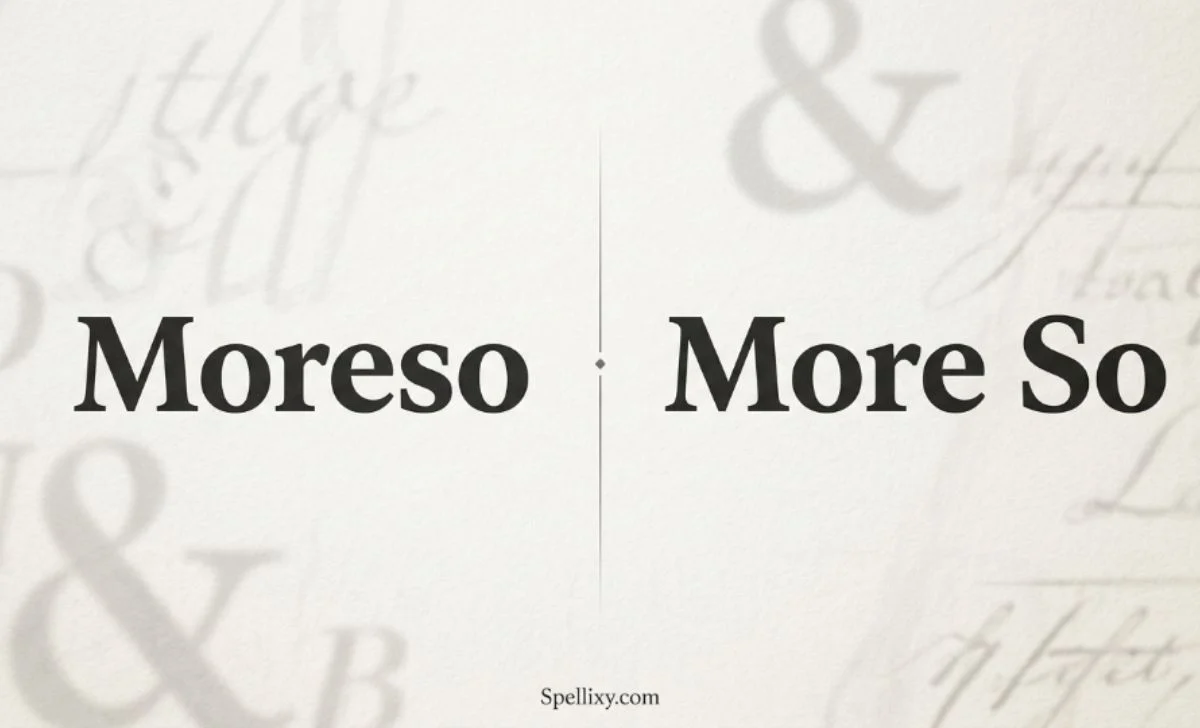
If you are unsure whether to write moreso or more so, the safest choice is more so. It is the standard two-word form used to mean “to a greater degree or extent.”
You may see moreso in American English and online writing, and it is not simply an invented spelling.
Collins lists it as a disputed form, while recent Cambridge research notes that the one-word spelling has a history in English. For formal or general-purpose writing, however, more so is the clearer choice.
Quick Answer
More so is the preferred spelling in standard English.
It means “to a greater degree” or “to a greater extent.” For example:
I enjoy winter, more so than summer.
Moreso is also found in real English usage, but it is a disputed variant. If you want the safest form for school, work, or professional writing, use more so.
What Does “More So” Mean?
More so means to a greater degree or extent. It is used when something applies more strongly to one person, thing, or situation than another.
For example:
I like both cities, but I enjoy Lahore more so than Karachi.
Here, more so shows that the speaker enjoys Lahore to a greater degree.
It can also refer back to an idea already mentioned:
The first task was difficult, but the second was more so.
Here, so refers back to difficult. The meaning is that the second task was even more difficult. Cambridge Grammar describes this use of more so as a way to compare degrees.
More So vs. Moreso
The difference is mainly about spelling and usage.
| Form | Status | Meaning |
|---|---|---|
| more so | Preferred | To a greater degree or extent |
| moreso | Disputed variant | Generally the same meaning |
More so is the better choice when you want clear, standard usage.
That said, it would be inaccurate to say that moreso never exists. Collins lists moreso as a disputed American English form, and the Oxford English Dictionary records the one-word spelling.
Recent Cambridge research also examines its development and changing use.
So the practical rule is simple: write more so unless you have a specific reason to use the one-word variant.
How to Use “More So” in a Sentence
More so often appears when you are comparing the degree of something.
More So Than
I prefer reading more so than watching television.
The rule affects beginners more so than experienced writers.
Even More So
Even more so adds stronger emphasis.
The second exam was difficult, even more so because we had little time.
I appreciated her help, even more so during a stressful week.
More So Because
You can also use more so to explain why something applies to a greater degree.
I was worried, more so because nobody had contacted me.
The delay was frustrating, more so because we had already been waiting for an hour.
More So on Its Own
Sometimes more so replaces a repeated adjective or adverb.
The first plan was expensive, but the second was more so.
This means the second plan was even more expensive.
More So in a Sentence
Here are some natural examples:
- I enjoy working from home, more so in the winter.
- She was upset, more so after hearing the news.
- The second option is practical, more so for small businesses.
- He enjoys football, more so than cricket.
- The new system is faster, even more so after the update.
- The decision was difficult, more so because we had little information.
The exact position of more so can change depending on what you are comparing. The important point is that it should clearly connect to the degree or quality being discussed.
More So Meaning and Usage
The phrase usually points back to something already stated or understood.
Consider this sentence:
The movie was good, but the ending was more so.
Here, more so means the ending was even better.
This is different from simply using more:
I want more coffee.
Here, more refers to an additional amount of coffee.
In more so, the word so helps refer back to an earlier quality, action, or description. That is why the two-word form often makes the grammar easier to see.
Is “More So” Formal or Informal?
More so works in both everyday and formal English.
You might hear it in conversation:
I was nervous, more so because it was my first interview.
You can also find it in professional or academic writing:
The policy affects smaller businesses more so than larger companies.
So there is no need to avoid more so simply because you are writing formally. The key is to use it where the comparison is clear.
For very formal writing, you can sometimes replace it with a more precise expression such as to a greater extent, but that is a style choice, not a grammar requirement.
What Is Another Word for “More So”?
The best alternative depends on the sentence.
| Alternative | Meaning |
|---|---|
| especially | To emphasize one particular thing |
| particularly | To highlight something specific |
| even more | To show a greater degree |
| to a greater extent | A more formal alternative |
| more strongly | When talking about strength or effect |
For example:
I was concerned, more so because of the delay.
You could also write:
I was especially concerned because of the delay.
However, these alternatives are not interchangeable in every sentence. More so often has a comparative meaning that especially does not fully reproduce.
Why Do People Say “More So”?
People use more so because it is a natural way to show that something applies to a greater degree.
For example:
I like both designs, but I prefer the second more so.
The phrase avoids repeating the whole idea:
I like both designs, but I prefer the second design to a greater degree.
In everyday English, the shorter form is much more natural.
Is “Moreso” Grammatically Correct?
Moreso is a disputed form rather than a simple “wrong word.”
Many style and grammar resources prefer more so, while dictionaries and linguistic research recognize that moreso does occur in English.
Collins labels it “disputed,” and Cambridge’s recent research discusses both the one-word and two-word forms.
For that reason, saying “moreso is never correct” is too absolute.
A better practical rule is:
Use “more so” in standard and formal writing.
That choice is clear, widely understood, and unlikely to be questioned by an editor.
When Should You Use “More So”?
Use more so when you want to show that a quality, feeling, action, or condition applies more strongly or to a greater extent.
It works especially well in patterns such as:
- more so than
- even more so
- all the more so
- more so because
- more so when
- more so in
For example:
The rule matters for beginners, more so than for experienced writers.
The phrase all the more so is also well established. Merriam-Webster defines it as a way of saying that something applies to a greater degree or extent.
“More So” vs. “Moreover”
These two expressions may look similar, but they do not mean the same thing.
More so means to a greater degree or extent.
I enjoyed the second book more so than the first.
Moreover means in addition or furthermore.
The book is affordable. Moreover, it is easy to find.
So:
- more so = to a greater degree
- moreover = in addition
Do not use moreover as a replacement for more so.
Can “More So” Start a Sentence?
Yes, but the construction should be clear.
For example:
More so than ever, businesses need reliable online security.
This means that businesses need it to a greater degree than before.
However, avoid awkward constructions such as:
❌ More so I agree with you.
A clearer version would be:
✅ I agree with you even more.
The phrase works best when the reader can easily tell what more is comparing or what so refers to.
How Do You Pronounce “More So”?
More so is pronounced naturally as two words in connected speech.
The important point is that the spelling does not change simply because the words may sound closely connected when spoken.
Whether you write more so or encounter the disputed moreso, the intended expression is generally the same in this context. Collins lists a pronunciation for moreso as well.
Common Mistakes With More So
Writing It as One Word
For standard writing, prefer:
❌ I like this one moreso.
✅ I like this one more so.
Confusing It With “Moreover”
❌ I like this design more so, it is cheaper.
If you mean “in addition,” use moreover:
✅ I like this design. Moreover, it is cheaper.
Using It Without a Clear Comparison
❌ The meeting was more so.
The reader may ask: more so than what?
A clearer sentence is:
✅ The second meeting was more so.
Here, the previous sentence should already establish the quality being compared.
FAQs
1. What is the meaning of “more so”?
More so means to a greater degree or extent. It often compares one person, thing, or situation with another.
2. What does “moreso” mean?
Moreso is a disputed one-word variant of more so. It generally carries the same meaning, but more so is the safer form for standard writing.
3. Is “moreso” one word or two?
Moreso is one word, while more so is two words. For standard and formal writing, more so is generally the better choice.
4. Is “moreso” grammatically correct?
It is a recognized but disputed variant. If you want the least controversial form, write more so.
5. Can you use “more so” in a sentence?
Yes. For example: “I enjoy the second option more so than the first.”
6. When should you use “more so” in a sentence?
Use it when you want to show that something applies to a greater degree, especially in comparisons.
7. How do you use “more so”?
Common patterns include more so than, even more so, and more so because.
8. Why do people say “more so”?
People use it to show that something is true or applies to a greater extent without repeating the full description.
9. What should I say instead of “more so”?
Depending on the context, you can use especially, particularly, even more, more strongly, or to a greater extent.
10. Is “more so” formal?
Yes. More so can be used in both casual and formal English. It is not limited to either style.
11. What does “even more so” mean?
Even more so means to an even greater degree. It adds stronger emphasis to a comparison.
12. What is the difference between “more so” and “moreover”?
More so means to a greater degree, while moreover means in addition or furthermore. They are not interchangeable.
Final Answer
More so is the safest and clearest form to use in standard English. It means “to a greater degree or extent” and commonly appears in expressions such as more so than and even more so.
Although moreso appears in real English usage and is recognized as a disputed variant, more so remains the better choice for professional, academic, and general writing.