Many English speakers and French learners often get confused between petit and petite because both words look similar and share the same meaning: “small.”
However, the real difficulty is not vocabulary but grammar rules. In French, words change form based on gender, which makes usage tricky for beginners.
This is why people often misuse these terms in writing and speaking. In this article, you will clearly understand petit or petite, when to use each form, and why this difference exists.
We will also cover examples, mistakes, and simple rules so you can use them correctly in real life communication without confusion.
Quick Answer
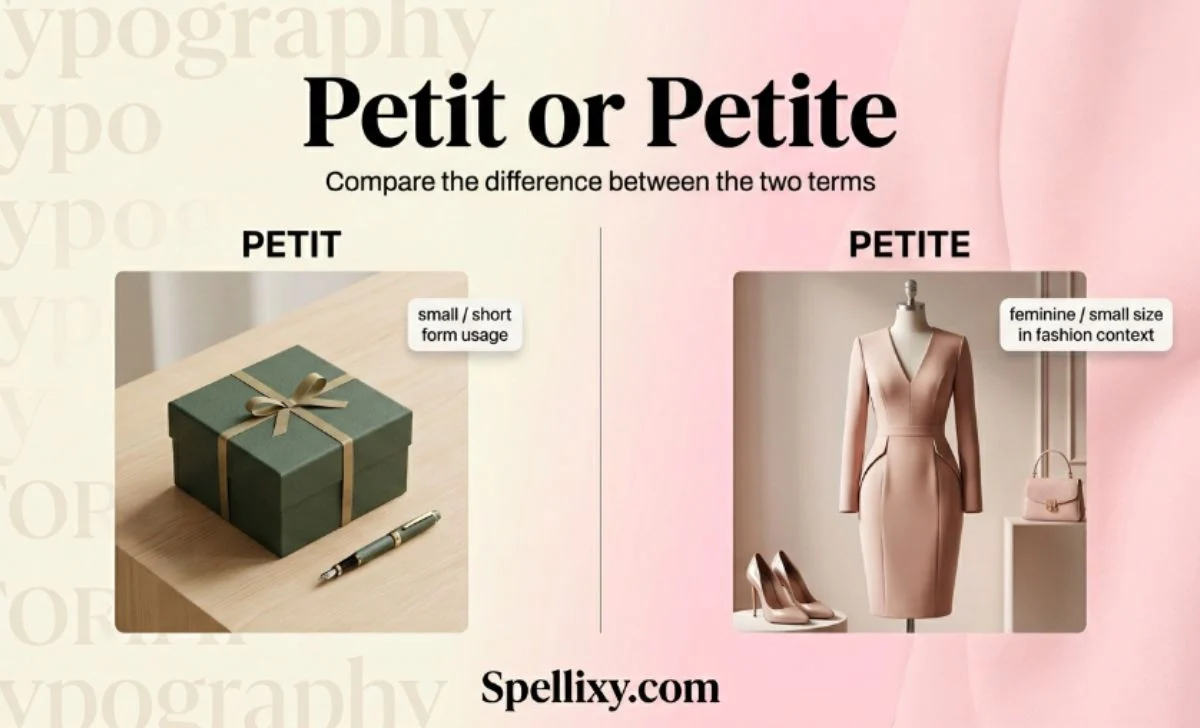
Petit and petite both mean “small,” but usage depends on noun gender in French.
- Petit → masculine nouns
- Petite → feminine nouns
This rule is part of French Grammar where adjectives must agree with nouns.
Correct Example
- Un petit chien (small dog – masculine)
- Une petite maison (small house – feminine)
Incorrect Example
- ❌ Une petit fille
- ❌ Un petite chien
What Does Petit or Petite Mean?
Both words describe size, age, or importance. Meaning stays the same, but form changes.
Common Meanings
- Small size
- Young age
- Something minor
Simple Usage Examples
- Un petit problème
- Une petite voiture
This follows rules of Adjective Agreement.
The Origin of Petit or Petite
Word History
The word comes from Old French petit, meaning “small.” Over time, French grammar developed gender-based rules, creating the feminine form “petite.”
Why the Confusion Happens
- English has no gender adjectives
- Both forms sound similar
- Only spelling changes slightly
This concept is studied in Linguistics.
British English vs American English
There is no difference between British and American usage because this is French grammar, not English spelling.
Comparison Table
| Aspect | British English | American English |
|---|---|---|
| Usage rule | French gender rules | Same |
| Spelling difference | None | None |
| Meaning | Same | Same |
Petit or Petite vs Other Variations
Spelling Comparison Table
| Spelling | Status | Usage | Region |
|---|---|---|---|
| petit | Correct | Masculine adjective | French |
| petite | Correct | Feminine adjective | French |
| petitte | Incorrect | Not valid | None |
Which Spelling Should You Use?
US Audience
Use correct French gender rules.
UK Audience
Same rule applies.
International Writing
Always match adjective with noun gender.
Academic Writing
Strict grammar accuracy required.
Social Media Usage
Often ignored, but correct usage looks professional.
Common Mistakes with Petit or Petite
Frequent Errors
- Mixing gender forms
- Using “petit” for all nouns
- Ignoring agreement rules
Corrected Examples
- ❌ Une petit voiture → ✔ Une petite voiture
- ❌ Un petite livre → ✔ Un petit livre
Petit or Petite in Everyday Examples
Emails
- J’ai un petit problème.
Social Media
- Une petite pause ☕
News Writing
- Une petite augmentation des prix.
School Writing
- Un petit devoir facile.
Business Writing
- Une petite entreprise en croissance.
Google Trends & Usage Data
Popular Countries
- United States
- United Kingdom
- Canada
- Australia
- India
Why People Search This Keyword
- French grammar confusion
- Exam preparation
- Translation issues
- Writing improvement
Related Grammar Rules
Similar Spelling Mistakes
- bon / bonne
- grand / grande
- petit / petite
Helpful Grammar Tips
- Always check noun gender
- Learn adjective pairs
- Practice daily examples
FAQs
What is the difference between petit and petite?
Petit is masculine, petite is feminine.
Is petit used in English?
No, it is a French word.
Can I use petit for everything?
No, gender matters.
What does petite mean?
It means small or little.
Why do French words change endings?
Because of gender rules.
Is French grammar hard?
No, it becomes easy with practice.
Conclusion
Understanding petit or petite is simple once you learn French grammar rules. Both words mean “small,” but the correct form depends on whether the noun is masculine or feminine.
This rule is part of essential French language structure and helps improve accuracy in writing and speaking.
Many beginners make mistakes by ignoring gender agreement, but regular practice makes it easy to master. Always match adjectives with the correct noun form to avoid errors.
With time, you will naturally use petit and petite correctly in everyday communication, making your French more accurate and professional.

Hi, I’m Michael McCarthy from Spellixy.com.
I help you learn English grammar, improve writing, and understand language in a simple and easy way.