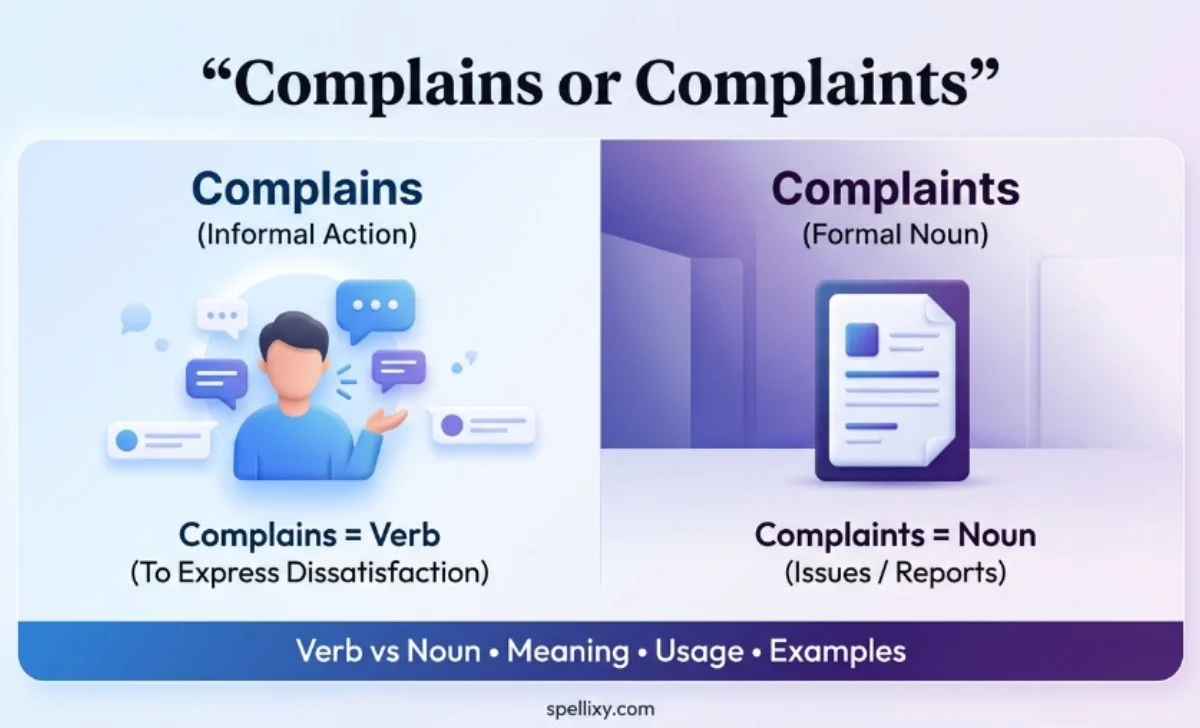
Many English learners get confused between “complains” and “complaints” because both words look almost the same and come from the same root word complain.
This small spelling change creates a big grammar difference, which often leads to mistakes in writing, speaking, emails, and even exams. People search this keyword to understand which form is correct and when to use each one.
In simple terms, one is an action word while the other is a thing or issue. This confusion becomes more common in customer service, patient reports, and daily English conversations.
In this guide, you will learn the exact meaning, pronunciation, usage rules, examples, and easy tricks so you never mix them again. Everything is explained in very simple English for quick understanding.
Complains or Complaints – Quick Answer
“Complains” and “complaints” are both correct, but they are used in different ways.
- Complains = action (verb)
- Complaints = things (noun)
✔ Simple Explanation:
- Complains → when someone is doing the action
- Complaints → when talking about problems or issues
✔ Examples:
- She complains about noise daily.
- The manager solved customer complaints quickly.
Pronunciation of Complains or Complaints
Both words come from the base word:
- Complain
Pronunciation:
- Complains → /kəm-PLEYNZ/
- Complaints → /kəm-PLEYNTS/
Simple Sound Guide:
- “Complains” ends with -z sound
- “Complaints” ends with -ts sound
Common Spoken Confusion:
Many learners pronounce both the same way, but the ending sound changes the meaning in spoken English.
Why People Confuse Complains or Complaints
There are three main reasons:
1. Same root word
Both come from complain, so they look similar.
2. Small spelling difference
Only “s” vs “ts” makes the difference.
3. Grammar role confusion
People don’t clearly understand:
- Verb
- Noun
4. Subject-verb confusion
- Subject-Verb Agreement causes errors like “He complaints” ❌
Easy Trick to Remember Complains or Complaints
Simple Memory Trick:
- Complains = Action (doing word) → “S = She/Someone does it”
- Complaints = Things (issues) → “T = Things reported”
Easy Formula:
- He/She + complains
- Many + complaints
Example:
- She complains
- Many complaints
The Origin of Complains or Complaints
The word comes from Latin:
- “complain” → complaindre (Old French)
- meaning: to express pain or dissatisfaction
Over time:
- English added -s for verbs (complains)
- and -ts for plural noun form (complaints)
This change happened as English grammar evolved to separate actions from objects clearly.
British English vs American English Spelling
Good news:
👉 There is no spelling difference between UK and US for these words.
Both use:
- complains
- complaints
✔ Comparison Table:
| Form | UK English | US English | Usage |
|---|---|---|---|
| Complains | same | same | verb |
| Complaints | same | same | noun |
✔ Unlike words like colour/color, this one stays the same globally.
Which Spelling Should You Use?
- If you are writing for global audience → use standard grammar rules
- If you are writing for school/exams → follow sentence structure rules
- If you are writing for business/email → use “complaints” for issues and “complains” for actions
✔ Best rule:
👉 Don’t focus on spelling difference, focus on grammar role.
Common Mistakes with Complains or Complaints
Wrong: He complaints a lot
Correct: He complains a lot
Wrong: I have a complain
Correct: I have a complaint
Wrong: Customer complain received
Correct: Customer complaint received
Wrong: She complaint every day
Correct: She complains every day
Main issue is mixing verb and noun forms.
Complains or Complaints in Everyday Examples
📧 Emails:
- We received your complaint and are reviewing it.
🏢 Office:
- Employee complaints are handled by HR.
📰 News:
- Residents complain about traffic issues.
📱 Social Media:
- Users often complain about app bugs.
🏥 Hospitals:
- Patient complaints are recorded daily.
Complains or Complaints – Google Trends & Usage Data
- “Complaints” is searched more than “complains”
- Most searches come from:
- India
- Pakistan
- UK
- Middle East learners
✔ Reason:
People usually search “complaints” because it is more common in:
- customer service
- legal issues
- formal writing
✔ Insight:
- “Complains” = grammar learning searches
- “Complaints” = real-world issue reporting searches
Comparison Table – Complains vs Complaints
| Feature | Complains | Complaints |
|---|---|---|
| Type | Verb | Noun |
| Meaning | action of expressing dissatisfaction | issues or problems |
| Usage | he/she/it complains | multiple complaints |
| Example | She complains daily | We have complaints |
| Context | action-based | issue-based |
FAQs
1. What is the difference between complains and complaints?
Complains is a verb, complaints is a noun.
2. Is it correct to say “I have a complain”?
No, correct is “I have a complaint”.
3. What is the meaning of complaints?
Problems or issues reported.
4. What is the meaning of complains?
To express dissatisfaction.
5. Can we use complains with I?
No, we use “I complain”.
6. Is complaints singular or plural?
Plural noun.
7. What is the singular of complaints?
Complaint.
8. Is “customer complain” correct?
No, it should be “customer complaint”.
9. What is patient complaints?
Issues reported by patients.
10. Is “he complaints” correct?
No, correct is “he complains”.
11. What is correct spelling: complain or complaint?
Both are correct but different forms.
12. Can complaints be used in email?
Yes.
13. What is verb form of complaint?
Complain.
14. What is noun form of complain?
Complaint.
15. Why do people confuse these words?
Because of similar spelling.
16. Is complains formal or informal?
Both depending on context.
17. Is complaints formal?
Yes, commonly used in formal writing.
18. What is complaint meaning in law?
A legal issue report.
19. Can we say many complains?
No, correct is many complaints.
20. Is complain plural?
No.
21. Can complaints be uncountable?
No, it is countable.
22. Is complain a noun?
No, it is a verb.
23. What is correct: she complain or she complains?
She complains.
24. What is correct usage in past tense?
Complained.
25. Is complaints used in business?
Yes.
26. Can complains be used in writing?
Yes, as verb.
27. What is correct: no complains or no complaints?
No complaints.
28. What is difference in pronunciation?
Complains ends with “z”, complaints with “ts”.
29. Is complaints singular?
No, plural.
30. What is base word?
Complain.
Conclusion
The confusion between complains and complaints is very common, but the rule is simple.
“Complains” is an action word that shows someone is expressing dissatisfaction, while “complaints” is a noun that refers to problems or issues themselves.
Once you understand this basic grammar rule, you can easily avoid mistakes in writing and speaking. This difference is important in professional communication, exams, customer service, and daily English usage.
Always remember: action = complains, and issue = complaints. With practice and examples, this confusion disappears completely and your English becomes more accurate and natural.
Discover More Blog :
- Señora or Señorita – Complete Meaning & Usage Guide
- Greatly or Grately: Which One Is Correct? Full Explanation
- Shavasana or Savasana: Which Is the Correct Spelling in Yoga?

Hi, I’m Michael McCarthy from Spellixy.com.
I help you learn English grammar, improve writing, and understand language in a simple and easy way.