If you have ever seen a small, furry animal at night and wondered whether it is a possum or opossum, you are not alone.
The two names are often used as if they mean exactly the same animal, but there is an important difference.
In general, opossum refers to marsupials found in the Americas, while possum usually refers to a different group of marsupials native to Australia and nearby regions.
However, “possum” is also commonly used as a shortened name for an opossum in North American English.
That overlap is what makes the words confusing. Understanding where the animals live, how the words are used, and what people mean by each name makes the distinction much easier.
Possum or Opossum: Which Is Correct?
Both possum and opossum are correct words, but they do not always refer to the same animals.
The correct choice depends mainly on the animal being discussed and, in some cases, the variety of English being used.
In North American English, opossum is the more precise name for animals in the opossum family found in the Americas.
The Virginia opossum, for example, is an American marsupial commonly called an opossum. In casual speech, especially in the United States, people often shorten opossum to possum.
As a result, you may hear or see both forms when people are talking about the same North American animal.
The word possum, however, also has a separate and established use. It commonly refers to several marsupial species native to Australia, New Guinea, and nearby areas.
These animals belong to a different group from American opossums. So, while the words can overlap in everyday American speech, they are not simply two interchangeable names for one animal worldwide.
A useful rule is this: opossum is the safer and more specific term when you mean an American opossum, while possum can refer either to an Australian-type possum or, informally, to an American opossum.
What Is an Opossum?
An opossum is a marsupial native to the Americas. The word is especially associated with the opossums of North and South America, including the familiar Virginia opossum found across much of the eastern and central United States.
Like other marsupials, opossums have a distinctive reproductive system in which very young offspring continue developing after birth.
In many species, the young spend an important part of their early development attached to their mother. This is one of the features that places opossums among marsupial mammals.
Opossums are generally nocturnal, meaning they are most active at night. They are adaptable animals that can live in forests, fields, suburban areas, and other environments where food and shelter are available.
This ability to adapt is one reason people sometimes encounter them around homes, gardens, garages, and other human-developed areas.
The Virginia opossum is particularly well known for its defensive behavior. When threatened, it may become extremely still and appear to be dead. This behavior is the source of the familiar expression “playing possum.”
What Is a Possum?
A possum is generally a marsupial from Australia, New Guinea, or nearby regions. There are many different species of possums, so the word does not describe one single animal.
Australian possums vary in appearance, size, and lifestyle. Some live mainly in trees, and many have adaptations that help them climb and move through their habitats. Examples include the common brushtail possum and various species of ringtail possums.
This is where the possum-versus-opossum distinction becomes important. An Australian possum and an American opossum may both be marsupials, but they belong to different animal groups and have different evolutionary histories.
So, if someone in Australia talks about a possum, they may be referring to an animal that is completely different from the North American animal that an American speaker calls an opossum.
Possum vs Opossum: The Main Difference
The easiest way to understand the difference is to look at their geographic groups.
| Feature | Possum | Opossum |
|---|---|---|
| Common region | Australia and nearby regions | The Americas |
| Animal group | Several Australian and related marsupial groups | Opossums of the Americas |
| Common example | Brushtail possum | Virginia opossum |
| Usually active | Often at night | Often at night |
| Marsupial | Yes | Yes |
| “Playing dead” | Not the defining behavior | Especially associated with opossums |
| Common North American short form | — | “Possum” |
The table shows why the terms can be confusing. Both animals are marsupials, and both can be nocturnal, but that does not make them the same animal. Their geographic distribution and biological classification are different.
There is also a language issue. In the United States and Canada, possum is frequently used as an informal shortened form of opossum. Therefore, an American saying “I saw a possum in my yard” may actually mean an opossum. The context and location help determine which animal is intended.
Why Is There an “O” in Opossum?
The O in opossum is part of the traditional spelling of the word. It is not an extra letter added to the beginning of possum simply for pronunciation.
The word opossum has a long history in English and comes from a word associated with an Indigenous language of the Americas. Over time, English adopted and standardized the form opossum. The shorter word possum developed as a shortened form in some varieties of English.
That is why you may see both forms in North American writing. Opossum is the full form, while possum can be an informal shortened form when referring to an opossum. At the same time, possum has its own separate meaning for Australian marsupials.
Therefore, the O is not simply a spelling variation that changes nothing. The full word opossum has its own history and specific biological use.
Is the “O” in Opossum Pronounced?
Yes, the O in opossum can be pronounced, and the full pronunciation is standard.
Opossum is commonly pronounced approximately like:
uh-POSS-um
The first syllable is usually unstressed, while the middle syllable receives the main stress.
In casual North American speech, however, people may drop the initial sound and say possum instead. This does not necessarily mean the speaker is using the wrong word. It reflects the common shortened form used in everyday speech.
For careful writing, especially when you want to identify the American animal clearly, opossum is a useful choice. In casual conversation, possum is also widely understood in North America.
Possum vs Opossum Size
There is no single size comparison that works for every possum and every opossum. The main reason is that possum refers to many different species, and opossum also covers numerous species rather than one uniform animal.
The familiar Virginia opossum is a medium-sized mammal with a long, pointed face, a mostly hairless tail, and a body that is adapted for climbing and moving through different environments. Its size can vary depending on the individual and other factors.
Australian possums also differ considerably in size. A small possum species can look very different from a larger species, so saying that “possums are always bigger” or “opossums are always smaller” would be misleading.
If you are comparing a particular possum species with a particular opossum species, it is better to compare their actual body length and weight. The words themselves are too broad to give one universal size difference.
Possum or Opossum Photos: How Can You Tell Them Apart?
Photos can be helpful when identifying these animals, but location is often just as important as appearance. If you are looking at an animal in North America, an opossum is a likely possibility.
If you are looking at a possum in Australia, you may be seeing one of the many Australian possum species.
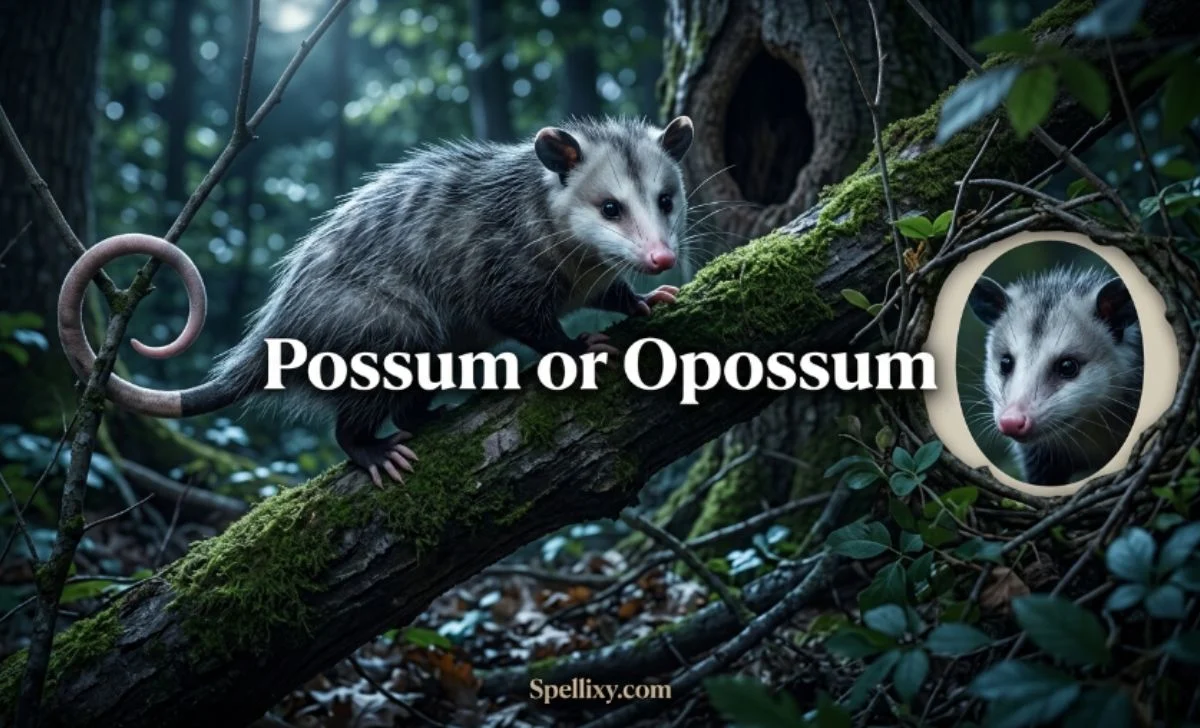
North American opossums often have a distinctive pointed face, small rounded ears, a long tail, and a somewhat coarse-looking coat.
The Virginia opossum is especially recognizable because its tail is largely hairless and can be used for climbing and gripping.
Australian possums vary much more in appearance because the term includes many species. Some have thick, furry tails, while others have body shapes and features adapted to life in trees.
For that reason, possum or opossum photos are most useful when they are labeled by species and location. A photograph alone can sometimes cause confusion if two unrelated marsupials are simply labeled “possum.”


Do Possums and Opossums Play Dead?
The phrase “playing possum” comes from the well-known defensive behavior of opossums. When an opossum feels seriously threatened, it may enter a state in which it becomes very still and appears lifeless.
This is not the same as an animal deliberately pretending in the human sense. It is an involuntary defensive response that can happen when the animal is under extreme stress.
The animal may remain motionless, with its body appearing limp, which can discourage a predator from continuing an attack.
This behavior is especially associated with American opossums. Therefore, the expression “playing possum” is closely connected with the opossum rather than being a general behavior shared equally by every animal called a possum.
For example:
The opossum played dead when the dog approached.
The phrase can also be used figuratively about people:
He was playing possum when the teacher asked who had broken the window.
In the second sentence, the person is not literally becoming unconscious. It means he is pretending not to notice or respond.
Why Do Opossums Play Dead?
Playing dead can give an opossum a chance to avoid further attention from a predator. Many predators prefer live prey that moves, reacts, or tries to escape. A motionless animal may sometimes be less attractive to attack.
The important point is that the behavior is not usually a conscious decision in the way a person might pretend to be asleep. It is a defensive response triggered by severe stress.
An opossum may remain motionless for a period of time and then recover once it no longer feels threatened.
Because the animal can look convincingly lifeless, people sometimes mistakenly assume that an injured or dead animal is lying on the ground when it may actually be displaying this defensive response.
If you encounter an apparently dead opossum outdoors, it is better not to handle it immediately. Give the animal space and allow it time to respond naturally.
Are Opossums Dangerous?
Opossums are generally not aggressive animals that seek out people. When confronted, they are more likely to avoid the threat, retreat, or use defensive behavior than deliberately chase a person.
However, “not usually aggressive” does not mean you should try to touch or corner one. Like any wild animal, an opossum can defend itself if it feels trapped or threatened. A frightened animal may bite or scratch when it has no way to escape.
This is particularly important around pets. A dog that approaches or corners an opossum may cause the animal to become defensive. The safest approach is to keep your distance and give the animal a clear path away from people and pets.
Seeing an opossum in your yard at night is not automatically a sign of danger. In many cases, the animal is simply searching for food or moving through its normal territory.
Should You Be Concerned if You See a Possum in Your Yard?
Usually, there is no reason to panic simply because you see a possum or opossum in your yard.
These animals may enter residential areas while looking for food, water, or shelter, especially where gardens, trash, fallen fruit, pet food, or other food sources are easily available.
The best response is usually to observe from a safe distance rather than approach the animal. Keep children and pets away, particularly if the animal appears injured, trapped, unusually aggressive, or unable to move normally.
If the animal leaves on its own, there may be nothing else you need to do. If it repeatedly enters a building or creates a specific problem, humane wildlife-control methods are preferable to trying to handle the animal yourself.
What Attracts Possums to Your Yard at Night?
Possums and opossums are often attracted to places where food and shelter are easy to find.
Outdoor pet food, unsecured garbage, fallen fruit, compost, and other accessible food sources can make a yard more appealing to nighttime wildlife.
Sheltered spaces can also encourage animals to investigate a property. Areas beneath decks, porches, sheds, garages, and other structures may provide protection from weather and predators.
If you want to make your property less attractive to wildlife, the most practical approach is to reduce easy access to food and potential shelter.
Store garbage securely, avoid leaving pet food outside overnight, and clean up fallen fruit where appropriate.
The goal should be to discourage the animal from visiting rather than harm it.
Where Do Opossums Go During the Day?
Because opossums are generally nocturnal, they are often less active during daylight hours. During the day, they may rest in protected locations such as hollow trees, brush piles, sheltered spaces, or other areas that provide cover.
Seeing an opossum during the daytime does not automatically mean that it is sick. However, behavior matters.
An animal that is active during the day but otherwise alert and capable of moving normally may simply have been disturbed or may be searching for food.
If an animal appears disoriented, unusually aggressive, injured, or unable to move properly, it is better to keep your distance and contact an appropriate local wildlife professional rather than attempting to pick it up.
How Long Do Opossums Live?
Opossums generally have relatively short lives compared with many other mammals of similar size, particularly in the wild.
Their lifespan can vary depending on species, habitat, food availability, predators, disease, weather, and other environmental pressures.
The term opossum covers many species, so there is no single lifespan that applies to every opossum worldwide.
The familiar Virginia opossum, for example, has a different life history from other opossum species found elsewhere in the Americas.
This is another reason to be careful with broad claims about “the possum” or “the opossum.” When discussing lifespan, size, behavior, or diet, the particular species and environment can make a significant difference.
Possum or Opossum: A Simple Way to Remember
If you only need one easy rule, remember the location.
Opossum usually refers to marsupials from the Americas.
Possum usually refers to marsupials from Australia and nearby regions, but in North American English, possum is also commonly used as a shortened form of opossum.
That means the sentence:
I saw an opossum in my American backyard.
is very clear.
But:
I saw a possum in my backyard.
could have a different interpretation depending on where the speaker lives and what animal they mean.
The words are therefore related in everyday usage, but they are not simply two spellings for exactly the same animal.
Possums Around Your Home
Seeing a possum or opossum around your home can be surprising, especially when the animal appears under a porch, near a garage, or beside a trash bin at night.
However, a visit does not necessarily mean that the animal has decided to make your home its permanent shelter.
ild animals often move through residential areas because houses, yards, gardens, and sheds can provide easy access to food and places to hide.
If an animal is simply passing through, the best response is usually to leave it alone. Avoid chasing it, cornering it, or trying to pick it up.
Most wildlife problems become more difficult when an animal feels trapped. Removing easy food sources and blocking access to suitable shelter after the animal has left can help reduce repeat visits.
Should You Let a Possum Live Under Your House?
It is generally not a good idea to intentionally allow a wild animal to establish a permanent shelter under your house.
Even a relatively harmless animal can create problems if it remains in an enclosed space for a long time. It may leave droppings, make noises, damage insulation, or create unpleasant odors.
That does not mean you should immediately try to remove an animal yourself. First, determine whether it is actually using the space and whether young animals may be present.
If there are babies, blocking an entrance too soon could separate them from their mother.
A safer approach is to use humane wildlife exclusion. Once the animal has left and you are certain the space is empty, openings can be secured so another animal cannot easily move in.
For persistent problems, a qualified local wildlife professional can advise you on the safest approach.
Should You Let a Possum Live in Your Garage?
A garage can provide an attractive hiding place because it is protected from weather and predators. An opossum may enter while looking for food or shelter, particularly if a door is left open at night.
You should not try to catch or handle the animal yourself. Instead, keep people and pets away from the area and give the animal an opportunity to leave. Remove accessible food and close the garage once you know the animal is outside.
If the animal remains inside, appears injured, or cannot find its way out, contacting a local wildlife professional is a better option than attempting to force it out.
Will a Possum Chase You?
A healthy opossum generally does not want to chase people. When confronted, it will usually try to escape or use defensive behavior rather than pursue a person.
An animal that feels cornered may hiss, show its teeth, or make itself appear more threatening. These behaviors are warnings that the animal feels unsafe. They should not be interpreted as an invitation to get closer.
If you encounter an opossum, give it plenty of space and avoid blocking its route. In most situations, allowing the animal to move away is the simplest and safest response.
Do Possums Get Scared of Dogs?
Dogs can frighten possums and opossums, but the response varies from one animal to another. A dog approaching quickly, barking, or trying to bite can make a wild animal feel trapped and cause it to defend itself.
This is why pets should not be allowed to investigate a wild animal closely. Even an animal that normally avoids confrontation may bite or scratch if it believes it has no way to escape.
If your dog discovers an opossum in the yard, call the dog away and keep it under control. Give the animal a clear escape route instead of allowing the two animals to confront each other.
Do Possums Scream at Night?
Possums and opossums can make a surprising range of sounds, particularly at night. Depending on the species and situation, these sounds can include hissing, growling, clicking, screeching, or other vocalizations.
People sometimes describe these sounds as a scream, especially when they hear an unfamiliar noise coming from a yard or roof at night. However, not every nighttime sound that resembles a scream necessarily comes from a possum.
Nocturnal wildlife can sound much louder and more alarming than expected when everything around it is quiet. If you hear repeated noises, it is better to identify the animal before assuming what caused them.
What Time Do Possums Go to Bed?
There is no exact “bedtime” that applies to every possum or opossum. These animals are generally nocturnal, so they tend to become active after dark and rest during much of the daytime.
Their activity can change according to weather, food availability, season, predators, and the individual animal. An opossum may also move around during daylight if it has been disturbed or needs to find food.
Therefore, saying that possums always go to sleep at a particular hour would be misleading. Their activity follows natural environmental conditions rather than a fixed schedule.
What Month Are Possums Most Active?
There is no single month when every possum species is most active. Activity depends on the species, climate, food supply, breeding season, and local environment.
In areas with mild conditions and abundant food, people may notice wildlife throughout much of the year.
In colder regions, seasonal weather can change how often animals are seen. Breeding and the presence of young can also increase movement around suitable habitats.
For this reason, it is better to think in terms of seasonal behavior rather than one universal month. Local wildlife patterns can be very different from one region to another.
When Do Possums Usually Have Babies?
The breeding season varies by species and location. This is especially important because possum and opossum can refer to animals from very different regions.
American opossums can reproduce more than once during a favorable year, while different Australian possum species have their own breeding patterns. The timing can therefore vary with climate, species, and food availability.
Baby opossums are commonly called joeys, the same general term used for the young of many marsupials.
Very young opossums are tiny at birth and continue developing after birth, with the mother providing protection and nourishment.
What Are Baby Opossums Called?
Baby opossums are called joeys. This term is widely used for young marsupials.Newborn opossums are extremely small and are born at a very early stage of development.
They make their way to the mother’s pouch, where they continue growing and developing. Later, they become more independent and eventually leave the pouch.
If you find a very young opossum alone, do not assume it is abandoned simply because it is small. Wildlife situations involving young animals can be complicated, so contacting a qualified wildlife rehabilitator is preferable to attempting to raise the animal yourself.
What Diseases Do Opossums Carry?
Like other wild mammals, opossums can carry parasites, bacteria, or other organisms that may cause disease. However, that does not mean every opossum is diseased or dangerous.
The sensible approach is to avoid direct contact with wild animals and their bodily fluids. Do not handle an unfamiliar opossum with bare hands, especially if it appears sick, injured, unusually aggressive, or disoriented.
It is also important not to judge an animal’s health solely by seeing it during the day. Behavior, physical condition, and the circumstances of the encounter all matter.
If you have had direct contact with a wild animal, particularly through a bite or scratch, seek appropriate medical or veterinary advice rather than trying to assess the risk yourself.
Can Opossums Get Rabies?
Opossums can contract rabies, but the risk is considered low compared with some other mammals. Their body temperature and other biological factors may make the disease less common in opossums, but this does not mean they are immune.
Therefore, it is incorrect to say that opossums can never carry rabies. Any wild mammal capable of contracting rabies should be treated with caution when it behaves abnormally or when direct contact occurs.
Never attempt to test whether a wild animal has rabies by touching or approaching it. If you are bitten or scratched by an unfamiliar wild animal, wash the affected area promptly and seek professional medical guidance about what to do next.
Why Shouldn’t You Touch a Possum?
You should avoid touching a wild possum or opossum because you cannot know how it will react when handled. Even a calm-looking animal may bite or scratch when it feels trapped.
There is also no good reason to pick up a healthy wild animal simply because it is nearby. The animal may be capable of leaving safely on its own.
If you find an animal that appears injured or helpless, contact a qualified wildlife rehabilitator or appropriate local wildlife service. Professionals can determine whether intervention is actually necessary and handle the animal safely.
What Food Is Poisonous to Opossums?
It is difficult to give one simple list of “poisonous foods” because the risks depend on the food, quantity, animal species, and circumstances.
However, feeding wild opossums is generally discouraged because human-provided food can create nutritional problems and encourage animals to become dependent on residential areas.
Food that is safe for people is not automatically appropriate for wildlife. Highly processed foods, spoiled food, excessive amounts of certain foods, and inappropriate diets can all cause problems.
If you want to help wildlife, it is usually better to maintain a healthy natural habitat rather than intentionally feeding wild animals. Secure household garbage and pet food so that animals do not become dependent on your property.
What Does It Mean When a Possum Hangs Around Your House?
A possum repeatedly visiting your property usually means that the area provides something useful, such as food, water, shelter, or a safe route through its territory.
It does not necessarily have a special meaning or indicate that the animal is trying to interact with you.
Outdoor pet food, garbage, fallen fruit, compost, and accessible shelter can all make a property attractive to wildlife. Once these attractions are removed, the animal may stop visiting.
If a possum regularly returns, look for the practical reason rather than assuming something unusual is happening. Wildlife behavior is usually connected to basic needs such as food, safety, and shelter.
What Do Possums Hate Most?
There is no universal smell or substance that every possum “hates” and will reliably avoid. Many products are marketed as wildlife repellents, but their effectiveness can vary depending on the animal and situation.
A more reliable long-term strategy is to remove the things that attract wildlife. Secure garbage, bring pet food indoors, clean up fallen fruit, and close potential entry points around buildings once you are sure no animals are inside.
Humane exclusion is usually more useful than trying to scare an animal away with a temporary smell or noise. The goal is to make the property less attractive rather than harm the animal.
Which Is Meaner: a Raccoon or a Possum?
Neither animal should simply be labeled “mean.” Both raccoons and opossums are wild animals, and their behavior depends heavily on the situation.
Raccoons are capable and adaptable animals that can become defensive when threatened. Opossums generally prefer avoiding confrontation and have their own defensive responses when they feel trapped.
The safest rule is the same for both: do not approach, corner, feed, or attempt to handle a wild animal. A peaceful animal can still react defensively if it believes it is in danger.
The Meaning of “Playing Possum”
Playing possum is an English expression that means pretending to be unconscious, unaware, or inactive in order to avoid attention.
The expression comes from the defensive behavior associated with American opossums. When seriously threatened, an opossum may become motionless and appear to be dead.
Today, the phrase is often used figuratively.
For example:
The child played possum when his parents asked who broke the vase.
The child is not literally acting like an opossum. The sentence means that he pretended not to notice or respond.
This is why playing possum is a useful example of how animal behavior can influence everyday English expressions.
Possum or Opossum: Common Usage by Region
The words can be understood differently depending on where English is being used. In North America, opossum is the standard full name for the American animal, while possum is frequently used informally as a shortened form.
In Australia and nearby regions, possum commonly refers to native Australian marsupials. Calling one of these animals an “opossum” would not normally be the correct identification.
This regional difference explains why two English speakers can use different words while both believe they are being correct. Their words may reflect different animals or different local conventions.
For international writing, opossum is often the clearest term when specifically discussing an American opossum. If the animal is Australian, possum is generally the appropriate term.
Possum or Opossum: Final Comparison
The easiest way to remember the difference is to connect each word with its usual region.
Opossum generally refers to marsupials of the Americas, including the familiar Virginia opossum.
Possum generally refers to various marsupials native to Australia and nearby regions. However, in North American English, possum is also commonly used as a shortened form of opossum.
Both are marsupials, and both can be nocturnal. However, they are not simply two names for one worldwide animal. Their species, habitats, appearance, and biological groups can differ.
So, if you are writing about an American animal and want the most precise term, opossum is usually the better choice. If you are discussing an Australian marsupial, possum is generally correct.
FAQs
1. Which is correct, opossum or possum?
Both words are correct, but they can refer to different animals. Opossum generally refers to marsupials in the Americas, while possum usually refers to Australian and nearby marsupials. In North America, however, possum is also commonly used as a shortened form of opossum.
2. Why is there an “O” in front of the word possum?
The O is part of the traditional word opossum. Possum later developed as a shortened form in English and also became the name commonly used for a separate group of Australian marsupials.
3. Is it correct to pronounce the O in opossum?
Yes. Pronouncing the initial O in opossum is correct. In casual North American speech, people may drop the initial sound and say possum instead.
4. What is the difference between a possum and an opossum?
An opossum generally refers to a marsupial from the Americas, while a possum usually refers to one of several marsupials native to Australia and nearby regions. The two are related as marsupials but are not the same animal group.
5. Should I be concerned if I see a possum in my yard?
Usually, simply seeing a possum or opossum in your yard is not a reason to panic. Keep your distance, bring pets inside, and avoid feeding or approaching the animal.
6. Should I let a possum live under my house?
It is better not to encourage a wild animal to establish a permanent shelter under your home. Once the animal has safely left, humane exclusion can help prevent it from returning.
7. What does it mean when a possum hangs around your house?
It usually means the property provides something the animal needs, such as food, water, shelter, or a safe route. It does not necessarily have a special meaning.
8. What attracts possums to your yard at night?
Accessible food, garbage, fallen fruit, pet food, water, and sheltered spaces can attract nighttime wildlife. Removing these attractions can reduce repeat visits.
9. What do possums hate most?
There is no single smell or substance that reliably repels every possum. Removing food sources and securing possible shelter is generally a more dependable way to discourage visits.
10. Will a possum chase you?
A healthy opossum generally prefers to escape rather than chase a person. If it feels trapped, however, it may defend itself, so giving it space is important.
11. Do possums get scared of dogs?
A dog can frighten a possum, especially if it approaches quickly or corners the animal. Keep dogs away from wild animals to prevent a defensive encounter.
12. Do possums scream at night?
Possums and opossums can make several sounds at night, including hissing and other vocalizations that people may describe as screaming. Not every nighttime animal noise, however, comes from a possum.
13. Where do opossums go during the day?
Because they are generally nocturnal, opossums often rest during the day in sheltered locations such as hollow trees, brush, or protected spaces.
14. What time do possums go to bed?
There is no fixed bedtime. Possums and opossums generally rest during daylight and become more active after dark, although weather, food, and other conditions can change their activity.
15. What month are possums most active?
There is no single month that applies to every possum species. Activity depends on species, climate, food availability, breeding patterns, and local conditions.
16. What month do possums usually have babies?
The timing varies by species and location. American opossums can reproduce during favorable periods, while Australian possum species have their own breeding patterns.
17. What are baby opossums called?
Baby opossums are called joeys. Like other marsupial young, they continue developing after birth and depend on their mother during their early life.
18. What diseases do opossums carry?
Like other wild mammals, opossums can carry parasites and disease-causing organisms. However, seeing an opossum does not mean that it is diseased. Avoid direct contact with wild animals.
19. Can opossums carry rabies?
Yes, opossums can contract rabies, although rabies is considered uncommon in them. Never assume a wild animal is disease-free, particularly if it is behaving abnormally.
20. Why can’t you touch possums?
Wild possums and opossums should not be handled because they may bite or scratch when frightened. If an animal appears injured, contact an appropriate wildlife professional instead.
21. What food is poisonous to opossums?
There is no simple universal list because risks depend on the food, amount, and animal species. Feeding wild opossums is generally discouraged because inappropriate human food can cause health problems.
22. What does “playing possum” mean?
“Playing possum” means pretending to be unconscious, unaware, or inactive to avoid attention. The expression comes from the defensive behavior associated with American opossums.
23. Do possums or opossums play dead?
The behavior is especially associated with American opossums. When seriously threatened, an opossum may become motionless and appear to be dead.
24. Which is meaner, a raccoon or a possum?
Neither should be described simply as “mean.” Both are wild animals that may defend themselves when threatened. Opossums generally prefer avoiding confrontation, but any wild animal should be given space.
25. Should I let a possum live in my garage?
It is better not to encourage a wild animal to remain inside a garage. Keep people and pets away, allow it a safe way out, and secure the entrance after it has left.
26. What do Mexicans call opossums?
In Mexico, opossums are commonly referred to by Spanish names such as tlacuache, with regional variations also occurring. The exact common name can differ across parts of the country.
27. How long do opossums live?
Opossum lifespan varies by species and environment. Wild individuals generally face predators, disease, food shortages, weather, and other risks that can affect how long they survive.
Conclusion
The difference between possum and opossum is mainly about both animal groups and regional usage.
An opossum generally refers to marsupials found in the Americas, while a possum usually refers to various marsupials native to Australia and nearby regions.
However, North American speakers often use possum as a shortened form of opossum, which explains much of the confusion.
The two animals share some broad features, such as being marsupials and often being active at night, but they are not simply the same animal with two spellings.
The word opossum is also behind the expression “playing possum,” which refers to the defensive behavior of American opossums.
When you understand the regional meaning, pronunciation, animal differences, and everyday usage, choosing between possum and opossum becomes much clearer.