Have you ever typed bareable and wondered if your spell checker was wrong? You are not alone. Many English learners and even native speakers confuse bareable and bearable because the words bare and bear both exist in English.
However, only one of these spellings is correct when you mean something that can be tolerated or endured.
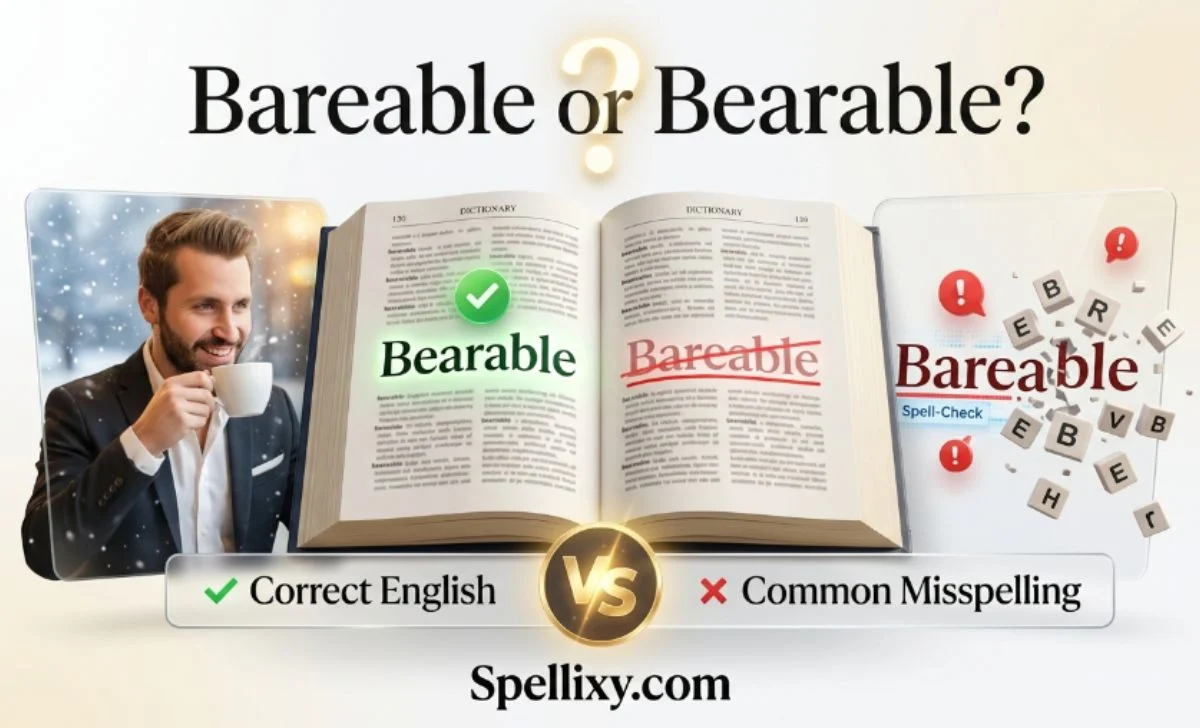
The correct spelling is bearable. The word bareable is a common misspelling and is not accepted in standard English dictionaries.
Whether you are writing an email, an essay, a social media post, or a business document, using the correct spelling helps your writing look more professional.
In this guide, you will learn the meaning of bearable, why bareable is incorrect, how to remember the right spelling, and how to use bearable correctly with clear examples.
Quick Answer
If you are deciding between bareable and bearable, the correct choice is bearable.
| Word | Correct? | Meaning |
|---|---|---|
| Bearable | ✅ Yes | Able to be tolerated, endured, or accepted. |
| Bareable | ❌ No | A misspelling. It is not a standard English word. |
Example:
- ✅ The pain was bearable after taking medicine.
- ❌ The pain was bareable after taking medicine.
In short: Always use bearable in formal and informal writing.
What Does Bearable Mean?
The adjective bearable means something that can be tolerated, endured, or managed without becoming impossible to handle. It often describes pain, weather, stress, noise, or difficult situations that are unpleasant but still manageable.
Simple definition
Bearable = able to be endured or tolerated.
For example:
- The heat became bearable once the rain started.
- Her headache was painful but still bearable.
- The workload was heavy, but it remained bearable.
- The traffic noise became more bearable after the windows were closed.
In everyday English, bearable usually suggests that something is not enjoyable, but it is not so bad that you cannot handle it.
Is Bareable a Real Word?
No. Bareable is not a standard English word.
It does not appear as a correct spelling in major English dictionaries because it is simply a spelling mistake of bearable.
Many people accidentally write bareable because the word bare is familiar. However, the adjective bearable comes from the verb bear, which means to tolerate, carry, or endure.
For that reason, the correct spelling always includes bear, not bare.
Correct examples
- ✅ This weather is finally bearable.
- ✅ The pain became more bearable after treatment.
- ✅ Her workload is difficult but bearable.
Incorrect examples
- ❌ The weather is bareable now.
- ❌ The pain is bareable.
- ❌ His schedule is bareable.
If you see bareable in writing, it should almost always be corrected to bearable.
Why Do People Misspell Bearable as Bareable?
The confusion happens because bear and bare are both real English words, but they have completely different meanings.
- Bear means to carry, endure, support, or tolerate.
- Bare means uncovered, exposed, or without clothing.
Since bearable means able to be endured, it must come from bear, not bare.
Think of it this way:
- Bear pain ✅
- Bear responsibility ✅
- Bear pressure ✅
You would never say:
- Bare pain ❌
- Bare responsibility ❌
Because bearable is built from the verb bear, the spelling with bear is the only correct one.
The Difference Between Bear and Bare
Understanding the parent words makes the spelling much easier to remember.
| Word | Meaning | Example |
|---|---|---|
| Bear | To endure, tolerate, support, or carry | I cannot bear the loud noise. |
| Bare | Uncovered, exposed, or empty | He walked with bare feet on the sand. |
Now compare their related forms:
- Bear → Bearable ✅
- Bare → Bareable ❌ (This word does not exist in standard English.)
A simple way to remember this is:
If you can bear something, it is bearable.
That one rule will help you avoid this common spelling mistake every time.
How to Use Bearable Correctly
The word bearable is used when something is difficult, unpleasant, or uncomfortable, but you can still deal with it. It often describes situations that are not ideal but are not impossible either.
Here are some of the most common contexts where bearable fits naturally.
Pain
Pain is one of the most frequent things described as bearable.
Examples:
- The medicine made the pain bearable.
- His back pain was uncomfortable but still bearable.
- The injury hurt, yet it remained bearable.
Weather
People often use bearable to describe very hot or cold weather that becomes easier to tolerate.
Examples:
- The evening breeze made the heat bearable.
- Winter was cold, but it was still bearable.
- The air conditioner made the office bearable.
Work or Daily Life
You can also use bearable for stress, pressure, or heavy workloads.
Examples:
- The project became more bearable after we hired another employee.
- Working from home made the long hours bearable.
- The traffic was frustrating but bearable.
Emotions and Situations
Sometimes bearable describes emotional experiences or difficult circumstances.
Examples:
- Her support made the loss more bearable.
- The waiting period became bearable with regular updates.
- Living alone was difficult but bearable.
Is More Bearable Correct?
Yes. More bearable is grammatically correct.
Because bearable is a longer adjective, English usually forms the comparative with more instead of adding -er.
Correct
- The weather is more bearable today.
- This chair is more bearable than the old one.
- The second treatment made the pain more bearable.
Incorrect
- ❌ Bearabler
- ❌ Most bearabler
Likewise, the superlative form is most bearable.
Examples:
- This is the most bearable solution.
- Summer evenings are the most bearable time to go outside.
Bearable Synonyms
If you do not want to repeat bearable, these words may work depending on the context.
| Synonym | Best Used For |
|---|---|
| Tolerable | Pain, weather, conditions |
| Endurable | Hardship, suffering |
| Manageable | Work, tasks, responsibilities |
| Acceptable | Quality, results, behavior |
| Livable | Living conditions |
| Sustainable | Long-term situations |
| Supportable | Decisions or arguments |
| Moderate | Levels of discomfort |
| Reasonable | Expectations or conditions |
| Enduring | Lasting through difficulty |
Remember that synonyms are not always interchangeable. Choose the word that best matches your sentence.
What Is the Opposite of Bearable?
The most common opposite of bearable is unbearable.
It describes something so painful, unpleasant, or difficult that it cannot be tolerated.
Examples
- The noise became unbearable after midnight.
- The summer heat was unbearable without air conditioning.
- The emotional stress felt unbearable.
Other antonyms include:
- Intolerable
- Insufferable
- Impossible to endure
- Unmanageable
Common Mistakes to Avoid
Many writers make the same mistakes because bear and bare look similar. Avoid these common errors.
| Incorrect | Correct |
|---|---|
| Bareable | Bearable |
| The pain is bareable. | The pain is bearable. |
| Bareable weather | Bearable weather |
| Bareable conditions | Bearable conditions |
Another mistake is confusing bearable with bare.
Remember:
- Bear = endure or tolerate.
- Bare = uncovered or exposed.
These words have different meanings, so they should never replace each other.
Memory Trick to Remember the Correct Spelling
A simple memory trick can help you spell bearable correctly every time.
Think about this sentence:
If you can BEAR it, it is BEARable.
Notice that both words begin with bear.
Examples:
- You bear pain, so the pain is bearable.
- You bear responsibility, so the workload becomes bearable.
- You bear stress, so the situation is bearable.
You never bare pain or bare responsibility, so bareable is never the correct spelling.
Bareable vs. Bearable: Side-by-Side Comparison
| Feature | Bearable | Bareable |
|---|---|---|
| Correct spelling | ✅ Yes | ❌ No |
| Found in dictionaries | ✅ Yes | ❌ No |
| Standard English | ✅ Yes | ❌ No |
| Means “able to be endured” | ✅ Yes | ❌ No |
| Suitable for formal writing | ✅ Yes | ❌ No |
| Suitable for informal writing | ✅ Yes | ❌ No |
Bearable is the only correct spelling when you mean something that can be tolerated or endured. Bareable is a common misspelling and should not be used in any type of writing.
FAQs
1. What does bearable mean?
Bearable means something that can be tolerated, endured, or managed. It often describes pain, weather, stress, or situations that are unpleasant but not impossible to handle.
2. Is it bareable or bearable?
The correct spelling is bearable. Bareable is a common misspelling and is not accepted in standard English.
3. Is “bareable” in the dictionary?
No. Bareable is not a standard English word and does not appear in major dictionaries. Always use bearable instead.
4. What is a word for bearable?
Common synonyms include tolerable, manageable, endurable, acceptable, and livable. The best synonym depends on the context.
5. Is more bearable grammatically correct?
Yes. More bearable is the correct comparative form.
Example: The weather is more bearable today than yesterday.
6. Is bearable a positive word?
Not exactly. It describes something unpleasant that can still be tolerated. It suggests a situation is manageable, not enjoyable.
7. What is the opposite of bearable?
The most common opposite is unbearable, which means impossible or extremely difficult to tolerate.
8. What is an example of bearable?
Example: The pain became bearable after taking the medicine.
Is format mein numbering bhi hogi aur SEO/readability dono better rahenge.
9. What does still bearable mean?
Still bearable means a situation is difficult or uncomfortable but can still be tolerated.
Example: The heat is intense, but it’s still bearable.
10. What does bearable person mean?
A bearable person is someone whose behavior or personality is tolerable, even if they are not especially pleasant.
Example: He’s not very friendly, but he’s bearable to work with.
11. What are the two meanings of bare?
The word bare has two common meanings:
- Uncovered or exposed (e.g., bare feet)
- Without anything extra (e.g., the bare minimum)
It is not related to the spelling bearable.
12. What is barrable?
Barrable is a different word from bearable. It is mainly used in legal contexts and means capable of being barred or prevented. It does not mean “able to be endured.”
13. What is the difference between bareable and bearable?
Bearable is the correct spelling and means able to be tolerated or endured. Bareable is a misspelling and should not be used in standard English.
14. How do you spell bearable correctly?
The correct spelling is bearable, spelled B-E-A-R-A-B-L-E. Remember: If you can bear it, it is bearable.
15. Why do people misspell bearable as bareable?
Many people confuse bear and bare because both are real English words. However, bearable comes from the verb bear (to endure), so bareable is always incorrect.
Conclusion
Choosing between bareable and bearable is simple once you know the difference. Bearable is the correct spelling and means able to be tolerated or endured.
The form bareable is a common misspelling and is not recognized in standard English.
Whenever you write about pain, weather, stress, or any situation that can be managed, always use bearable.
Remember this simple tip: If you can bear it, it is bearable. Keeping this rule in mind will help you avoid spelling mistakes and write with confidence.
Discover More Blogs :
- Publically or Publicly: The Definitive Answer to This Spelling Confusion
- Peek or Peak: A Practical Guide to Correct Usage
- Spicy or Spicey: Which Spelling Deserves a Place in Your Writing
- Sells or Sales: Simple Explanation That Actually Makes Sense