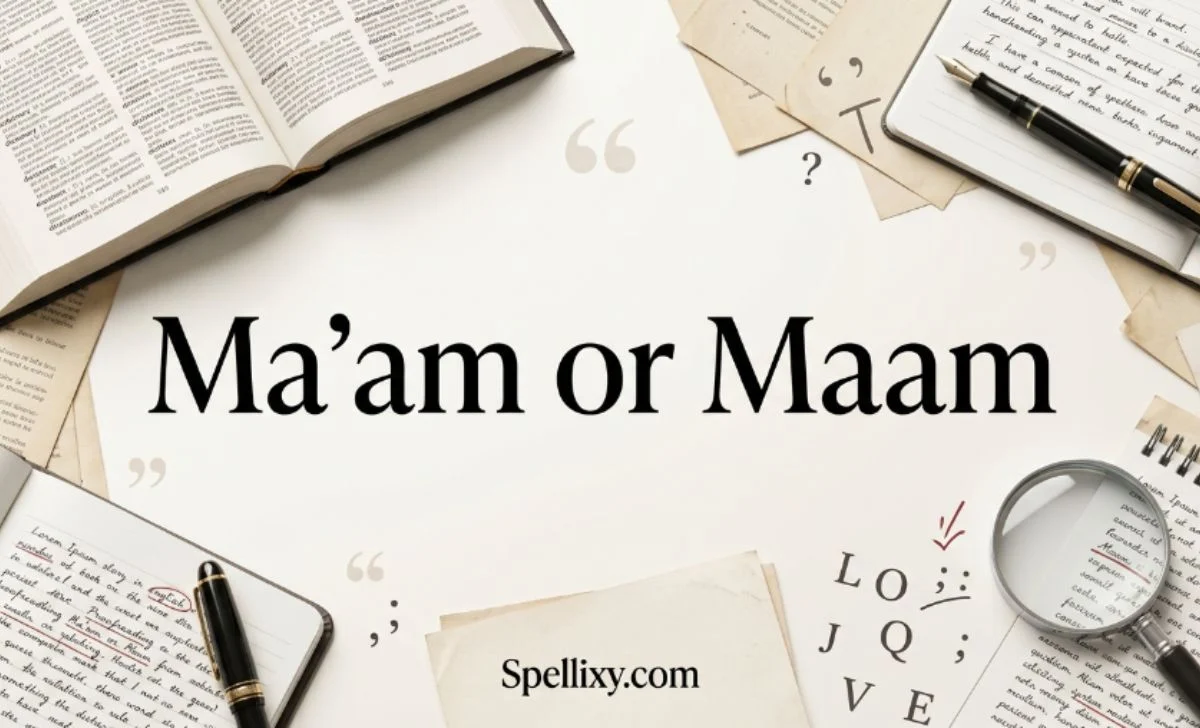
You finish writing an email to your teacher or manager and pause at the greeting. Should you write “Dear Maam” or “Dear Ma’am”?
It is a small detail, but using the wrong form can make an otherwise professional message look careless.
This confusion is common because both spellings look similar and many people type maam without realizing that ma’am is the standard English form.
The missing apostrophe is easy to overlook, especially on phones and social media.
In this guide, you’ll learn the difference between ma’am and maam, what ma’am means, why it has an apostrophe, when to use it in emails, letters, and everyday conversations, and how to avoid one of the most common punctuation mistakes in English.
Quick Answer
Ma’am is the correct spelling. It is the standard English contraction of madam and is used as a polite way to address a woman.
Maam is simply a misspelling. It is not accepted in standard English writing and should be avoided in emails, letters, school assignments, and professional communication.
| Word | Status | Best Use |
|---|---|---|
| Ma’am | Standard English | ✅ Emails, letters, workplaces, schools, and everyday conversations |
| Maam | Incorrect spelling | ❌ Avoid in formal and professional writing |
If you’re ever unsure, remember this simple rule: always write “ma’am” with an apostrophe.
What Does Ma’am Mean?
Ma’am is a respectful way to address a woman. It is the shortened form of madam, with the apostrophe showing that letters have been omitted.
People commonly use ma’am when speaking to or writing to:
- Teachers
- Managers
- Customers
- Police officers
- Military officers
- Older women
- Women you don’t know personally
The word shows politeness rather than familiarity. In many situations, using ma’am is a sign of good manners and professional respect.
Examples
- Yes, ma’am, I’ll finish the report today.
- Excuse me, ma’am, you dropped your wallet.
- Thank you, ma’am, for your help.
- Good morning, ma’am.
The exact level of formality can vary by country and culture, but ma’am is widely understood as a respectful form of address.
What Does Maam Mean?
In standard English, maam does not have an accepted meaning.
Most of the time, maam appears because someone forgets to include the apostrophe in ma’am. It is a spelling mistake rather than a separate English word.
For example:
❌ Dear Maam,
✅ Dear Ma’am,
❌ Thank you, Maam.
✅ Thank you, Ma’am.
Although many people type maam in text messages or on social media, it is not considered correct spelling. If you’re writing anything important, always use ma’am.
Why Does Ma’am Have an Apostrophe?
The apostrophe in ma’am is not optional. It has an important job.
Ma’am is a contraction of madam. When the word was shortened, some letters were removed and replaced with an apostrophe.
This follows the same pattern as other English contractions.
| Full Word | Contraction |
|---|---|
| Madam | Ma’am |
| Do not | Don’t |
| Cannot | Can’t |
| I am | I’m |
Because the apostrophe represents missing letters, writing maam without it is considered incorrect.
A simple way to remember this is that ma’am comes from madam, so it should always keep its apostrophe.
Ma’am vs. Maam: What’s the Difference?
The difference is simple but important.
Ma’am is the correct spelling recognized in dictionaries, style guides, and professional writing. Maam is a spelling mistake that usually happens when the apostrophe is omitted.
| Feature | Ma’am | Maam |
|---|---|---|
| Standard English | ✅ Yes | ❌ No |
| Correct spelling | ✅ Yes | ❌ No |
| Used in emails | ✅ Yes | ❌ Avoid |
| Used in business writing | ✅ Yes | ❌ No |
| Used in school assignments | ✅ Yes | ❌ No |
The pronunciation remains the same, but only ma’am is considered correct in writing.
After learning this difference, you’ll be able to spot the mistake immediately whenever you see maam.
Is Ma’am or Maam Correct for a Teacher?
When speaking to or writing to a female teacher, ma’am is the correct choice.
Students often begin emails with greetings such as:
- Dear Ma’am,
- Good morning, Ma’am.
- Thank you, Ma’am.
These forms are polite and appropriate in schools, colleges, and universities.
Writing Dear Maam without the apostrophe may seem like a small mistake, but teachers usually expect correct spelling in academic communication. Using ma’am shows attention to detail and respect.
Keep in mind that some teachers may prefer to be addressed by their name or title, such as Ms. Carter or Professor Lee. If you know their preference, use it. Otherwise, Ma’am is generally a safe and respectful option.
Is “Dear Ma’am” Correct?
Yes. Dear Ma’am is a correct and widely accepted greeting in formal correspondence.
You can use it when:
- You do not know the woman’s name.
- You are writing to a teacher.
- You are contacting a customer service representative.
- You are sending a formal request or inquiry.
For example:
Dear Ma’am,
I am writing to inquire about my application status.
However, if you know the recipient’s name, using it is usually more personal and professional.
Better:
Dear Ms. Johnson,
instead of
Dear Ma’am,
Using the person’s name whenever possible creates a stronger connection and follows modern email etiquette.
How to Use Ma’am in an Email
Ma’am is appropriate in an email when you don’t know the recipient’s name or when you want to show respect.
It is common in schools, customer service, government offices, and formal business communication.
Examples
- Dear Ma’am,
- Good morning, Ma’am.
- Thank you for your time, Ma’am.
- I appreciate your guidance, Ma’am.
If you know the recipient’s name, use it instead. A personalized greeting is more professional and makes your email feel more direct.
Preferred
Dear Ms. Wilson,
Instead of
Dear Ma’am,
Using the correct title also helps avoid confusion, especially when you’re communicating with someone for the first time.
How to Use Ma’am in a Letter
The same rule applies to letters. If you know the woman’s name, begin with her name and title. If you don’t, Dear Ma’am is an acceptable formal greeting.
Correct examples
Dear Ma’am,
Dear Ms. Adams,
Dear Professor Brown,
Avoid writing Dear Maam because it contains a spelling mistake. Even a small punctuation error can make a formal letter appear less polished.
Can I Say “Ma’am” to a Girl?
Yes, but it depends on the situation.
Ma’am is used to show respect, not to describe someone’s age. It is appropriate when speaking to teachers, customers, supervisors, police officers, or any woman you want to address politely.
In casual conversations with friends or classmates, ma’am may sound too formal or unnecessary.
For example:
- Appropriate: Yes, Ma’am. I’ll submit the assignment today.
- Less natural: Hi, Ma’am! Want to grab lunch with us?
Choosing the right form of address depends on your relationship with the person and the setting.
How Do You Address a Teacher as Ma’am?
Many students use Ma’am when speaking to female teachers in classrooms or writing academic emails.
Examples include:
- Good morning, Ma’am.
- Thank you, Ma’am.
- Excuse me, Ma’am. I have a question.
- Dear Ma’am, I have attached my assignment.
If your teacher prefers a specific title such as Ms. Smith, Mrs. Khan, or Professor Johnson, follow that preference. Using someone’s preferred title shows courtesy and professionalism.
How Do You Pronounce Ma’am?
Ma’am (mam)
Ma’am is usually pronounced as “mam,” with a short a sound. The apostrophe affects the spelling, but it does not change how the word is spoken.
Whether you’re speaking in a classroom, office, or everyday conversation, the pronunciation remains the same.
Ma’am in a Sentence
These examples show how ma’am is used naturally in different situations.
At school
- Good afternoon, Ma’am.
- Thank you for explaining the lesson, Ma’am.
At work
- Excuse me, Ma’am. Could you review this report?
- Yes, Ma’am. I’ll complete the task before noon.
Customer service
- How may I help you today, Ma’am?
- Have a wonderful day, Ma’am.
Formal writing
- Dear Ma’am, I would like to request additional information about the program.
These examples all use ma’am as a respectful form of address.
Common Mistakes to Avoid
Using ma’am correctly is simple once you know a few common mistakes.
Writing maam instead of ma’am
This is the most common error. Always include the apostrophe because ma’am is a contraction of madam.
✅ Thank you, Ma’am.
❌ Thank you, Maam.
Forgetting to capitalize Ma’am in greetings
When Ma’am begins a greeting or directly addresses someone, capitalize it.
✅ Dear Ma’am,
✅ Good morning, Ma’am.
Using Ma’am when you know the person’s preferred title
If someone signs their emails as Ms. Garcia, Dr. Ahmed, or Professor Lewis, use that title instead of Ma’am. It makes your communication more personal and professional.
Omitting the comma when directly addressing someone
When Ma’am is used to address a person directly, separate it with a comma.
✅ Yes, Ma’am.
✅ Thank you, Ma’am.
❌ Yes Ma’am.
❌ Thank you Ma’am.
A Simple Memory Trick
Think of the word madam.
Since Ma’am is the shortened form of madam, it always needs an apostrophe. If you don’t see the apostrophe, the spelling is probably wrong.
A quick rule to remember is:
No apostrophe, no correct spelling.
This simple trick can help you avoid one of the most common punctuation mistakes in emails, letters, and everyday writing.
FAQs
1. Is “Ma’am” or “Maam” correct?
Ma’am is the correct spelling. It is the standard contraction of madam and always includes an apostrophe. Maam is a misspelling and should be avoided in formal and professional writing.
2. What does ma’am mean?
Ma’am is a polite form of address used for a woman. It is commonly used when speaking to teachers, managers, customers, or women you want to address respectfully.
3. What does maam mean?
In standard English, maam has no separate meaning. It is usually an incorrect spelling of ma’am caused by leaving out the apostrophe.
4. Can I say “Ma’am” to a girl?
Yes, you can. Ma’am is a respectful way to address a woman or girl in formal situations. However, in casual conversations with friends or people your own age, it may sound too formal.
5. How do I address a teacher as Ma’am?
You can simply say “Good morning, Ma’am,” “Thank you, Ma’am,” or begin an email with “Dear Ma’am,” if you do not know the teacher’s preferred title. If the teacher uses Ms., Mrs., Dr., or Professor, it is better to use that title instead.
6. Is “Dear Ma’am” correct?
Yes. Dear Ma’am is a correct greeting when you do not know the recipient’s name. If you know her name, using Dear Ms. Smith or another appropriate title is usually more professional.
7. How do I address a female in an email?
If you know the person’s name, use Ms., Mrs., Dr., or another appropriate title followed by the surname. If you do not know her name, Dear Ma’am is an acceptable formal greeting.
8. Is “Dear Sir” outdated?
Not completely. Dear Sir is still used in some formal letters, but many organizations now prefer gender-neutral greetings such as Dear Hiring Manager, Dear Customer Support Team, or using the recipient’s name whenever possible.
9. How do I end a letter to an unknown person?
Choose a professional closing such as:
- Sincerely,
- Kind regards,
- Best regards,
- Respectfully,
These closings work well whether or not you know the recipient’s name.
10. What is the most respectful way to end a letter?
Sincerely remains one of the most professional and widely accepted closings. Depending on the situation, Respectfully or Kind regards are also excellent choices.
11. What should I avoid in email greetings?
Avoid misspelling Ma’am as Maam, using informal greetings in professional emails, or addressing someone by the wrong title. If you know the recipient’s name, use it instead of a generic greeting whenever possible.
12. How do you end an email to someone you’ve never met?
A professional closing such as Kind regards, Best regards, or Sincerely is appropriate. Always include your name and, if relevant, your job title or contact information.
Final Verdict
If you’re choosing between Ma’am and Maam, the answer is straightforward: Ma’am is the correct spelling.The apostrophe is an important part of the word because Ma’am is a contraction of madam.
Whether you’re writing to a teacher, replying to a manager, sending a business email, or addressing someone respectfully, Ma’am is the standard form recognized in English.
Although Maam is common in text messages and online typing, it is considered a spelling mistake in standard English. Using Ma’am helps your writing look polished, professional, and grammatically correct.
Discover More Blogs :
- Finalise or Finalize :What’s the Best Choice for Professional Writing
- Ate or Eaten: The Correct Way to Use These Verb Forms in English
- Posible or Possible : Here’s the Spelling You Should Always Use
- Divine or Devine: The Word You See Everywhere but Spell Wrong
- Publically or Publicly: A Writer’s Guide to the Correct Form