English has many words that look almost the same but have very different meanings. One common example is peoples and people’s. Many students, writers, bloggers, and even native English speakers are unsure which one is correct.
Should you write people’s rights, peoples of the world, or peoples’ traditions? The small apostrophe changes the meaning completely.
Using the wrong form can make your writing look unprofessional or even change what you want to say.
This guide explains the difference between peoples and people’s, shows when each word is correct, provides real examples, and shares simple grammar rules so you can write confidently in school, business, emails, blogs, and everyday English.
Peoples or People’s – Quick Answer
The answer depends on what you want to say.
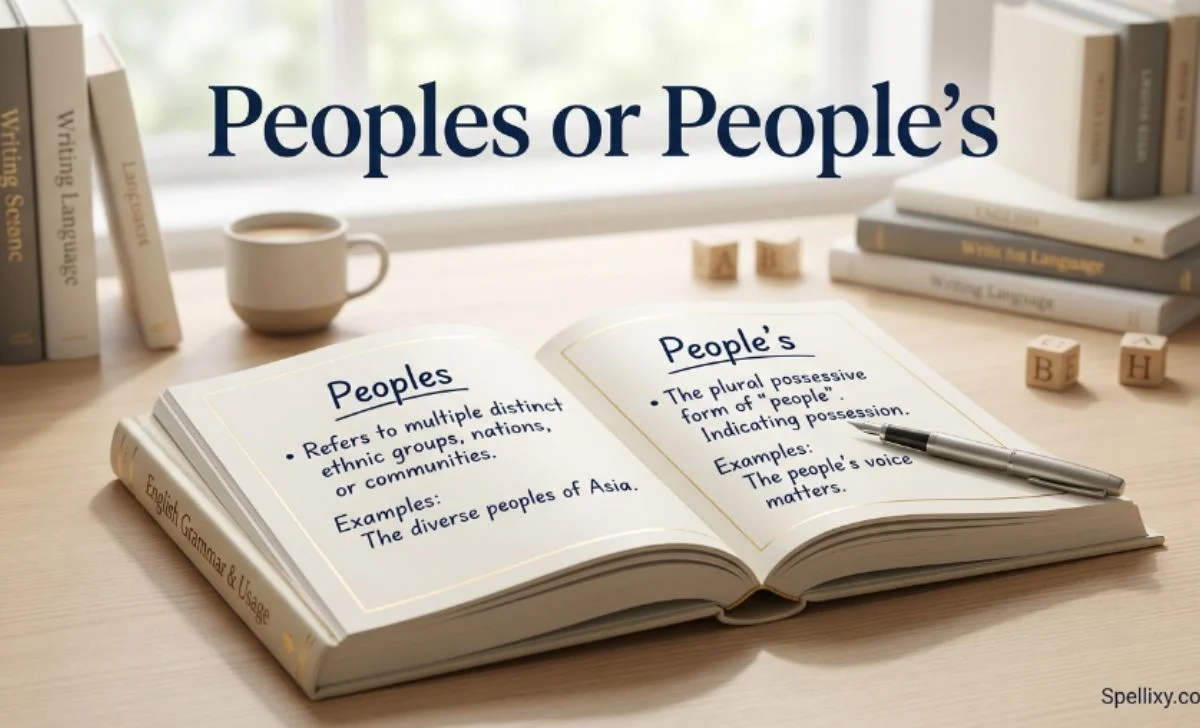
- People’s is the possessive form of people. It means something belongs to or is connected with people.
- Peoples is the plural form of “people” used when referring to distinct cultural, ethnic, or national groups. It is a real English word, but it is much less common than people.
For everyday English, people’s is the form you will use most often because it shows ownership or association.
For example:
✅ The people’s voice should be heard.
Here, the voice belongs to the people.
Another example:
✅ The museum celebrates the traditions of Indigenous peoples.
In this sentence, peoples refers to multiple cultural or ethnic groups rather than one large group of people.
Correct Examples
| Sentence | Why It Is Correct |
|---|---|
| The people’s choice surprised everyone. | Shows something belonging to the people. |
| We must protect the people’s rights. | Rights belong to the people. |
| Indigenous peoples have unique traditions. | Refers to several distinct ethnic groups. |
| The conference welcomed many peoples from around the world. | Means different nations or communities. |
| The people’s trust is important for democracy. | Trust belongs to the people. |
Incorrect Examples
| Incorrect Sentence | Correct Sentence |
|---|---|
| The peoples rights were ignored. | The people’s rights were ignored. |
| Every country’s people’s have different customs. | Every country’s people have different customs. |
| The people’s of Europe have rich histories. | The peoples of Europe have rich histories. |
| Indigenous people’s protect their traditions. | Indigenous peoples protect their traditions. |
| Many people’s attended the event. | Many people attended the event. |
A simple trick can help you remember the difference.
If you can replace the phrase with “belongs to the people,” then people’s is correct.
If you are talking about different nations, ethnic groups, or cultures, then peoples is the correct word.
What Is the Difference Between People, Peoples, and People’s?
Many learners think these words mean exactly the same thing. In reality, each has its own grammar rule and purpose. Understanding these differences makes your writing clearer and more accurate.
What Does “People” Mean?
People is the standard plural form of person. It refers to two or more individuals and is one of the most common nouns in English.
Examples include:
- People enjoy listening to music.
- Many people work from home.
- People learn new skills every day.
- Friendly people make a community stronger.
- Young people often use social media.
In everyday English, people is almost always the correct choice when talking about a group of individuals.
What Does “Peoples” Mean?
Many writers ask, “Is peoples correct?”
Yes. Peoples is a correct English word. However, it has a very specific meaning.
Instead of meaning many individuals, peoples refers to multiple distinct groups of people, usually based on culture, ethnicity, language, nationality, or historical identity.
This word appears most often in:
- History books
- Geography
- Anthropology
- Sociology
- Human rights documents
- International law
- United Nations publications
- Academic writing
Examples include:
- The Indigenous peoples of North America have diverse traditions.
- Ancient peoples built remarkable civilizations.
- Different peoples have their own languages and customs.
- The rights of Indigenous peoples are protected under international law.
- Many peoples preserved their cultural identity despite centuries of change.
Notice that peoples does not simply mean “many people.” Instead, it emphasizes separate communities or nations.
What Does “People’s” Mean?
People’s is the possessive form of people.
It shows that something belongs to, affects, or relates to people as a group.
Examples include:
- The people’s opinion matters.
- The people’s decision changed history.
- The people’s confidence increased.
- The government should respect the people’s wishes.
- The people’s health remains a national priority.
You can test yourself with one easy question:
Does something belong to the people?
If the answer is yes, then people’s is almost certainly the correct choice.
For example:
- the people’s voice
- the people’s freedom
- the people’s trust
- the people’s safety
- the people’s future
In each sentence, the noun belongs to or is associated with the people.
Is Peoples Correct?
One of the most searched grammar questions online is, “Is peoples correct?”
The answer is yes, but only in certain situations.
Many learners assume peoples is a spelling mistake because they rarely hear it in everyday conversation. In reality, major dictionaries recognize peoples as a correct plural noun with a specialized meaning.
You should use peoples only when referring to distinct cultural, ethnic, or national groups.
For example:
- The Indigenous peoples of Australia maintain rich cultural traditions.
- African peoples have contributed to world history in countless ways.
- The conference brought together peoples from every continent.
- The museum tells the stories of ancient peoples.
- International organizations work to protect the rights of Indigenous peoples.
However, if you simply mean several individuals, people is still the correct word.
Compare these examples:
✅ Thousands of people attended the concert.
❌ Thousands of peoples attended the concert.
The second sentence is incorrect because it refers to individuals, not different cultural groups.
Another comparison:
✅ The peoples of South America have diverse traditions.
✅ The people of South America are welcoming.
Although both sentences are correct, they express different ideas.
- People treats everyone as one general population.
- Peoples highlights multiple distinct cultural or ethnic communities.
Understanding this difference is one of the easiest ways to avoid grammar mistakes and write with confidence.
What Does People’s Mean?
The apostrophe is the only visible difference between people’s and peoples, but it changes the meaning completely.
While peoples refers to multiple cultural or ethnic groups, people’s shows possession. In other words, it tells readers that something belongs to or is connected with people.
If you remember this simple rule, you will avoid one of the most common English grammar mistakes.
The Apostrophe Rule
An apostrophe (‘s) is used to show ownership or possession.
For example:
- The student’s book belongs to the student.
- The company’s office belongs to the company.
- The teacher’s desk belongs to the teacher.
- The people’s voice belongs to the people.
The same grammar rule applies to people’s.
Think of it this way:
People + ‘s = People’s (something belongs to people).
Examples:
- The people’s vote changed the election.
- The people’s trust is important.
- The people’s safety comes first.
- The people’s health should be protected.
- The people’s opinion matters.
In each sentence, the noun after people’s belongs to or relates to the people.
Possessive Meaning
The word people is already plural. Unlike most plural nouns ending in -s, it has an irregular plural form.
- Person → People
- Child → Children
- Man → Men
- Woman → Women
To make these irregular plural nouns possessive, simply add ‘s.
| Irregular Plural | Possessive Form | Example |
|---|---|---|
| People | People’s | The people’s choice |
| Children | Children’s | Children’s books |
| Men | Men’s | Men’s clothing |
| Women | Women’s | Women’s health |
This is why people’s is correct.
Examples of People’s
Here are examples you will often see in everyday English.
Government
- The government should protect the people’s rights.
- Leaders must earn the people’s trust.
- The constitution guarantees the people’s freedom.
Education
- The school values the people’s opinions.
- Teachers should respect the people’s concerns.
Business
- Companies should listen to the people’s feedback.
- Brands grow when they understand the people’s needs.
Health
- Doctors care about the people’s well-being.
- Public policies improve the people’s health.
Daily Conversation
- The people’s happiness matters.
- Everyone respected the people’s decision.
Peoples or People’s: Comparison Table
The easiest way to understand these words is to compare them side by side.
| Word | Meaning | Correct Usage | Example |
|---|---|---|---|
| People | More than one person | Everyday English | Many people visited the park. |
| Peoples | Different nations, ethnic groups, or cultures | History, geography, anthropology, international law | Indigenous peoples protect their traditions. |
| People’s | Possessive form of people | Shows ownership | The people’s voice deserves respect. |
Quick Comparison
| Question | Correct Word |
|---|---|
| Talking about many individuals? | People |
| Talking about different ethnic groups? | Peoples |
| Showing something belongs to people? | People’s |
| Talking about rights, opinions, or voices? | People’s |
| Talking about tribes or nations? | Peoples |
Easy Memory Trick
Ask yourself one question.
Does something belong to the people?
If yes, use people’s.
If no, ask another question.
Am I talking about different cultural or ethnic groups?
If yes, use peoples.
Otherwise, use people.
This simple trick works almost every time.
How to Use Peoples Correctly
Many English learners avoid the word peoples because they think it is incorrect. In reality, dictionaries recognize it as a proper English word. The key is knowing when to use it.
Indigenous Peoples
The most common use of peoples appears in discussions about Indigenous communities.
Examples:
- Indigenous peoples have protected their traditions for centuries.
- Governments should respect Indigenous peoples’ rights.
- Museums preserve the history of Indigenous peoples.
Notice that when ownership is needed, the possessive form becomes peoples’ with the apostrophe after the s because peoples is already plural.
Example:
- Indigenous peoples’ languages are disappearing.
Different Nations and Ethnic Groups
Use peoples when referring to separate communities rather than one large population.
Examples:
- The peoples of Europe speak many languages.
- Ancient peoples developed remarkable civilizations.
- African peoples have rich cultural traditions.
- The peoples of Asia celebrate many festivals.
- Different peoples preserve unique customs.
Oxford Dictionary Meaning
Leading English dictionaries define peoples as:
Different races, nations, tribes, or ethnic groups considered separately.
That definition explains why peoples appears frequently in:
- History
- Anthropology
- Sociology
- Geography
- International law
- Human rights reports
- Academic research
You will rarely use peoples in casual conversations because people is usually enough.
How to Use People’s Correctly
The word people’s is much more common than peoples because everyday English often needs the possessive form.
People’s Rights
Examples include:
- The people’s rights must be protected.
- Every nation should respect the people’s freedoms.
- Leaders serve the people’s interests.
People’s Opinions
Examples:
- The people’s opinions shaped the decision.
- Politicians should hear the people’s concerns.
- The survey measured the people’s views.
People’s Lives
One of the most searched phrases is:
People’s or peoples lives?
The correct answer is almost always:
✅ People’s lives
Examples:
- Technology has changed people’s lives.
- Education improves people’s lives.
- Good healthcare saves people’s lives.
- Clean water protects people’s lives.
- Better jobs improve people’s lives.
Use peoples’ lives only when discussing several distinct groups.
Example:
- Climate change affects many Indigenous peoples’ lives differently.
This is much less common.
People’s Wishes
Examples:
- The judge respected the people’s wishes.
- Democracy reflects the people’s voice.
- The leader ignored the people’s demands.
People’s or Peoples in a Sentence
Seeing these words in context makes the grammar much easier.
Everyday English
- People enjoy spending time with family.
- The people’s decision surprised everyone.
- Many people travel during holidays.
- The people’s confidence increased.
Business Writing
- Businesses should understand the people’s needs.
- The company values people’s feedback.
- Successful brands earn the people’s trust.
Academic Writing
- Ancient peoples created advanced societies.
- Researchers studied Indigenous peoples.
- Historians compare different peoples across continents.
News Writing
- The government promised to protect the people’s rights.
- Leaders met with Indigenous peoples.
- The report highlighted the concerns of local people.
Social Media
- I love meeting new people.
- Respect other people’s opinions.
- We should celebrate all peoples and cultures around the world.
By choosing the correct form based on meaning, not just spelling, you can make your writing clearer, more professional, and grammatically accurate.
Common Grammar Mistakes with Peoples or People’s
Even skilled writers sometimes mix up people, peoples, and people’s because the words are closely related.
However, each one has a different purpose in English grammar. Understanding these differences helps you write more clearly and avoid common punctuation mistakes.
Frequent Errors
Below are some of the most common mistakes and their corrections.
| Incorrect | Correct | Explanation |
|---|---|---|
| Many peoples attended the meeting. | Many people attended the meeting. | Use people for a group of individuals. |
| The peoples rights were ignored. | The people’s rights were ignored. | Rights belong to the people, so use the possessive form. |
| The people’s of Asia have different traditions. | The peoples of Asia have different traditions. | Use peoples for different ethnic or cultural groups. |
| Every people’s enjoys music. | Every people enjoys music. | No possession is shown here. |
| Several people’s visited the museum. | Several people visited the museum. | The apostrophe is unnecessary. |
Corrected Examples
Compare these sentence pairs to understand the difference.
❌ The peoples opinion matters.
✅ The people’s opinion matters.
❌ Different people’s have unique customs.
✅ Different peoples have unique customs.
❌ The peoples voted yesterday.
✅ The people voted yesterday.
❌ The people’s of the Pacific Islands share rich traditions.
✅ The peoples of the Pacific Islands share rich traditions.
❌ The peoples voice was heard.
✅ The people’s voice was heard.
Quick Grammar Checklist
Before writing, ask yourself these questions:
- Am I talking about many individuals? → People
- Am I talking about different nations or ethnic groups? → Peoples
- Am I showing ownership? → People’s
This simple checklist will solve almost every grammar question related to these words.
People vs Peoples vs People’s vs Persons
These four words are related, but they are not interchangeable. Each has its own meaning and usage.
Comparison Table
| Word | Meaning | Example | Common Usage |
|---|---|---|---|
| Person | One individual | One person entered the room. | Singular noun |
| People | More than one person | Many people attended. | Everyday English |
| Peoples | Different nations or ethnic groups | Indigenous peoples protected their traditions. | Academic and formal writing |
| People’s | Possessive form of people | The people’s decision changed history. | Everyday English |
Person vs People
Person refers to one individual.
Examples:
- One person called today.
- Every person has rights.
- She is a kind person.
People is the normal plural.
Examples:
- Many people attended the event.
- People love good stories.
- People learn from experience.
People vs Peoples
Although these words differ by only one letter, their meanings are different.
People
Use it for a general group of individuals.
Examples:
- People enjoy music.
- People work hard.
- People travel for business.
Peoples
Use it when referring to different cultural, ethnic, or national groups.
Examples:
- Indigenous peoples have unique traditions.
- Ancient peoples built remarkable monuments.
- Many peoples celebrate the harvest differently.
People’s vs Peoples
This is where many writers become confused.
People’s shows possession.
Examples:
- The people’s voice
- The people’s trust
- The people’s choice
- The people’s freedom
Peoples names different groups of people.
Examples:
- Indigenous peoples
- Ancient peoples
- Tribal peoples
- Arctic peoples
Remember this easy rule:
- Apostrophe = possession.
- No apostrophe = multiple cultural groups.
Person or Persons?
Another common question is whether you should write people or persons.
In modern English, people is the preferred plural in almost every situation.
Examples:
- Two people arrived early.
- Three people applied for the job.
The word persons still appears in legal, official, and technical documents.
Examples:
- Missing persons report
- Persons under eighteen
- Authorized persons only
For normal writing, choose people instead of persons.
Is It Different in British and American English?
Many grammar topics have different spellings in British and American English, such as colour/color or travelling/traveling.
However, people, peoples, and people’s follow the same grammar rules in both varieties of English.
UK vs US Usage
Whether you write for readers in the United States, the United Kingdom, Canada, Australia, or India, the rules remain the same.
| Usage | American English | British English |
|---|---|---|
| People | ✅ Correct | ✅ Correct |
| Peoples | ✅ Correct | ✅ Correct |
| People’s | ✅ Correct | ✅ Correct |
| People’s rights | ✅ Common | ✅ Common |
| Indigenous peoples | ✅ Common | ✅ Common |
The only difference is how frequently certain expressions appear.
For example, Indigenous peoples is especially common in:
- United Nations documents
- Academic journals
- History books
- Anthropology research
- Human rights reports
Meanwhile, people’s is common in everyday writing everywhere.
Examples include:
- People’s opinions
- People’s lives
- People’s health
- People’s money
- People’s rights
So, you never need to change the spelling based on your audience’s country.
Google Trends & Usage Data
Search interest shows that thousands of English learners look up people, peoples, and people’s because the apostrophe and plural form are confusing.
Popular Countries
The keyword is searched most often in countries where English is the primary language or widely studied.
| Country | Why People Search |
|---|---|
| United States | School grammar, business writing, editing, and SEO content |
| United Kingdom | Apostrophe rules and possessive nouns |
| Canada | Academic writing and English learning |
| Australia | Grammar improvement and proofreading |
| India | Competitive exams, education, and professional communication |
Students, bloggers, journalists, copywriters, editors, teachers, and content marketers frequently search this topic to improve their writing accuracy.
Why People Search This Keyword
People usually search “Peoples or People’s” because they want quick answers to practical grammar questions.
The most common search intentions include:
- Is peoples a real word?
- Should I write people’s or peoples?
- Where does the apostrophe go?
- How do dictionaries define these words?
- What is the difference between people, peoples, and people’s?
- How do I use them in sentences?
- Which form is correct for academic writing?
- Is people’s lives grammatically correct?
- How do native English speakers use these words?
- Are the rules different in British and American English?
By understanding these questions, you can choose the correct word with confidence and write naturally in every situation.
Related Grammar Rules
Understanding people, peoples, and people’s becomes much easier when you also know a few related grammar rules. These rules apply to many English nouns and will improve your writing in general.
Apostrophe Rules
An apostrophe is mainly used to show possession.
Here are the basic rules.
| Noun Type | Possessive Form | Example |
|---|---|---|
| Singular noun | Add ‘s | The student’s book |
| Regular plural ending in s | Add ‘ | The teachers’ lounge |
| Irregular plural not ending in s | Add ‘s | Children’s toys, Men’s shoes, People’s rights |
Since people is an irregular plural noun, its possessive form is always people’s.
Examples:
- The people’s choice
- The people’s money
- The people’s safety
- The people’s future
- The people’s confidence
Plural vs Possessive Nouns
Many learners confuse plural nouns with possessive nouns.
| Plural | Possessive | Example |
|---|---|---|
| Cats | Cats’ | The cats’ food |
| Students | Students’ | The students’ classroom |
| Children | Children’s | The children’s playground |
| People | People’s | The people’s opinions |
A simple reminder is:
- Plural tells you how many.
- Possessive tells you who owns something.
Similar Grammar Mistakes
If you struggle with people’s, you may also confuse these common word pairs.
| Common Mistake | Correct Usage |
|---|---|
| Its / It’s | Possession vs contraction |
| Whose / Who’s | Possession vs “who is” |
| Your / You’re | Possession vs “you are” |
| Their / They’re / There | Possession, contraction, and place |
| Peoples / People’s | Plural cultures vs possession |
Learning these grammar pairs together makes English writing much easier.
FAQs
1. Should I use peoples or people’s?
Use people’s when something belongs to people, such as people’s rights or people’s opinions. Use peoples only when referring to different nations, ethnic groups, or cultures.
2. Where does the apostrophe go in people’s?
The apostrophe comes before the s because people is an irregular plural noun. The correct possessive form is people’s.
3. How do you use peoples correctly?
Use peoples when discussing separate cultural, ethnic, or national groups.
Example:
The Indigenous peoples protected their traditions.
4. What does “people’s” mean?
People’s means something belongs to or is associated with people.
Example:
The people’s voice should always be heard.
5. Is people’s correct English?
Yes. People’s is completely correct and follows standard English grammar rules.
6. How do you use people’s?
Use it before a noun to show possession.
Examples include:
- People’s lives
- People’s health
- People’s rights
- People’s choices
7. How do you use people’s in a sentence?
Example:
The government’s decision affected the people’s future.
8. Is it Jones or Jones’s?
Most modern style guides recommend Jones’s for the singular possessive form.
Example:
Jones’s car was parked outside.
Some newspapers use Jones, but Jones’s is generally preferred.
9. Is it correct to say “other people’s lives”?
Yes.
Other people’s lives is grammatically correct because the lives belong to other people.
10. What is the difference between people and peoples?
People refers to a general group of individuals.
Peoples refers to distinct cultural, ethnic, or national communities.
11. Is it 2 people or 2 persons?
In everyday English, 2 people is correct.
2 persons is mainly used in legal or formal documents.
12. What are 10 examples of apostrophe sentences?
Examples:
- The people’s vote mattered.
- The child’s toy was broken.
- The women’s team won.
- The men’s jackets were expensive.
- The children’s books were colorful.
- The dog’s leash was missing.
- My friend’s car is new.
- The company’s profits increased.
- The teachers’ meeting starts today.
- The cats’ bowls are empty.
13. Is peoples a real English word?
Yes. Peoples is a real English word recognized by major dictionaries. It refers to different cultural, ethnic, or national groups.
14. When should you use peoples instead of people?
Use peoples when you want to emphasize separate communities rather than one general population.
15. Can people’s refer to more than one person?
Yes.
Since people is already plural, people’s refers to something belonging to multiple people.
16. What is the possessive form of people?
The possessive form is people’s.
17. What is the plural of person?
The standard plural is people.
The word persons is mostly limited to legal and official contexts.
18. Is peoples used in British English?
Yes.
Both British and American English recognize peoples with the same meaning.
19. Is peoples used in American English?
Yes.
It commonly appears in academic writing, history, anthropology, and international law.
20. Why is people’s written with an apostrophe?
The apostrophe shows possession.
Example:
The people’s decision changed history.
21. Can peoples and people’s be used interchangeably?
No.
Although they look similar, they have different meanings and cannot replace each other.
22. How do you pronounce peoples and people’s?
Both are pronounced very similarly, but their meanings differ based on context.
23. What are common mistakes with peoples and people’s?
The biggest mistake is using peoples when possession is intended or adding an apostrophe where none is needed.
24. How do dictionaries define peoples and people’s?
Dictionaries define peoples as different nations or ethnic groups, while people’s is the possessive form of people.
25. Which is more common in everyday English: people, peoples, or people’s?
People is the most common, followed by people’s. Peoples is much less common and mainly appears in formal, historical, and academic contexts.
Conclusion
Understanding the difference between people, peoples, and people’s helps you write with confidence and accuracy.
People is the everyday plural of person, people’s is the possessive form used to show ownership, and peoples refers to different nations, cultures, or ethnic groups.
The apostrophe is small, but it changes the meaning of a sentence completely. Whenever you are unsure, ask yourself whether you are showing possession or referring to separate communities.
If something belongs to people, use people’s. If you mean multiple cultural groups, use peoples. For everyday conversations, emails, blogs, and business writing, people and people’s are the forms you will use most often.
Mastering these simple grammar rules will make your English clearer, more professional, and easier to understand.

Hi, I’m Michael McCarthy from Spellixy.com.
I help you learn English grammar, improve writing, and understand language in a simple and easy way.