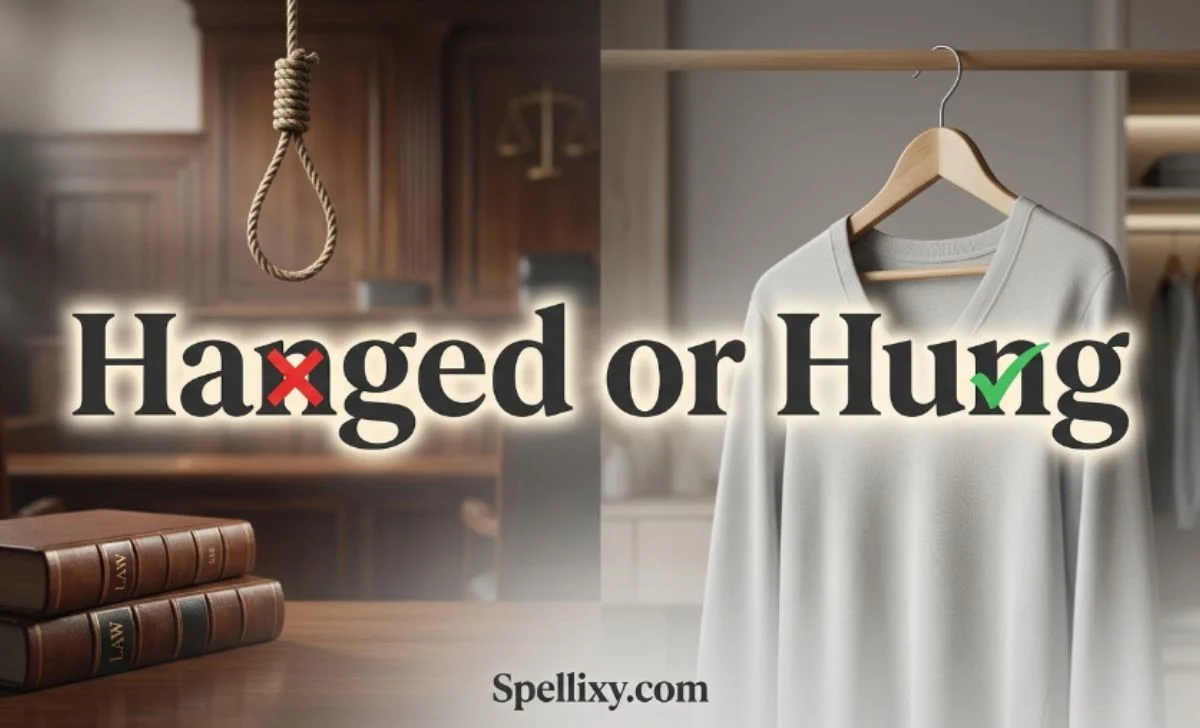
Have you ever stopped while writing and wondered whether it should be hanged or hung? You are not alone.
These two words come from the same verb—hang—but they are not always interchangeable. Choosing the wrong one can make a sentence sound awkward or even change its meaning completely.
The confusion is common because both words are correct in different situations. In this guide, you will learn the simple grammar rule, understand when to use each word, and see plenty of real-life examples.
By the end, you will know exactly whether hanged or hung is the right choice for everyday writing, school assignments, business communication, and professional content.
Hanged or Hung – Quick Answer
The short answer is simple:
- Hung is used when talking about placing or suspending something.
- Hanged is used only when referring to a person who was executed by hanging.
This is one of the few special grammar rules in English where the same verb has two different past tense and past participle forms depending on the meaning.
For example:
- ✅ She hung the painting on the wall.
- ✅ They hung colorful lights across the garden.
- ✅ The judge ordered that the criminal be hanged according to the law.
- ✅ In the past, some prisoners were hanged for serious crimes.
If your sentence is about pictures, clothes, decorations, curtains, signs, or other objects, hung is almost always the correct choice. If it describes execution by hanging, use hanged instead.
Correct Examples
These examples show the correct use of each word in everyday English.
Using “Hung”
- The family hung a mirror in the hallway.
- Sarah hung her jacket by the door.
- We hung balloons for the birthday party.
- He carefully hung the artwork above the fireplace.
- The photographer hung several pictures in the gallery.
Using “Hanged”
- The prisoner was hanged after the court’s final decision.
- Historical records show that several pirates were hanged.
- The man was hanged for treason centuries ago.
- The novel tells the story of a soldier who was hanged during wartime.
A simple memory trick is this:
If it’s an object, use “hung.” If it’s an execution, use “hanged.”
What Is the Difference Between Hanged and Hung?
Although both words come from the verb hang, they serve different purposes in modern English. Understanding this difference helps you avoid one of the most common grammar mistakes.
When to Use Hung
Use hung whenever something is placed, attached, or suspended from another object. This is the form you will use in almost every everyday conversation, email, article, or social media post.
Examples include:
- The children hung their backpacks on the hooks.
- We hung new curtains in the living room.
- She hung the family photo above the sofa.
- Colorful lanterns were hung across the street.
- His coat hung neatly in the closet.
Whether you are talking about decorations, clothing, artwork, lights, signs, or tools, hung is the correct choice.
When to Use Hanged
Use hanged only when referring to a legal or historical execution carried out by hanging.
Because this meaning is very specific, most people rarely need to use hanged in everyday writing. You are most likely to see it in history books, legal documents, newspapers discussing historical events, or historical fiction.
Examples include:
- The convicted criminal was hanged in the nineteenth century.
- According to the records, the spy was hanged after the trial.
- Several rebels were hanged during the conflict.
Outside this context, replacing hung with hanged is considered incorrect.
Quick Comparison
| Situation | Correct Word | Example |
|---|---|---|
| A picture on a wall | Hung | She hung a picture in the office. |
| Clothes on a hanger | Hung | He hung his coat in the closet. |
| Christmas decorations | Hung | They hung lights around the house. |
| A flag on a pole | Hung | The workers hung the new flag. |
| Judicial execution | Hanged | The prisoner was hanged after the trial. |
| Historical execution | Hanged | Several pirates were hanged centuries ago. |
Remember this rule whenever you write:
Use hung for things. Use hanged for people executed by hanging. Almost every sentence you write will use hung, while hanged is reserved for its special legal and historical meaning.
What Does “Hung” Mean?
The word hung is the standard past tense and past participle of hang when referring to objects or things. It means something has been placed, attached, or suspended from another object.
This is the form you will use in almost every conversation, email, article, or piece of professional writing.
If your sentence involves a picture, clothes, decorations, signs, curtains, lights, or any other object, hung is the correct choice.
Common Meanings of “Hung”
The word hung can describe different actions depending on the context, but they all share the idea of something being suspended or attached.
Common meanings include:
- Placing a picture or mirror on a wall.
- Hanging clothes on a hook or hanger.
- Decorating a room with lights, banners, or ornaments.
- Suspending an object from the ceiling or another support.
- Describing something that naturally hangs down.
Examples:
- She hung a painting in the dining room.
- We hung fairy lights around the patio.
- He hung his coat by the front door.
- A wooden sign hung outside the café.
- The branches hung low after the storm.
Can you say “The picture was hanged”?
No. Since a picture is an object, the correct sentence is “The picture was hung on the wall.”
Simple Usage Examples
Here are more examples of hung in everyday writing.
Home
- We hung family photos in the hallway.
- She hung fresh curtains in the bedroom.
School
- The teacher hung student artwork on the notice board.
- A welcome banner was hung at the school entrance.
Office
- The company hung its new logo in the reception area.
- Awards were hung along the conference room wall.
What Does “Hanged” Mean?
The word hanged is a special form of the verb hang. It is used only when referring to a person who was executed by hanging as a legal or historical punishment.
Unlike hung, this word has a very limited use in modern English. Most people encounter it in history books, legal documents, historical novels, or news reports discussing events from the past.
Legal and Historical Meaning
When a sentence refers to execution by hanging, hanged is always the correct word.
Examples:
- The prisoner was hanged after the trial.
- Historical records show that several pirates were hanged.
- The man was hanged for treason during the seventeenth century.
Using hung in these sentences would be grammatically incorrect.
Sentence Examples
Correct:
- The criminal was hanged by order of the court.
- According to history, the rebel leader was hanged.
- The novel tells the story of a man who was hanged many years ago.
Incorrect:
- ❌ She hanged a picture above the fireplace.
- ❌ They hanged their jackets near the entrance.
Both incorrect examples should use hung because they refer to objects, not execution.
Why Do People Confuse Hanged and Hung?
Many writers assume that hung and hanged are interchangeable because both come from the verb hang. That assumption leads to one of the most common grammar mistakes in English.
The confusion exists because most English verbs have only one past tense form. However, hang is an exception.
When the meaning is to suspend or attach an object, the correct form is hung.
When the meaning is execution by hanging, the correct form is hanged.
This distinction has been part of standard English grammar for centuries and is recognized in both British English and American English.
A simple question can help you choose the right word every time:
- Is it an object? → Use hung.
- Is it a legal or historical execution? → Use hanged.
Once you understand this rule, deciding between hanged and hung becomes straightforward, and you’ll avoid one of the most frequently searched grammar mistakes in English.
The Grammar Rule for Hang
The verb hang is unusual because it has two accepted past tense and past participle forms, depending on its meaning. Most English verbs follow one pattern, but hang is an exception.
Here’s the rule:
- Use hung when talking about objects or things that are suspended.
- Use hanged only when referring to the execution of a person by hanging.
Past Tense of Hang
The past tense changes according to the context.
| Meaning | Base Verb | Past Tense | Example |
|---|---|---|---|
| Suspend an object | Hang | Hung | She hung the picture yesterday. |
| Execute by hanging | Hang | Hanged | The prisoner was hanged after the trial. |
Past Participle of Hang
The same rule applies to the past participle.
| Meaning | Past Participle | Example |
|---|---|---|
| Objects | Hung | The decorations have been hung. |
| Execution | Hanged | The criminal had been hanged. |
Hanged vs Hung Comparison
Understanding the differences side by side makes the grammar rule much easier to remember.
| Feature | Hung | Hanged |
|---|---|---|
| Meaning | Suspended or attached | Executed by hanging |
| Used For | Objects, decorations, clothes, pictures | People in legal or historical executions |
| Everyday English | Very common | Very rare |
| Formal Writing | Yes | Yes, but only in execution context |
| Example | The painting was hung on the wall. | The prisoner was hanged. |
The easiest way to remember this comparison is that almost everything is “hung,” while only executed people are “hanged.”
Common Mistakes with Hanged and Hung
Even experienced writers sometimes confuse these two words. Most mistakes happen because people use hanged for ordinary objects.
Frequent Errors
The picture was hanged on the wall.
The picture was hung on the wall.
She hanged her coat in the closet.
She hung her coat in the closet.
They hanged Christmas lights outside.
They hung Christmas lights outside.
The prisoner was hung after the trial.
The prisoner was hanged after the trial.
Notice that the first three examples involve objects, while the last sentence refers to a legal execution.
Corrected Examples
Here are more examples showing the correct usage.
| Incorrect | Correct |
|---|---|
| He hanged the mirror yesterday. | He hung the mirror yesterday. |
| We hanged new curtains. | We hung new curtains. |
| The photo was hanged above the fireplace. | The photo was hung above the fireplace. |
| The criminal was hung in 1820. | The criminal was hanged in 1820. |
Hanged and Hung in Everyday Writing
Most people will use hung far more often than hanged because everyday writing usually involves objects rather than historical punishments.
Emails
Correct:
- I hung the new notice in the meeting room.
- The certificates have been hung in the reception area.
News Writing
Examples:
- The city hung flags across the streets to celebrate the festival.
- According to historical documents, the prisoner was hanged in 1856.
School Writing
Examples:
- Students hung their science projects on the classroom wall.
- The history lesson explained why criminals were hanged in medieval England.
Business Writing
Examples:
- The company hung its new logo in the lobby.
- Decorative artwork was hung throughout the office.
Social Media
Examples:
- We finally hung our wedding photos!
- Just hung new curtains and the room looks amazing.
In everyday communication, hung is almost always the correct choice.
Related Grammar Rules
If you often confuse hanged and hung, you may also find these grammar pairs challenging.
Lay vs Lie
- Lay means to place something down.
- Lie means to recline or rest.
Example:
- Please lay the book on the table.
- I want to lie down for a while.
Sat vs Set
- Sat is the past tense of sit.
- Set usually means to place something somewhere.
Example:
- She sat by the window.
- He set the glass on the table.
Affect vs Effect
- Affect is usually a verb.
- Effect is usually a noun.
Example:
- Lack of sleep can affect your concentration.
- The medicine had an immediate effect.
Learning these common grammar pairs can improve your writing accuracy and help you avoid mistakes that frequently appear in emails, essays, business documents, and online content.
FAQs
1. Is it hanged or hung?
Both are correct, but they have different meanings. Hung is used for objects, while hanged is used only for the execution of a person.
2. What is the difference between hanged and hung?
Hung refers to objects that are suspended or attached. Hanged refers to a person who was executed by hanging.
3. When should I use hung?
Use hung when talking about pictures, clothes, mirrors, signs, decorations, curtains, lights, or any other object.
4. When should I use hanged?
Use hanged only when referring to a legal or historical execution by hanging.
5. Is “The picture was hanged” correct?
No. The correct sentence is “The picture was hung on the wall.”
6. Is “The prisoner was hung” grammatically correct?
No. It should be “The prisoner was hanged.”
7. What is the past tense of hang?
The past tense depends on the meaning:
- Hung for objects.
- Hanged for executions.
8. What is the past participle of hang?
The past participle follows the same rule:
- Hung for ordinary situations.
- Hanged for executions.
9. Why does hang have two past tense forms?
Because English preserves a special grammar rule that distinguishes ordinary hanging from judicial execution.
10. Is hung more common than hanged?
Yes. Hung is used in everyday English, while hanged appears mainly in legal or historical contexts.
11. Is hanged still used today?
Yes, but only when discussing executions, history, or legal matters.
12. Can I use hung for people?
Yes, if the meaning is simply suspended. However, when referring to execution by hanging, the correct word is hanged.
13. Is hanged used in British English?
Yes. Both British English and American English follow the same grammar rule.
14. Is hung correct in American English?
Yes. Hung is the standard form for objects in both varieties of English.
15. Are hung and hanged interchangeable?
No. Using one in place of the other can change the meaning of your sentence.
16. Is hang an irregular verb?
Yes. It is an irregular verb because it has two accepted past forms based on meaning.
17. Which form should I use in academic writing?
Follow the standard grammar rule:
- Hung for objects.
- Hanged for executions.
18. Do dictionaries accept both hung and hanged?
Yes. Major dictionaries list both forms and explain their different uses.
19. Which word should I use for decorations?
Always use hung.
Example: They hung decorations across the hall.
20. Which word should I use for historical events?
If the event involves execution by hanging, use hanged.
21. How can I remember the difference?
Think about the meaning:
- Things are hung.
- People executed by hanging are hanged.
22. Is this grammar rule difficult?
No. Once you understand the difference in meaning, choosing the correct word becomes easy.
23. Is “hung up” always correct?
Yes. Common expressions like hung up the phone, hung up a coat, or hung up a picture all use hung.
24. Why do many people confuse these words?
Because both words come from the verb hang, but only one has a special meaning related to execution.
25. Which word should I use most often?
In everyday English, you will almost always use hung. Reserve hanged only for legal or historical discussions about execution.
Conclusion
Choosing between hanged and hung is easier once you know the grammar rule. Use hung whenever you are talking about pictures, clothes, decorations, signs, curtains, or anything that is attached or suspended.
Use hanged only when referring to the legal or historical execution of a person. Although both words come from the verb hang, they are not interchangeable.
Using the correct form makes your writing clearer, more accurate, and more professional. Whenever you are unsure, focus on the meaning of the sentence rather than the verb itself.
Remember this simple rule: objects are hung, while people executed by hanging are hanged. Following this guideline will help you avoid one of the most common grammar mistakes in English.

Hi, I’m Michael McCarthy from Spellixy.com.
I help you learn English grammar, improve writing, and understand language in a simple and easy way.