
Many English learners and even native speakers confuse emigrate and immigrate because both describe moving from one country to another.
The difference is not about the action itself but the point of view. Emigrate focuses on leaving a country, while immigrate focuses on entering a new one.
A third word, migrate, is also common, which makes the topic even more confusing. If you have ever wondered whether to write emigrate or immigrate, this guide will help.
You will learn the meaning, grammar, pronunciation, examples, and the difference between immigrate vs emigrate vs migrate so you can choose the correct word in every situation.
Emigrate or Immigrate – Quick Answer
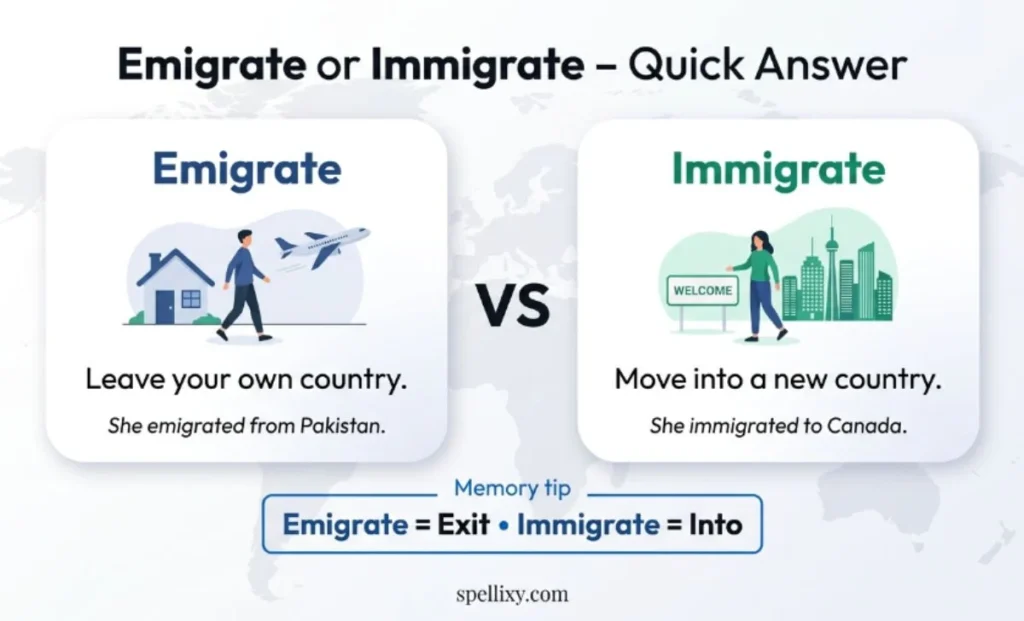
The simple rule is easy to remember:
- Emigrate means to leave your home country and settle in another country.
- Immigrate means to enter a new country to live there permanently or for a long period.
The same journey can be described using both words, depending on the viewpoint.
Example:
- Maria emigrated from Spain.
- Maria immigrated to Canada.
Both sentences describe the same move. The first focuses on the country she left, while the second focuses on the country she entered.
When comparing immigrate vs emigrate vs migrate, remember that migrate is the broadest term. It simply means moving from one place to another, whether between countries, regions, or even by animals during seasonal migration.
Correct Example
Ahmed emigrated from Pakistan in 2022.
Ahmed immigrated to Canada after receiving permanent residency.
Thousands of birds migrate every winter.
Skilled workers often immigrate after getting a work visa.
Many families emigrate to improve their quality of life.
Incorrect Example
Ahmed immigrated from Pakistan.
Ahmed emigrated from Pakistan.
Ahmed emigrated to Canada.
Ahmed immigrated to Canada.
Birds immigrate every winter.
Birds migrate every winter.
What Does Emigrate or Immigrate Mean?
Although these words are closely related, they are not interchangeable. Understanding their meanings will help you avoid one of the most common grammar mistakes in English writing.
Common Meanings
| Word | Meaning | Focus |
|---|---|---|
| Emigrate | Leave your country to live elsewhere | Leaving |
| Immigrate | Enter another country to live there | Arriving |
| Migrate | Move from one place to another | General movement |
Think of it this way:
- Emigrate = Exit
- Immigrate = Into
- Migrate = Move
This simple trick helps many learners remember the difference between immigrate and emigrate.
People often search for immigrate emigrate and migrate because these three verbs describe similar actions but have different meanings depending on context.
Simple Usage Examples
Below are practical examples showing when each word is correct.
Emigrate Examples
- My grandparents emigrated from Italy after World War II.
- She plans to emigrate from India next year.
- Thousands of families emigrate each year for better opportunities.
- Engineers often emigrate for international careers.
- Some professionals choose to emigrate after receiving job offers abroad.
These examples answer many searches for emigrate vs immigrate examples and emigrate or immigrate examples.
Immigrate Examples
- They immigrated to Australia with skilled worker visas.
- His family immigrated to the United States in 2018.
- Many students later immigrate after completing university.
- She hopes to immigrate to Canada through an express entry program.
- Doctors often immigrate where healthcare professionals are needed.
Migrate Examples
- Birds migrate south during winter.
- Some workers migrate between cities for seasonal jobs.
- Fish migrate to breeding areas every year.
- People sometimes migrate within their own country.
- Technology companies can migrate their data to cloud servers.
Notice that migrate is not limited to people. It can describe animals, populations, data, or businesses moving from one location to another.
Immigrate vs Emigrate vs Migrate
Many learners search for immigrate vs emigrate vs migrate because the three words seem almost identical. The easiest way to understand them is by looking at their perspective.
| Word | Meaning | Example |
|---|---|---|
| Emigrate | Leave a country | She emigrated from Pakistan. |
| Immigrate | Enter a country | She immigrated to Canada. |
| Migrate | Move from one place to another | Birds migrate every winter. |
Imagine a woman moving from India to Australia.
From India’s point of view:
She emigrated from India.
From Australia’s point of view:
She immigrated to Australia.
From a general point of view:
She migrated to Australia.
This comparison explains why immigrate vs migrate is another common search. While every immigrant migrates, not every migrant is an immigrant. Migration includes temporary movement, internal movement, and even animal migration.
Pronunciation Guide
Many users also search for emigrate pronunciation and immigrate vs emigrate pronunciation because the words look and sound similar.
Emigrate Pronunciation
Emigrate
- UK: EM-i-grayt
- US: EM-i-grayt
The stress falls on the first syllable.
Example:
“Thousands of people emigrate each year.”
Immigrate Pronunciation
Immigrate
- UK: IM-i-grayt
- US: IM-i-grayt
The pronunciation is almost identical except for the opening sound.
A useful memory trick is to say them together:
- Emigrate = leave from
- Immigrate = arrive in
Repeating both words aloud makes it much easier to remember which one fits your sentence.
Why Do People Confuse Emigrate and Immigrate?
The confusion happens because both words describe the same journey from different viewpoints. In everyday conversation, people often focus on the move itself instead of whether someone is leaving or arriving.
Other reasons include:
- Both words end with -migrate.
- They are used in discussions about visas, citizenship, immigration law, and international relocation.
- Many news articles shorten the explanation.
- English learners often translate directly from their first language.
- The related word migrate adds another layer of confusion.
For example:
- She emigrated from Germany.
- She immigrated to Canada.
Both statements are correct because they describe different parts of the same journey.
Understanding this distinction will improve your grammar, academic writing, business communication, and everyday English.
The Origin of Emigrate or Immigrate
Knowing where these words come from makes them much easier to remember. Their history explains why one means leaving a country while the other means entering one.
Both emigrate and immigrate share the Latin root migrare, which means “to move” or “to change one’s place.” Over time, English added different prefixes to show the direction of movement.
- E- / Ex- means out of.
- Im- / In- means into.
Because of these prefixes, the words have opposite perspectives even though they describe the same journey.
Word History
The verb migrate entered English first through Latin and French influences. As international travel, trade, and settlement became more common, English developed more specific words to describe movement between countries.
That is why we now have three related verbs:
| Word | Latin Prefix | Meaning |
|---|---|---|
| Migrate | — | Move from one place to another |
| Emigrate | E- (Out) | Leave a country |
| Immigrate | Im- (Into) | Enter another country |
Today these words appear in many fields, including:
- English grammar
- Immigration law
- Government policies
- News reporting
- Travel writing
- Academic research
- Population studies
- Human geography
- International relations
You will also see related nouns such as:
| Verb | Related Noun |
|---|---|
| Emigrate | Emigration |
| Immigrate | Immigration |
| Migrate | Migration |
Likewise, the people involved are called:
- Emigrant – a person leaving a country.
- Immigrant – a person entering a new country.
- Migrant – someone who moves from one place to another.
Understanding these word families improves both your vocabulary and your writing.
Why the Confusion Happens
Many people search for emigrate or immigrate because the words have similar spellings and nearly identical pronunciation.
Here are the main reasons people confuse them.
1. They Describe the Same Journey
Imagine a family moving from India to Australia.
From India’s viewpoint:
The family emigrated from India.
From Australia’s viewpoint:
The family immigrated to Australia.
Both sentences are correct.
2. The Prefixes Are Small
The only visible difference is the beginning of the word:
- Emigrate
- Immigrate
When reading quickly, many writers overlook the prefixes.
3. Both Are Used in Immigration Topics
Articles about visas, citizenship, permanent residency, border control, work permits, and relocation often use both words together.
Readers naturally assume they are interchangeable.
4. Migrate Adds Another Layer
Many learners also compare immigrate vs migrate because migrate is broader.
For example:
- Birds migrate.
- Fish migrate.
- Workers migrate.
- Data migrates to cloud servers.
Only people can immigrate or emigrate between countries.
5. Direct Translation
In many languages there is only one common verb for moving abroad.
When learners translate directly into English, they often choose the wrong word.
Memory Trick
A simple trick can help you remember forever.
| Word | Remember |
|---|---|
| Emigrate | Exit your country |
| Immigrate | Move Into another country |
| Migrate | Move anywhere |
Another easy phrase is:
Emigrate FROM a country.
Immigrate TO a country.
If you remember FROM and TO, you will rarely make a mistake.
British English vs American English
Unlike words such as colour/color or centre/center, there is no spelling difference between British English and American English.
Both varieties use:
- Emigrate
- Immigrate
- Migration
- Immigration
- Emigration
The meanings also remain exactly the same.
Whether you write for readers in the United States, United Kingdom, Canada, Australia, India, or another English-speaking country, the grammar rules do not change.
The only noticeable differences are sometimes found in pronunciation, vocabulary surrounding immigration systems, or legal terminology.
Comparison Table
| Feature | British English | American English |
|---|---|---|
| Emigrate | ✔ Correct | ✔ Correct |
| Immigrate | ✔ Correct | ✔ Correct |
| Migrate | ✔ Correct | ✔ Correct |
| Emigration | ✔ Correct | ✔ Correct |
| Immigration | ✔ Correct | ✔ Correct |
| Meaning | Same | Same |
| Grammar | Same | Same |
| Usage | Same | Same |
For international writing, you can confidently use the same spellings in every region.
Emigrate or Immigrate vs Other Variations
Many users search for similar words because they are unsure which one is correct.
The table below compares the most common variations.
Spelling Comparison Table
| Word | Correct Spelling | Usage | Region |
|---|---|---|---|
| Emigrate | ✔ Yes | Leave a country | Worldwide |
| Immigrate | ✔ Yes | Enter a country | Worldwide |
| Migrate | ✔ Yes | General movement | Worldwide |
| Emigration | ✔ Yes | Act of leaving | Worldwide |
| Immigration | ✔ Yes | Act of entering | Worldwide |
| Emigrant | ✔ Yes | Person leaving | Worldwide |
| Immigrant | ✔ Yes | Person entering | Worldwide |
| Migrant | ✔ Yes | Person or thing moving | Worldwide |
Emigrate vs Immigrate Examples
These examples show how the same event can be described from different perspectives.
| Situation | Correct Sentence |
|---|---|
| Leaving Mexico | She emigrated from Mexico. |
| Entering Canada | She immigrated to Canada. |
| General movement | She migrated to Canada. |
| Leaving Japan | They emigrated from Japan. |
| Entering New Zealand | They immigrated to New Zealand. |
Notice that migrate is correct, but it is less specific than emigrate or immigrate.
Common Contexts Where These Words Appear
Understanding real-life contexts makes choosing the correct word much easier.
Immigration
You are likely to see immigrate in topics such as:
- Permanent residency
- Green Card applications
- Work visas
- Student visas
- Citizenship
- Naturalization
- Immigration policy
- Immigration law
- Immigration interviews
- Border control
Example:
Skilled professionals often immigrate to Canada through economic immigration programs.
Emigration
The word emigrate commonly appears when discussing:
- Leaving a home country
- International relocation
- Economic migration
- Better job opportunities
- Family reunification
- Education abroad
- Political migration
Example:
Thousands of graduates emigrate from developing countries each year.
Migration
The broader word migrate appears in many different fields.
Examples include:
- Human migration
- Animal migration
- Seasonal migration
- Internal migration
- Population movement
- Digital migration
- Cloud migration
- Database migration
Because migrate has such a broad meaning, it is not always the best choice when discussing immigration between countries.
Quick Recap
Remember these three simple rules:
- Emigrate = Leave a country.
- Immigrate = Enter a country.
- Migrate = Move from one place to another.
If someone leaves Pakistan for Canada, you can correctly say:
- They emigrated from Pakistan.
- They immigrated to Canada.
- They migrated to Canada.
All three are grammatically correct, but each highlights a different perspective.
Which Spelling Should You Use?
The answer depends on what you want to describe, not where you live. Unlike many English words, emigrate and immigrate do not have different spellings in British English and American English. The correct choice depends on whether you are talking about leaving a country or entering one.
If the sentence focuses on someone leaving their home country, use emigrate. If it focuses on someone arriving in a new country to live, use immigrate. If you simply want to describe movement without focusing on departure or arrival, use migrate.
Choosing the correct word improves grammar, makes your writing more accurate, and prevents one of the most common vocabulary mistakes in English.
US Audience
American English uses emigrate and immigrate exactly the same way as other English varieties.
Examples:
- My grandparents emigrated from Italy before moving to the United States.
- She hopes to immigrate to the United States after receiving a work visa.
- Thousands of professionals immigrate every year through employment-based immigration programs.
Because immigration is a common topic in the United States, these words frequently appear in government documents, legal writing, newspapers, and academic articles.
UK Audience
British English follows the same grammar rules.
Examples:
- They emigrated from South Africa.
- They later immigrated to the United Kingdom.
- Skilled workers may immigrate through approved visa routes.
There is no spelling change between British and American English.
International Writing
If your audience includes readers from different countries, always use the standard meanings.
Use:
- Emigrate from a country.
- Immigrate to a country.
- Migrate when discussing general movement.
This works well in travel blogs, educational websites, international news, and immigration guides.
Academic Writing
Universities and research papers expect precise vocabulary.
Correct examples:
- The study examined international migration patterns.
- Many graduates emigrate from developing countries.
- Skilled workers often immigrate to high-income economies.
- Population migration influences economic growth.
Academic writing often uses related terms such as:
- migration
- immigration
- emigration
- migrant
- immigrant
- emigrant
- population movement
- international mobility
Social Media Usage
Social media users often confuse these words because posts are short.
Incorrect:
I immigrated from Pakistan.
Correct:
I emigrated from Pakistan.
Correct:
I immigrated to Canada.
If space is limited, some writers simply use moved abroad because it avoids confusion while remaining easy to understand.
Common Mistakes with Emigrate or Immigrate
Many grammar mistakes happen because writers forget which country the sentence is focusing on.
Frequent Errors
Here are the mistakes seen most often.
| Incorrect | Correct |
|---|---|
| Immigrated from India | Emigrated from India |
| Emigrated to Canada | Immigrated to Canada |
| Birds immigrate every winter | Birds migrate every winter |
| Fish emigrate south | Fish migrate south |
| We immigrated out of Pakistan | We emigrated from Pakistan |
Another common mistake is using migrate when discussing permanent immigration.
Example:
Less specific:
My family migrated to Australia.
More specific:
My family immigrated to Australia.
Both are grammatically correct, but the second sentence clearly explains that the family settled there.
Corrected Examples
Incorrect:
She immigrated from Germany.
Correct:
She emigrated from Germany.
Incorrect:
They emigrated to Canada.
Correct:
They immigrated to Canada.
Incorrect:
Whales immigrate every year.
Correct:
Whales migrate every year.
Incorrect:
We immigrated out of England.
Correct:
We emigrated from England.
Incorrect:
He emigrated into Australia.
Correct:
He immigrated to Australia.
Emigrate or Immigrate in Everyday Examples
Understanding grammar becomes easier when you see real-life examples.
Emails
Professional Email
I recently immigrated to Canada and would like to update my employment records.
Personal Email
Our family emigrated from Pakistan last year, and we are enjoying life in Australia.
University Email
I plan to immigrate after completing my master’s degree.
Social Media
Examples:
- We finally immigrated to New Zealand.
- My grandparents emigrated from Ireland many years ago.
- Moving abroad has been an exciting journey.
- Our immigration process is finally complete.
News Writing
Journalists usually choose the most precise word.
Examples:
- Thousands of workers emigrated from the region during the economic crisis.
- Many families immigrated to Canada through skilled worker programs.
- Governments continue to review immigration policies.
- Migration levels increased compared with previous years.
School Writing
Students often write about history or geography.
Examples:
- Millions of Europeans emigrated during the nineteenth century.
- Many families immigrated to North America for better opportunities.
- Seasonal migration helps many animals survive changing weather.
Business Writing
Companies also use these words.
Examples:
- The company hired professionals who recently immigrated to Australia.
- International recruitment supports skilled immigration.
- Employee relocation often involves immigration documents and work permits.
- Businesses may migrate their databases to cloud platforms, but employees immigrate to another country.
Google Trends & Usage Data
Search interest in emigrate or immigrate remains strong because learners, students, and professionals regularly confuse these words.
People also compare:
- immigrate vs emigrate vs migrate
- immigrate vs migrate
- immigrate emigrate and migrate
- emigrate vs immigrate examples
- emigrate or immigrate examples
- emigrate pronunciation
- immigrate vs emigrate pronunciation
These searches show that users want practical explanations rather than dictionary definitions.
Popular Countries
The keyword is searched frequently in countries where English education, international migration, or immigration programs are common.
| Country | Common Search Intent |
|---|---|
| United States | Immigration grammar and legal writing |
| United Kingdom | English learning and vocabulary |
| Canada | Immigration terminology |
| Australia | Visa and migration programs |
| India | English grammar and overseas education |
Other countries with strong interest include:
- Pakistan
- New Zealand
- Ireland
- Germany
- South Africa
- Philippines
- Nigeria
- Singapore
Why People Search This Keyword
People usually search emigrate or immigrate because they want to:
- understand the grammar difference
- improve English vocabulary
- write correctly in essays
- prepare for English exams
- avoid mistakes in immigration documents
- improve academic writing
- understand immigration news
- learn the correct pronunciation
- compare immigrate vs migrate
- compare immigrate vs emigrate vs migrate
- find simple examples
- understand the meaning quickly
Related Grammar Rules
Learning emigrate and immigrate becomes easier when you understand similar grammar patterns.
Similar Spelling Mistakes
These word pairs also confuse English learners.
| Word Pair | Difference |
|---|---|
| Affect vs Effect | Action vs Result |
| Accept vs Except | Receive vs Exclude |
| Principal vs Principle | Person vs Rule |
| Complement vs Compliment | Complete vs Praise |
| Stationary vs Stationery | Not moving vs Writing materials |
| Farther vs Further | Physical distance vs Additional |
| Then vs Than | Time vs Comparison |
| Who’s vs Whose | Contraction vs Possession |
| Lose vs Loose | Misplace vs Not tight |
| Advice vs Advise | Noun vs Verb |
Like emigrate and immigrate, these pairs require understanding the meaning instead of relying only on spelling.
Helpful Grammar Tips
Use these simple rules whenever you write.
- Emigrate always matches from.
- She emigrated from India.
- They emigrated from Brazil.
- Immigrate usually matches to.
- She immigrated to Canada.
- They immigrated to Australia.
- Migrate is the broader word.
- Birds migrate south.
- Workers migrate between cities.
- Data migrates to cloud storage.
- Remember the prefixes.
- E = Exit
- Im = Into
- Ask yourself one question before writing:
Am I talking about leaving a country or entering one?
If the answer is leaving, use emigrate.
If the answer is entering, use immigrate.
If the direction is not important, use migrate.
FAQs
1. Is it emigrate or immigrate?
Both words are correct, but they describe different directions of the same journey. Emigrate means leaving your home country, while immigrate means entering another country to live there.
2. What is the difference between emigrate and immigrate?
The main difference is perspective. You emigrate from your country of origin and immigrate to your destination country.
Example:
- She emigrated from Pakistan.
- She immigrated to Canada.
3. What is the difference between immigrate vs emigrate vs migrate?
These three verbs are closely related but have different meanings.
- Emigrate means leaving a country.
- Immigrate means entering another country.
- Migrate means moving from one place to another, whether permanently or temporarily.
4. Do you emigrate from or immigrate to?
You always emigrate from one country and immigrate to another.
Correct examples:
- They emigrated from India.
- They immigrated to Australia.
5. What does emigrate mean?
Emigrate means leaving your home country to live in another country permanently or for a long period.
6. What does immigrate mean?
Immigrate means entering a foreign country with the intention of living there permanently or for an extended time.
7. What does migrate mean?
Migrate refers to moving from one place to another. It can describe people, animals, birds, fish, workers, populations, or even digital systems.
8. Can I use migrate instead of immigrate?
Sometimes, but not always. Migrate is a general word, while immigrate specifically refers to entering another country to live there.
9. What is an emigrant?
An emigrant is someone who leaves their home country to settle in another country.
10. What is an immigrant?
An immigrant is someone who enters another country to live there permanently or long-term.
11. What is migration?
Migration is the movement of people, animals, or objects from one place to another. It includes international migration, internal migration, seasonal migration, and digital migration.
12. Is emigrate the opposite of immigrate?
Yes. These words describe the same journey from opposite viewpoints.
- Emigrate = Leave a country.
- Immigrate = Enter a country.
13. Why do people emigrate?
People emigrate for better career opportunities, education, family reunification, business growth, healthcare, safety, or a better quality of life.
14. Why do people immigrate?
People immigrate to begin a new life, accept a job, continue their education, reunite with family, or obtain permanent residency and citizenship.
15. Which is correct: emigrated to Canada or immigrated to Canada?
The correct phrase is immigrated to Canada because the sentence focuses on entering Canada.
If the sentence focuses on leaving another country, use emigrated from.
16. Which is correct: immigrated from India or emigrated from India?
The correct phrase is emigrated from India because the person is leaving India.
17. Is there a spelling difference between British English and American English?
No. Both British English and American English use emigrate, immigrate, migration, emigration, and immigration with the same spelling and meaning.
18. How can I remember the difference?
Use this simple memory trick:
- Emigrate = Exit
- Immigrate = Into
Another easy rule is:
- Emigrate from
- Immigrate to
19. Are emigrant and immigrant different?
Yes.
An emigrant leaves a country, while an immigrant enters a new country. They can describe the same person depending on the point of view.
20. Is migration only about people?
No. Migration also refers to the movement of birds, fish, insects, wildlife, workers, populations, computer systems, websites, databases, and cloud services.
21. Which word is commonly used in immigration law?
Legal documents often use both immigration and emigration because they describe entering and leaving countries under immigration rules, visa requirements, and citizenship laws.
22. What is the correct emigrate pronunciation?
Emigrate is pronounced EM-i-grayt. The stress falls on the first syllable.
23. What is the correct immigrate pronunciation?
Immigrate is pronounced IM-i-grayt. The ending sounds almost the same as emigrate, but the first syllable is different.
24. Why do people search “emigrate or immigrate reddit”?
Many users search emigrate or immigrate reddit to read real experiences, grammar discussions, memory tips, and practical examples shared by other English learners. While these discussions can be helpful, trusted dictionaries and grammar guides are better sources for accurate usage.
25. Which word should I use in formal writing?
Use emigrate when writing about leaving a country, immigrate when writing about entering another country, and migrate when discussing movement in general. Choosing the correct word improves essays, business documents, legal writing, research papers, and professional communication.
Conclusion
Choosing between emigrate or immigrate is easy once you understand the direction of movement.
Use emigrate when someone leaves their home country and immigrate when they enter a new country to live there.
If you are talking about movement in a broader sense, migrate is the correct choice. Remember the simple rule: emigrate from, immigrate to, and migrate between places.
Applying these grammar rules will make your writing more accurate, whether you are creating academic papers, business documents, immigration forms, emails, or everyday messages.
By using the correct word in the right context, you communicate more clearly, avoid common grammar mistakes, and write with greater confidence.