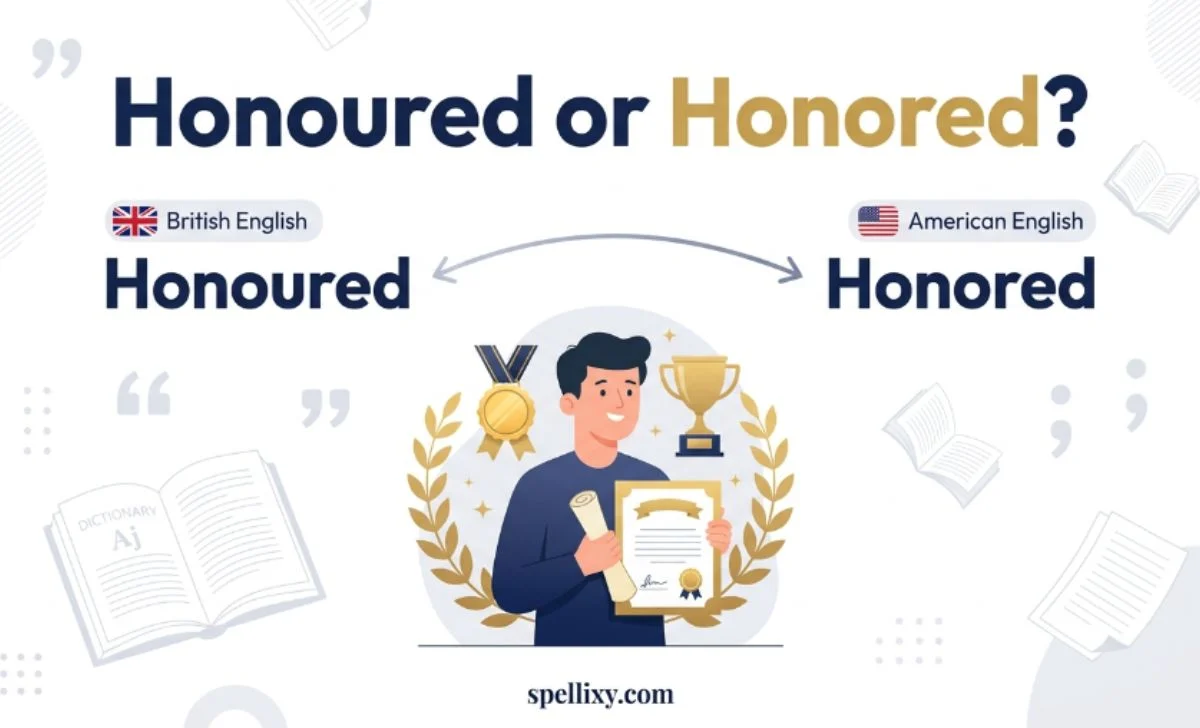
Have you ever wondered whether honoured or honored is the correct spelling? Many writers, students, and English learners ask this question because both versions appear in books, websites, and everyday writing.
The good news is that both spellings are correct, but they belong to different forms of English. Honoured is the preferred spelling in British English, while honored is used in American English.
Knowing which version to choose helps you write more clearly and professionally. In this guide, you’ll learn the meaning, pronunciation, synonyms, grammar rules, sentence examples, and the difference between these spellings.
You’ll also discover when to use each one in academic writing, business communication, emails, and social media with complete confidence.
Honoured or Honored – Quick Answer
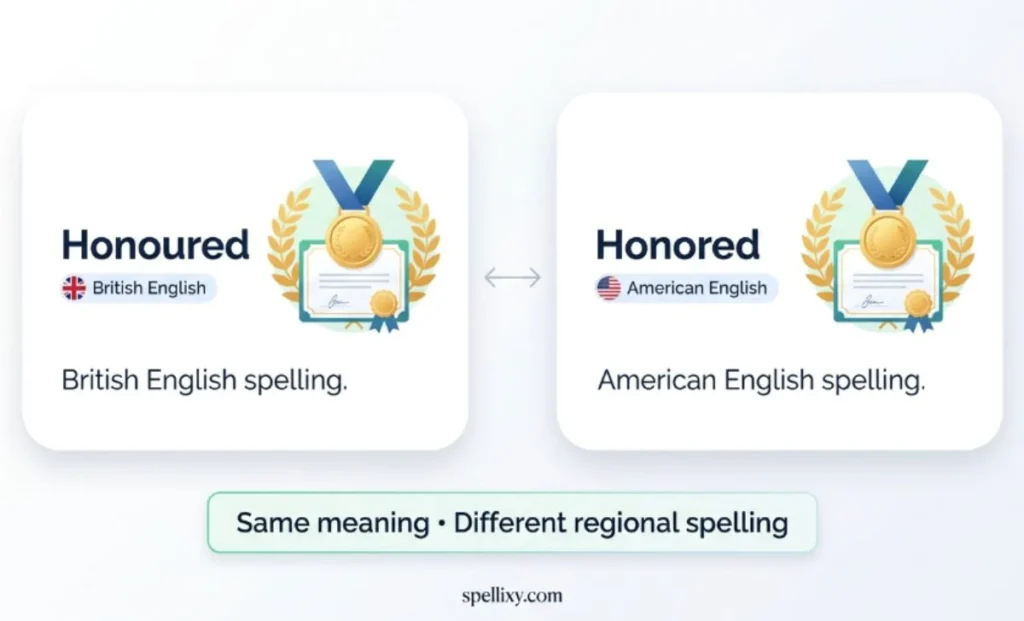
The quick answer is simple. Honoured and honored have exactly the same meaning. The only difference is the spelling.
- Honoured is the standard spelling in British English, Australian English, New Zealand English, and many other countries that follow British spelling conventions.
- Honored is the standard spelling in American English.
Both words mean feeling respected, recognized, privileged, or proud because someone has shown appreciation or given you a special distinction.
For example:
- I am honoured to receive this award. ✅ (British English)
- I am honored to receive this award. ✅ (American English)
Both sentences are grammatically correct. The best choice depends on the audience you are writing for.
If you are asking “honoured or honored meaning,” the answer is simple: both spellings describe the same feeling of respect, appreciation, gratitude, or privilege.
Similarly, people often search “i feel honoured or honored.” Again, both are correct. Choose the spelling that matches your English style.
Correct Example
These examples show the correct use of both spellings.
British English
- We are honoured to welcome our special guest.
- I am honoured to accept this award.
- She felt honoured to represent her country.
- It was an honour to meet the author.
- The school was honoured for its excellent results.
American English
- We are honored to welcome our special guest.
- I am honored to accept this award.
- She felt honored to represent her country.
- It was an honor to meet the author.
- The organization was honored for its community service.
Incorrect Example
The most common mistake is mixing British and American spellings in the same document.
Incorrect:
- I am honoured to receive this honor.
Correct British English:
- I am honoured to receive this honour.
Correct American English:
- I am honored to receive this honor.
Another mistake is changing spellings halfway through an article.
Incorrect:
- The guest was honoured during the ceremony, and later everyone said they were honored to attend.
Choose one spelling style and use it consistently throughout your writing.
What Does Honoured or Honored Mean?
Whether you write honoured or honored, the meaning remains exactly the same. The word expresses feelings of respect, appreciation, gratitude, pride, or privilege after receiving recognition or being given a special opportunity.
People often use this word when they receive an award, an invitation, public recognition, or an important responsibility.
For example:
- I am honoured to speak at today’s graduation ceremony.
- We are honored to work with such talented people.
- She felt honoured when her research received international recognition.
- He was honored for his years of public service.
These examples answer one of the most searched questions: “honoured or honored meaning.”
The word can describe both personal feelings and official recognition.
Examples include:
- Feeling honoured by a compliment.
- Being honored with a medal.
- Feeling honoured to help others.
- Being honored during an award ceremony.
- Feeling honoured to represent your company.
Common Meanings
Although the spelling changes between British and American English, the meanings stay the same.
| Expression | Meaning |
|---|---|
| Honoured | Feeling respected or privileged (British English) |
| Honored | Feeling respected or privileged (American English) |
| Honour | Respect or high regard (British English) |
| Honor | Respect or high regard (American English) |
| Honourable | Deserving respect (British English) |
| Honorable | Deserving respect (American English) |
People also search for “honoured or honored synonym.” Depending on the context, common synonyms include:
- respected
- appreciated
- privileged
- recognized
- valued
- admired
- celebrated
- praised
- distinguished
- esteemed
Each synonym has a slightly different meaning, but all express respect or recognition.
For example:
Instead of saying,
I am honoured to be here.
You could also say,
- I feel privileged to be here.
- I am grateful to be here.
- I feel deeply respected.
- I appreciate this opportunity.
- I am thankful for this recognition.
The exact synonym depends on the tone and context of your sentence.
Simple Usage Examples
Understanding real-life examples makes the difference much easier.
Example 1
I am honoured meaning
The phrase “I am honoured” means:
I feel respected, grateful, and privileged because someone has recognized me or given me a special opportunity.
Example:
I am honoured to receive this lifetime achievement award.
Example 2
We are honoured meaning
The phrase “We are honoured” means:
Our group feels proud and grateful because we have received recognition or an important opportunity.
Example:
We are honoured to welcome all our guests to today’s event.
Example 3
I feel honoured or honored
Both spellings are correct.
British English:
I feel honoured to be part of this project.
American English:
I feel honored to be part of this project.
The meaning is exactly the same.
Example 4
Honoured or honored in a sentence
British English:
- She was honoured for her bravery.
- The students were honoured during the graduation ceremony.
- He felt honoured to meet the Prime Minister.
- Our family was honoured by the invitation.
American English:
- She was honored for her bravery.
- The students were honored during graduation.
- He felt honored to meet the president.
- Our team was honored with a community award.
These examples demonstrate that the only difference is spelling, not meaning or grammar.
The Origin of Honoured or Honored
Understanding the history of honoured and honored makes the spelling difference much easier to remember. Although the words look different, they come from the same origin and carry exactly the same meaning. The only real distinction is the spelling convention followed in different parts of the world.
The word honour entered English through Old French honor and ultimately comes from the Latin word honor (or honos), meaning respect, dignity, esteem, reputation, or recognition. Over time, British English adopted the spelling honour, while American English simplified it to honor by removing the silent u.
Today, both spellings are accepted worldwide, provided you remain consistent throughout your writing.
Word History
The history of honoured reflects the development of the English language over hundreds of years.
In Middle English, many words entered the language from Old French, which had already borrowed them from Latin. During this period, spellings were not standardized, so writers often used different versions of the same word.
As dictionaries and grammar guides became more influential, spelling conventions developed.
- British English preserved the traditional spelling honour, honoured, and honourable.
- American English adopted the simplified spellings honor, honored, and honorable, following spelling reforms that favored shorter forms.
This pattern is also seen in many other words.
| British English | American English |
|---|---|
| Honour | Honor |
| Honoured | Honored |
| Honourable | Honorable |
| Honouring | Honoring |
| Colour | Color |
| Favourite | Favorite |
| Neighbour | Neighbor |
These differences affect spelling only. The pronunciation, grammar, and meaning remain almost identical.
Why the Confusion Happens
Many people search for honoured or honored because both spellings appear in books, newspapers, websites, certificates, and social media.
Here are the main reasons for the confusion.
1. Both Spellings Are Correct
Unlike genuine spelling mistakes, honoured and honored are both correct.
The only difference is regional usage.
- British English → Honoured
- American English → Honored
Because both forms are widely used online, readers often think one must be incorrect.
2. The Silent Letter “U”
The extra u in honour does not change pronunciation.
This leads many learners to wonder whether the letter is necessary.
The answer depends on the spelling style you follow.
3. The Internet Uses Both Versions
International websites often receive visitors from many countries.
As a result, one article may use British spelling while another uses American spelling, making both versions appear equally common.
4. Similar Words Follow the Same Pattern
People who search honour spelling UK usually discover that many British spellings include an extra u.
Examples include:
- Colour → Color
- Favourite → Favorite
- Labour → Labor
- Neighbour → Neighbor
- Behaviour → Behavior
Because of this pattern, writers often wonder whether honoured follows the same rule. It does.
5. Mixed Writing Styles
Another common mistake is mixing British and American spellings within the same document.
Incorrect:
I am honoured to receive this honor.
Correct British English:
I am honoured to receive this honour.
Correct American English:
I am honored to receive this honor.
Choosing one spelling style and using it consistently creates a more professional piece of writing.
British English vs American English
The difference between honoured and honored is one of the best-known spelling differences between British English and American English.
Both spellings have the same pronunciation, meaning, and grammar. The choice depends entirely on your audience.
If you write for readers in the United Kingdom, Australia, New Zealand, or countries that follow British spelling, use honoured.
If your audience is in the United States, use honored.
Many international organizations also choose one style and apply it consistently across all documents.
Comparison Table
| Feature | British English | American English |
|---|---|---|
| Main spelling | Honoured | Honored |
| Base word | Honour | Honor |
| Adjective | Honourable | Honorable |
| Present participle | Honouring | Honoring |
| Pronunciation | Same | Same |
| Meaning | Same | Same |
| Grammar | Same | Same |
| Formal writing | ✔ Yes | ✔ Yes |
| Academic writing | ✔ Yes | ✔ Yes |
Honour Spelling UK
One of the most common searches is “honour spelling UK.”
In the United Kingdom, the correct spellings are:
- Honour
- Honoured
- Honourable
- Honouring
- Guest of honour
- Honour roll (when following British style)
These spellings are standard in British schools, universities, newspapers, government publications, and business writing.
Honour or Honor Pronunciation
Many English learners also search for “honour or honor pronunciation.”
The good news is that both words are pronounced almost exactly the same.
British English:
- Honour → ON-er
- Honoured → ON-erd
American English:
- Honor → AHN-er
- Honored → AHN-erd
The spelling changes, but the pronunciation changes very little. The biggest difference comes from the natural accent rather than the letters themselves.
A simple way to remember this is that the “u” is written but not pronounced in British English. This is why many learners are surprised when they first compare the two spellings.
Honoured or Honored vs Other Variations
Many learners think honoured and honored are the only spellings to remember. In reality, they belong to a larger family of words that also follow British and American spelling conventions. Learning these related forms will help you write more naturally and avoid mixing spelling styles.
Spelling Comparison Table
| Word | Correct Spelling | Usage | Region |
|---|---|---|---|
| Honoured | ✔ Yes | Past tense/Past participle | British English |
| Honored | ✔ Yes | Past tense/Past participle | American English |
| Honour | ✔ Yes | Noun/Verb | British English |
| Honor | ✔ Yes | Noun/Verb | American English |
| Honourable | ✔ Yes | Adjective | British English |
| Honorable | ✔ Yes | Adjective | American English |
| Honouring | ✔ Yes | Present Participle | British English |
| Honoring | ✔ Yes | Present Participle | American English |
| Guest of honour | ✔ Yes | Fixed expression | British English |
| Guest of honor | ✔ Yes | Fixed expression | American English |
| Honour society | ✔ Yes | Less common | British English |
| Honor society | ✔ Yes | Standard expression | American English |
| Honour roll | ✔ Yes | British style | British English |
| Honor roll | ✔ Yes | Common school term | American English |
Although the spelling changes, the meaning never changes. The key is to remain consistent throughout your writing.
Which Spelling Should You Use?
The correct spelling depends on your audience rather than the meaning. Whether you write honoured or honored, readers will understand the same message. However, using the preferred spelling for your audience makes your writing look more polished and professional.
US Audience
If your readers are in the United States, always choose the American spellings.
Use:
- Honored
- Honor
- Honorable
- Honoring
Examples:
- I am honored to receive this award.
- She was honored for her leadership.
- It is an honor to be here.
- The charity honored its volunteers.
These spellings are standard in American schools, universities, newspapers, business communication, and government publications.
UK Audience
For readers in the United Kingdom, use the traditional British spellings.
Use:
- Honoured
- Honour
- Honourable
- Honouring
Examples:
- I am honoured to receive this award.
- She was honoured for her service.
- It is an honour to meet you.
- The organisation honoured local volunteers.
This style is also preferred in Australia, New Zealand, and many Commonwealth countries.
International Writing
If your audience includes readers from different countries, choose one spelling style and use it consistently.
For example, if you begin with:
I am honoured to be invited.
Continue using:
- honour
- honourable
- honouring
Do not switch later to:
- honor
- honorable
- honoring
Consistency is more important than choosing one spelling over the other.
Academic Writing
Universities usually expect writers to follow one style guide.
If your institution follows British English, use:
- honour
- honoured
- honourable
If it follows American English, use:
- honor
- honored
- honorable
Consistency is especially important in:
- Research papers
- Essays
- Thesis writing
- Dissertations
- Journal articles
- University assignments
Changing spelling styles within the same document can reduce the professionalism of your work.
Social Media Usage
Social media is more flexible, but consistency still matters.
Examples using British English:
- I feel honoured to be part of this amazing event.
- Truly honoured to receive this recognition.
- It was an honour to speak today.
Examples using American English:
- I feel honored to be part of this amazing event.
- Truly honored to receive this recognition.
- It was an honor to speak today.
Both styles are widely accepted because social media has a global audience.
Common Mistakes with Honoured or Honored
Most mistakes happen because writers mix British and American spellings without realizing it.
Frequent Errors
Here are some of the most common mistakes.
| Incorrect | Correct |
|---|---|
| Honoured and honor in one sentence | Use honoured with honour |
| Honored and honour together | Use honored with honor |
| Honourable and honored mixed | Keep one spelling style |
| Honouring with honor | Use honouring with honour |
| Honoring with honour | Use honoring with honor |
Another common mistake is assuming one spelling is wrong.
Remember:
- Honoured is correct.
- Honored is also correct.
The difference is regional spelling, not grammar.
Corrected Examples
Incorrect:
I am honoured to receive this honor.
Correct British English:
I am honoured to receive this honour.
Correct American English:
I am honored to receive this honor.
Incorrect:
She was honoured by the organization for her honor.
Correct British English:
She was honoured by the organisation for her honourable service.
Correct American English:
She was honored by the organization for her honorable service.
Incorrect:
We are honored to welcome the guest of honour.
Correct British English:
We are honoured to welcome the guest of honour.
Correct American English:
We are honored to welcome the guest of honor.
Honoured or Honored in Everyday Examples
Seeing these words in everyday situations makes the difference easier to understand.
Emails
Professional Email (British English)
I am honoured to accept your invitation and look forward to attending the conference.
Professional Email (American English)
I am honored to accept your invitation and look forward to attending the conference.
Social Media
British English
- Feeling honoured to receive this award today.
- We are honoured to welcome everyone.
- It is an honour to support this cause.
American English
- Feeling honored to receive this award today.
- We are honored to welcome everyone.
- It is an honor to support this cause.
News Writing
Examples:
- The scientist was honoured for outstanding research.
- The athlete was honored during the national ceremony.
- Community leaders were recognized and honored for public service.
- The university honoured distinguished graduates.
School Writing
Students often use these expressions in essays and speeches.
Examples:
- Our school was honoured to host the competition.
- The principal honored the top-performing students.
- The class felt honoured to meet the author.
- She was honored with the highest academic award.
Business Writing
Examples:
- We are honoured to partner with your organisation.
- Our company is honored to serve customers worldwide.
- It is an honour to receive your trust.
- We feel honored to announce our new partnership.
These expressions are common in business letters, award ceremonies, company announcements, press releases, and professional communication.
Google Trends & Usage Data
Interest in honoured or honored remains steady because writers often need to know which spelling matches their audience. Students, professionals, bloggers, editors, and English learners frequently compare these spellings before publishing content.
The most common searches include:
- honoured or honored meaning
- honoured or honored synonym
- honoured or honored in a sentence
- i am honoured meaning
- i feel honoured or honored
- honour spelling UK
- honour or honor pronunciation
- we are honoured meaning
- honoured vs honored
- honour or honor
These searches show that users are looking for practical guidance, examples, and grammar explanations rather than simple dictionary definitions.
Popular Countries
Search interest is highest in countries where English is widely spoken or studied.
| Country | Common Search Intent |
|---|---|
| United States | American spelling and writing style |
| United Kingdom | British spelling and grammar |
| Canada | Choosing between UK and US spelling |
| Australia | British spelling conventions |
| India | English grammar and academic writing |
Other countries with strong search interest include Pakistan, New Zealand, Ireland, South Africa, Singapore, and the Philippines.
Why People Search This Keyword
Most users search honoured or honored because they want to:
- know which spelling is correct
- understand the meaning
- improve grammar
- write professional emails
- complete academic assignments
- prepare speeches
- write award acceptance messages
- understand British and American spelling differences
- learn the correct pronunciation
- avoid spelling mistakes in formal writing
- use the right wording on certificates and invitations
Related Grammar Rules
Understanding honoured and honored becomes much easier when you learn the spelling patterns used in British and American English. These patterns appear in many everyday words, not just this one.
Once you understand the rule, you can apply it to dozens of similar spellings.
Similar Spelling Mistakes
The following words follow the same British and American English pattern.
| British English | American English |
|---|---|
| Honour | Honor |
| Honoured | Honored |
| Honourable | Honorable |
| Honouring | Honoring |
| Colour | Color |
| Favourite | Favorite |
| Neighbour | Neighbor |
| Behaviour | Behavior |
| Labour | Labor |
| Jewellery | Jewelry |
| Centre | Center |
| Theatre | Theater |
| Defence | Defense |
| Licence (noun) | License |
| Travelling | Traveling |
| Cancelled | Canceled |
These spelling differences are standard. Neither version is wrong. Simply use the style that matches your audience.
Helpful Grammar Tips
Keep these simple rules in mind whenever you write.
- Use honoured with honour, honourable, and honouring in British English.
- Use honored with honor, honorable, and honoring in American English.
- Never mix British and American spellings in the same document.
- Follow your school, university, company, or publisher’s preferred style guide.
- Keep your spelling consistent from beginning to end.
A simple memory trick is:
- British English = U
- American English = No U
For example:
- Honour → Honor
- Honoured → Honored
- Honourable → Honorable
This rule also works for many other British and American spelling differences.
FAQs
1. Is honoured or honored correct?
Both spellings are correct. Honoured is used in British English, while honored is the preferred spelling in American English. The meaning and pronunciation are the same.
2. What is the difference between honoured and honored?
There is no difference in meaning. The only difference is regional spelling. Choose honoured for British English and honored for American English.
3. What does honoured or honored mean?
Both words mean feeling respected, appreciated, recognized, or privileged because someone has shown admiration or given you a special honor.
4. What is the honoured or honored synonym?
Common synonyms include respected, recognized, privileged, appreciated, esteemed, valued, admired, and praised. The best synonym depends on the context.
5. How do you use honoured or honored in a sentence?
Example in British English: She was honoured for her outstanding service.
Example in American English: She was honored for her outstanding service.
6. What does “I am honoured” mean?
I am honoured means you feel proud, grateful, and respected because someone has recognized your achievements or invited you to an important event.
7. What does “We are honoured” mean?
We are honoured means a group feels grateful and privileged to receive recognition, appreciation, or an important opportunity.
8. Should I write “I feel honoured” or “I feel honored”?
Both are correct. Use I feel honoured in British English and I feel honored in American English.
9. What is the correct honour spelling UK?
In the United Kingdom, the correct spellings are honour, honoured, honourable, and honouring.
10. What is the difference between honour and honor?
There is no difference in meaning. Honour is British English, while honor is American English.
11. What is the correct honour or honor pronunciation?
Both words are pronounced almost the same. The extra u in honour is silent and does not change the pronunciation.
12. Is honoured a real word?
Yes. Honoured is the standard British English spelling and is widely used in the UK, Australia, and other Commonwealth countries.
13. Is honored a real word?
Yes. Honored is the standard American English spelling and is used throughout the United States.
14. Is honoured more formal than honored?
No. Both spellings are equally formal. The only difference is the regional spelling style.
15. Which spelling should I use in academic writing?
Use the spelling required by your institution or style guide. British universities usually prefer honoured, while American universities use honored.
16. Can I mix honoured and honored in the same article?
No. Choose one spelling style and use it consistently throughout your document.
17. What is the difference between honourable and honorable?
Like honoured and honored, these words have the same meaning. Honourable is British English, and honorable is American English.
18. What is the difference between honouring and honoring?
Both forms are correct. Honouring is British English, while honoring is American English.
19. Is guest of honour or guest of honor correct?
Both are correct. Use guest of honour in British English and guest of honor in American English.
20. Why do British English words use the letter “u”?
Many British spellings kept the traditional u from historical spelling, while American English simplified words by removing it.
21. Why do people search “honoured or honored reddit”?
Many people visit Reddit to read personal opinions and writing advice. However, dictionaries and grammar guides remain the most reliable sources for correct spelling.
22. Which spelling is better for professional writing?
Neither is better. Choose the spelling that matches your audience and keep it consistent throughout your writing.
23. Can I use honoured in the United States?
American readers will understand honoured, but honored is the standard spelling used in the United States.
24. Can I use honored in the United Kingdom?
People in the UK will understand honored, but honoured is the preferred British spelling.
25. How can I remember the difference?
Remember this simple rule: British English keeps the letter “u,” while American English removes it. If your audience is British, write honoured. If your audience is American, write honored.
Conclusion
Choosing between honoured or honored is simple once you know your audience. Both spellings have the same meaning, pronunciation, and grammar.
The only difference is regional usage. Honoured belongs to British English, while honored is the preferred American English spelling.
The same pattern also applies to related words such as honour, honourable, and honouring. Whether you are writing an academic paper, business email, social media post, speech, or formal document, always use one spelling style consistently.
Doing so makes your writing look professional and polished. By remembering this simple rule, you can avoid common spelling mistakes and write confidently in both British and American English.
Discover More Blog :
- Presenter or Presentor: The Complete Grammar Guide
- Holiday or Holliday: Full Guide to Meaning, Usage, and Common Mistakes

Hi, I’m Michael McCarthy from Spellixy.com.
I help you learn English grammar, improve writing, and understand language in a simple and easy way.